
Commercial fishing vessels, offshore workboats, and marine navigation bridges present harsh operating conditions for electronic display systems. Bridge workstations integrate real-time inputs from CHIRP sonars, radar sweeps, engine telemetry, and electronic charting systems (ECDIS). Displays installed on open flying bridges or unshielded helms face continuous exposure to dense salt fog, green water spray, and intense solar reflection.
Deploying consumer or commercial-grade monitors in these marine positions results in rapid failure: optical washout in sunlight, night-vision blindness from poor dimming, and salt crystallization shorting internal drive boards. Understanding marine display standards under IEC 60945 is essential to long-term offshore reliability.
1. Optical Physics: Eliminating Air Gaps & Refractive Index Reflection
Solar reflection off seawater can exceed 15,000 lux. In standard air-gap display assemblies, light passes through three distinct refractive boundaries: air to outer glass, inner glass to air gap, and air gap to the LCD polarizer. Each boundary transition reflects roughly 4.5% of incident light, resulting in severe glare and washed-out sonar echoes.
High-reliability marine systems, including the Marine Fishing Touch Monitor Sonar Chartplotter (12″, 15″, 18″, 21″), eliminate this air gap via full optical bonding. Optical-grade silicone or resin matches the refractive index of glass (n ≈ 1.49 to 1.51), cutting total internal reflections to below 0.2%. Furthermore, optical bonding prevents internal moisture condensation and fogging when bridge temperatures plunge during nighttime open-sea passages.
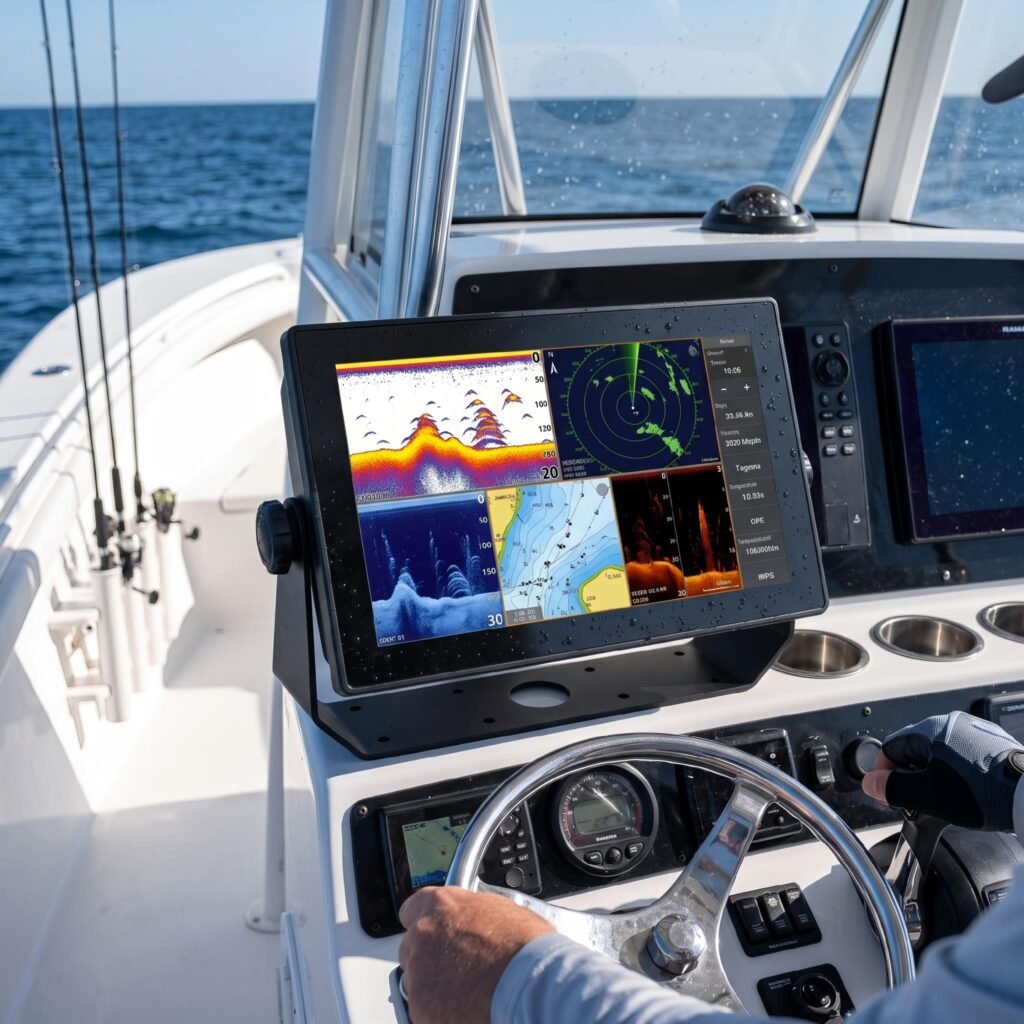
Marine Fishing Touch Monitor for Sonar & Chartplotters
Engineered for commercial fishing vessels and marine helms. Available in 12″, 15″, 18″, and 21″ form factors. Features a sunlight-readable 1500-nit optically bonded display, 0–100% deep dimming for night navigation, and an IP67 waterproof enclosure.
2. Night Navigation: Deep Dimming Curves (0% to 100%)
While daytime readability requires backlight outputs exceeding 1000 to 1500 nits, night navigation requires extreme low-light performance. If a display cannot dim below 20 or 30 nits, the operator’s night-adjusted scotopic vision is impaired, creating serious maritime navigation hazards.
Marine-grade displays implement true continuous 0% to 100% pulse-width modulation (PWM) or hybrid analog dimming, allowing backlights to dial down to under 0.5 nits without flicker. This allows skippers to monitor shallow-water bottom contours and sonar returns in total darkness without bridge glare.
Marine Bridge Display Engineering Matrix
| Parameter | Standard Commercial Monitor | Marine-Grade Fishing Touch Display |
|---|---|---|
| Daylight Luminance | 250 – 350 nits (Washed out in sunlight) | 1000 – 1500 nits Ultra-High Luminance |
| Nighttime Dimming | Minimum 20–30 nits (Blinds night vision) | True 0% – 100% Deep Dimming (<0.5 nits) |
| Optical Bonding | Air gap (Fogging and internal reflections) | Full optical bonding (Zero fog, high contrast) |
| Salt Fog Protection | Uncoated aluminum / plastic frame | Conformal coated PCBs & marine-grade housing |
Upgrading your vessel helm, fishing fleet sonar array, or marine navigation console? Contact INNODA’s marine electronics engineering team for dimming curve specifications, optical bonding data sheets, and console mounting drawings.