
Designing modern 13.3-inch widescreen human-machine interfaces demands balancing compact enclosure dimensions against the thermal dissipation requirements of multi-core processing architectures running Windows 11 IoT Enterprise. In high-density industrial control cabinets, ambient operating temperatures routinely reach 50°C to 60°C. Because internal cooling fans cannot be deployed in sealed, dust-laden manufacturing environments, the structural metal chassis functions as the sole convective and radiative heat sink.
When selecting the chassis manufacturing process, mechanical engineers face a critical metallurgical tradeoff: high-pressure die casting using commercial aluminum alloys (such as A380 or ADC12) versus precision CNC machining from aerospace-grade wrought aluminum plate (6061-T6). This choice directly governs thermal conductivity, structural porosity, and the long-term reliability of internal semiconductor silicon.
1. Metallurgical Composition and Thermal Conductivity Disparities
Die-cast alloys contain high concentrations of silicon (Si) to optimize molten metal fluidity and reduce shrink tearing during high-speed mold injection. However, free silicon crystals dispersed across the grain boundaries scatter acoustic phonons and conducting electrons, substantially degrading thermal conductivity.
Conductive Heat Transfer Rate (Fourier’s Law): q = -k × A × (dT / dx) Thermal Conductivity Comparison: k_A380 (Die-Cast Alloy): ≈ 96.0 W/(m·K) k_6061-T6 (Wrought CNC Alloy): ≈ 167.0 W/(m·K) Thermal Conduction Ratio: k_6061 / k_A380 = 167.0 / 96.0 ≈ 1.74 × (74% Superior Heat Transfer Efficiency)
In addition to lower bulk conductivity, high-pressure die casting inevitably introduces microscopic trapped gas porosity (0.5% to 3.0% void volume). These micro-voids act as localized thermal insulation barriers, creating localized hotspots directly behind the CPU cold plate mounting boss.
To eliminate thermal throttling without resorting to mechanical fans, high-reliability industrial automation cells implement the 13.3″ Aluminum Bezel Industrial Panel PC Windows 11, which utilizes high-purity CNC-machined front and rear aluminum structures providing maximum continuous thermal conduction.
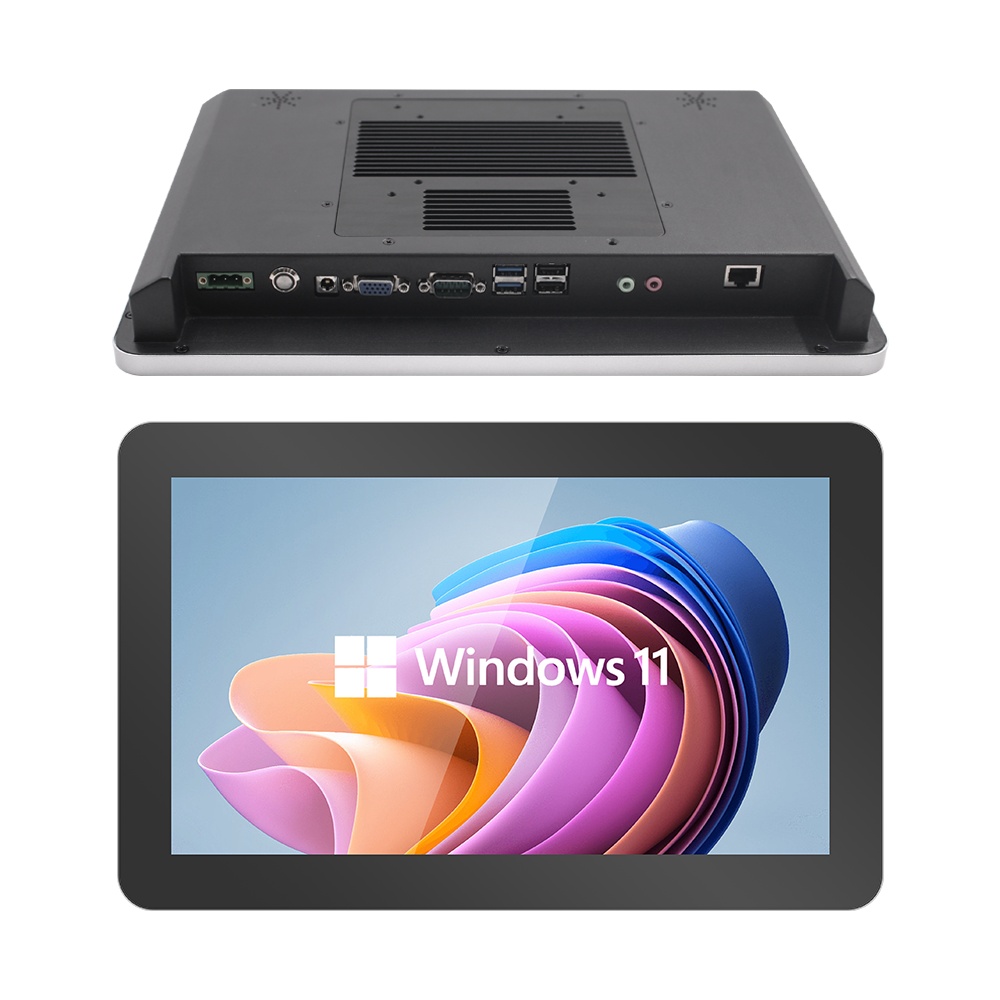
13.3″ Aluminum Bezel Fanless Panel PC (Windows 11)
Engineered with high-purity 6061-T6 aluminum front bezel and heavy-duty finned heatsink chassis. Delivers passive thermal dissipation, high shock resistance, and 24/7 reliability for Windows 11 IoT SCADA automation.
2. Thermal Resistance Network from CPU Die to Ambient Air
The total thermal resistance path (Θ_ja) of a fanless panel PC comprises multiple discrete conduction and convection stages:
- Junction-to-Case (Θ_jc): Governed by the bare-die processor packaging (Intel 15W TDP SoC architecture).
- Case-to-Spreader Interface (Θ_cs): Mitigated by applying high-performance phase-change material (PCM) with a thermal conductivity of 6.0 W/(m·K) compressed under a calibrated spring-loaded retention bracket.
- Spreader-to-Chassis Bulk Conduction (Θ_chassis): Where the 74% higher conductivity of 6061-T6 aluminum reduces temperature gradients across the outer heatsink fins.
- Chassis-to-Ambient Convection (Θ_ca): Optimized by designing fin height, fin spacing (pitch ≥ 8 mm to prevent boundary layer interference), and high-emissivity black anodization (ε ≥ 0.85).
Enclosure Manufacturing Process & Thermal Comparison
| Engineering Parameter | Die-Cast A380 Aluminum Enclosure | Precision CNC 6061-T6 Enclosure |
|---|---|---|
| Bulk Thermal Conductivity | 96 W/(m·K) (Silicon crystal phonon scattering) | 167 W/(m·K) (High-purity wrought matrix) |
| Internal Porosity Voids | 1.0% – 3.0% micro-voids (Thermal hot spots) | Zero porosity (Homogeneous extruded billets) |
| Yield Strength (Fatigue) | 160 MPa (Brittle under cyclic shock) | 276 MPa (Resists severe mechanical deflection) |
| Anodizing Surface Quality | Cloudy, uneven gray due to silicon bleed | Uniform, deep black anodize (ε = 0.88 emissivity) |
3. Windows 11 IoT Enterprise Thermal Throttle Prevention
Windows 11 IoT Enterprise dynamically monitors ACPI thermal zones. When the junction temperature (T_j) hits 90°C, the PROCHOT signal triggers clock throttling, slashing processor core frequencies from 3.4 GHz down to 800 MHz. By deploying 6061-T6 aluminum enclosures, peak full-load junction temperatures stabilize at 68°C under 50°C ambient environments, maintaining 100% deterministic execution for machine vision and real-time motion control tasks.
Selecting the right enclosure metallurgy ensures continuous computing throughput without risking field shutdowns. Contact INNODA’s mechanical engineering team for thermal dissipation simulation data, 3D STEP files, and custom front bezel cutouts.