
Heavy mining excavators, offshore drilling vessels, and commercial port container cranes operate in environments where industrial computers face prolonged outdoor exposure. On open deck bridges and machinery superstructures, 19-inch human-machine interface terminals are exposed to tropical storm surges, wave-slamming green water, and temporary deck submergence during heavy seas. Surviving these conditions requires meeting the rigorous requirements of the IEC 60529 IP67 ingress protection standard (immersion up to 1 meter depth for 30 minutes).
However, maintaining true hermetic sealing across years of outdoor operation requires active mechanical maintenance. Without routine inspection of elastomeric seals, breather membranes, and cable connector preloads, environmental thermal cycling can cause microscopic seal relaxing, allowing water ingress under hydrostatic head pressure.
1. Submersible Hydrostatic Head Pressure Mechanics
When an IP67-rated industrial panel PC is temporarily submerged or subjected to standing pooling water, hydrostatic pressure exerts inward normal forces across all enclosure mating joints, glass seams, and I/O connector interfaces:
Hydrostatic Fluid Pressure Formula: p_hydro = ρ × g × h Where: – Seawater Density ρ ≈ 1025 kg/m³. – Gravitational Acceleration g = 9.81 m/s². – Immersion Depth h = 1.00 m (standard IP67 verification test). Resulting Hydrostatic Head Pressure: p_hydro = 1025 × 9.81 × 1.00 = 10,055.25 Pa ≈ 0.1006 bar (1.46 PSI). Total Inward Hydraulic Force on 19″ Front Glass Face (A ≈ 0.125 m²): F_hydraulic = p_hydro × A = 10,055.25 × 0.125 ≈ 1,256.9 N inward load.
Thin sheet-metal bezels or plastic chassis flex under 1,250 N of hydraulic force. This structural deflection relieves contact stress along the perimeter gasket, opening micro-channels that allow water to bypass the seal. A monolithic CNC-machined 6061-T6 aluminum enclosure eliminates chassis deflection, maintaining uniform sealing pressure under full submersion.
To deliver continuous reliability in submersible and open-ocean environments, heavy industry operators standardize on the 19″ Full IP67 CNC Aluminum Waterproof Panel PC, which combines a rigid CNC aluminum housing with continuous closed-cell fluorosilicone gaskets seated in precision-machined retention grooves.
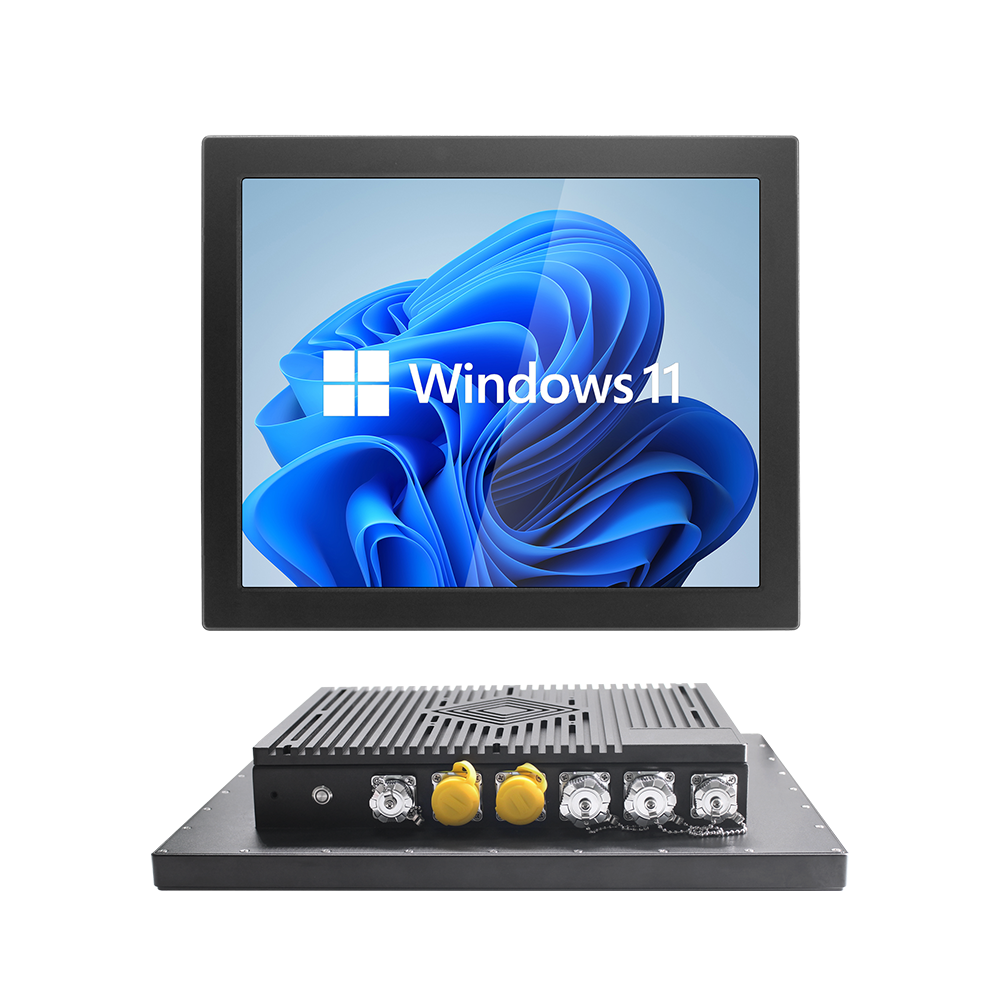
19″ Full IP67 CNC Aluminum Industrial Panel PC
Built to survive temporary submersion, severe marine deck washdowns, and heavy industrial vibration. Features a solid 6061-T6 CNC aluminum enclosure, 1-meter IP67 immersion rating, all-metal M12 aviation connectors, and oil-resistant fluorosilicone sealing.
2. Elastomer Chemical Durability: Fluorosilicone vs. Standard EPDM
Maintaining ingress protection requires selecting the appropriate sealing elastomer based on field chemical exposure:
- Hydrocarbon Fuel & Solvent Resistance: On marine vessels and mining machinery, diesel exhaust, hydraulic fluids, and grease mist coat the terminal exterior. Standard EPDM and natural silicone swell, soften, and lose tensile strength when exposed to hydrocarbons.
- Fluorosilicone Polymer (FVMQ) Superiority: Incorporates trifluoropropyl side groups along the siloxane polymer backbone. This molecular structure delivers outstanding resistance to petroleum fuels, synthetic engine oils, and harsh washdown detergents while maintaining elasticity from -40°C to +180°C.
- Precision Bolt Preload Calibration: Gasket sealing depends on uniform bolt torque. Utilizing calibrated stainless steel fasteners prevents localized pinching and maintains a 30% nominal gasket compression ratio.
Severe Marine & Heavy Industry PC Comparison
| Operational Metric | Standard IP65 Panel PC | Engineered 19″ Full IP67 CNC PC |
|---|---|---|
| Ingress Protection Level | IP65 front only (Rear ports completely exposed) | Full IP67 (Front, rear, and all M12 aviation I/O) |
| 1-Meter Submersion Test | Fails immediately (Water penetrates vents) | Certified 30-min continuous 1m submersion (IEC 60529) |
| Chassis Material | Stamped sheet metal or plastic housing | Heavy CNC-machined 6061-T6 aluminum billet |
| Gasket Material Grade | Standard EPDM or sponge foam tape | Continuous molded aerospace-grade fluorosilicone |
| I/O Connection Interface | Standard RJ45 & USB ports (Unsealed) | Thread-locking metal M12 circular connectors |
3. Preventative Field Maintenance Checklist
- Gasket Elastic Recovery Inspection: During annual dry-dock or planned overhauls, inspect exposed perimeter fluorosilicone seals for cracking, hardening, or foreign particle accumulation. Wipe clean using pure isopropyl alcohol.
- M12 Connector O-Ring Lubrication: Apply a microscopic film of food-grade silicone grease (FDA 21 CFR compliant) to M12 female connector O-rings before mating to prevent binding during seasonal disconnections.
- ePTFE Breather Vent Clearance: Ensure the rear-mounted hydrophobic pressure-equalization vent is clear of salt crusting or mud accumulation, allowing internal air volume to breathe during sudden 40°C ambient temperature swings.
Standardizing mission-critical heavy industrial cockpits on full IP67 CNC aluminum panel PCs ensures operational continuity across extreme weather conditions. Contact INNODA’s severe-environment support team to request complete immersion testing reports, M12 cable pinout diagrams, and custom bracket engineering.