
In modern high-speed beverage bottling halls, automated food packaging plants, and chemical batching suites, supervisory human-machine interfaces are transitioning toward large-format 16:9 widescreen displays. A 21.5-inch Full HD (1920×1080) interface allows machine operators to monitor multi-stage SCADA diagrams, live vision-inspection feeds, and real-time process trends simultaneously. However, deploying large-format touch displays in washdown industrial environments introduces significant mechanical sealing challenges.
As display diagonal dimensions increase from compact 10-inch screens to 21.5 inches, perimeter seal length expands from under 800 mm to over 1,500 mm. Under high-pressure cleaning or chemical washdown regimens, larger front bezels experience structural beam deflection, while wide-area projected capacitive (PCAP) glass matrices face severe signal degradation from surface water films.
1. Perimeter Gasket Stress Distribution & Bezel Beam Deflection
Achieving a certified IP65 water-jet barrier across a 21.5-inch perimeter requires maintaining uniform elastomeric contact pressure along every millimeter of the sealing interface. Under the IEC 60529 IP65 standard, enclosures must withstand continuous water jetting from a 6.3 mm nozzle delivering 12.5 L/min at 30 kPa from a 2.5-meter distance:
Beam Deflection and Gasket Compression Loss: Maximum Mid-Span Deflection (Simply Supported Beam): δ_max = (5 × q × L_span^4) / (384 × E × I) Where: – q = Linear gasket reaction load (≈ 4.5 N/mm for 30% silicone compression). – L_span = Longest unsupported bezel edge (≈ 520 mm for 21.5″ display). – E = Modulus of elasticity (Aluminum 6061-T6 ≈ 68.9 GPa; Stamped Sheet Steel ≈ 200 GPa). – I = Area moment of inertia (b × h^3 / 12). Conclusion: If front bezel wall thickness h is reduced from 8.0 mm down to 2.5 mm, moment of inertia I drops by a factor of 32.8, causing mid-span deflection to exceed 1.8 mm under clamping preload, completely releasing gasket sealing compression midway between fasteners.
Standard commercial displays housed in thin stamped sheet metal flex noticeably under washdown water pressure, opening micro-gaps that draw liquid directly into internal timing controller electronics. A rigid CNC-machined aluminum or heavy-gauge stainless steel front bezel provides high flexural rigidity, guaranteeing uniform gasket compression across the entire 1,500 mm perimeter.
To eliminate washdown leakage risks across wide viewing areas, automated manufacturing cells implement the 21.5″ Full IP65 Waterproof Touch Industrial Monitor, which combines a reinforced front chassis with seamless IP65 sealing across both front and rear enclosures.
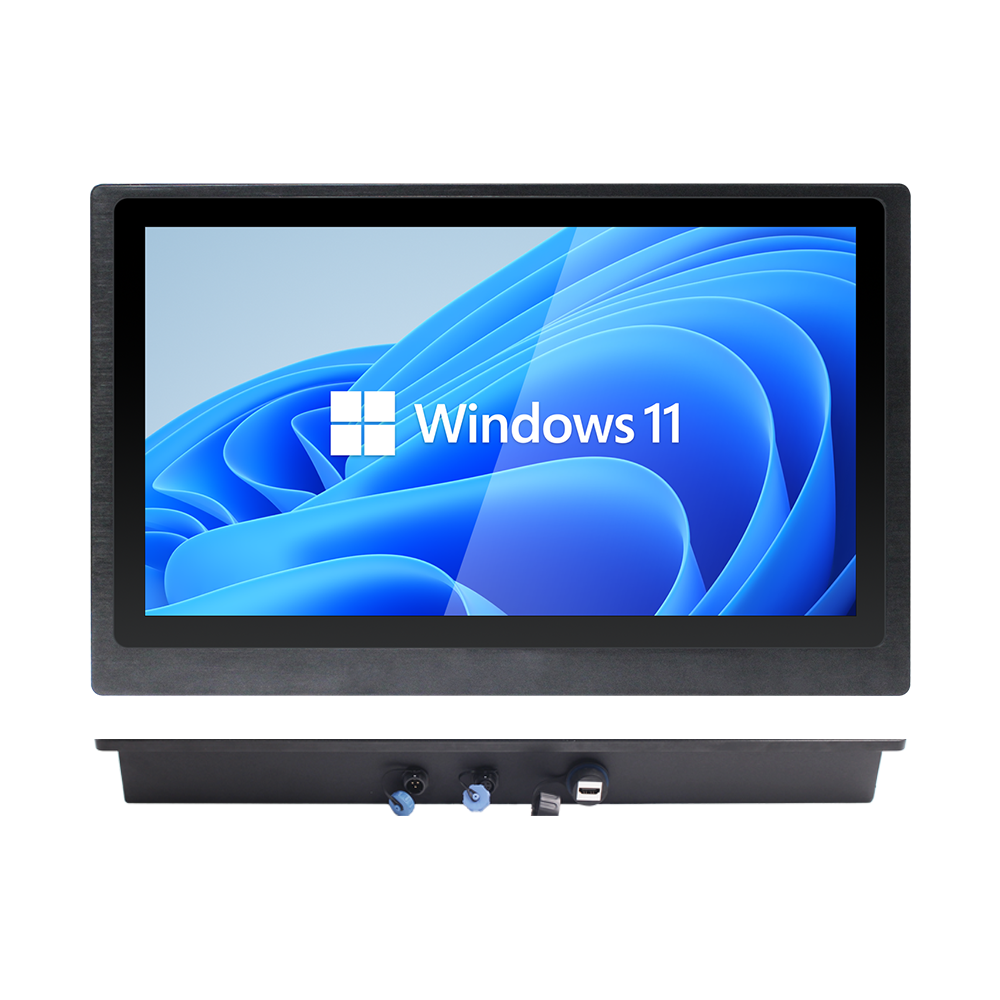
21.5″ Full IP65 Waterproof Touch Industrial Monitor
Engineered for food processing, cleanroom SCADA, and outdoor kiosk applications. Features an expansive 21.5″ Full HD display, certified full IP65 waterproof sealing, 10-point projected capacitive touch with water-rejection firmware, and wide DC voltage input.
2. Conductive Water Film Rejection & Mutual-Capacitance DSP Tuning
Large-format PCAP touch panels utilize expansive indium tin oxide (ITO) sensor matrices. When continuous water droplets or saline cleaning detergents spray across the 21.5-inch active glass area, surface conductive fluid paths mimic human finger touches:
- Self vs. Mutual Capacitance Tracking: Self-capacitance measures the capacitance of an entire electrode track to ground, causing water sheets to register as continuous false presses (“ghost touches”). Advanced industrial controllers deploy mutual-capacitance scanning, measuring inter-electrode coupling capacitance at discrete X-Y intersections to isolate localized finger touch profiles.
- Digital Signal Processing (DSP) Water Suppression: When continuous moisture films connect adjacent sensing nodes, the touch controller DSP executes spatial filtering algorithms that analyze the negative charge profile of water versus the positive displacement of a human finger, dynamically suppressing false touch coordinates.
- 7H Chemically Toughened Cover Glass: Provides high surface scratch resistance against industrial sand, cleaning scrubs, and chemical wipe-down solutions without losing optical clarity.
21.5″ Industrial Washdown Monitor Comparison Matrix
| Engineering Parameter | Commercial Desktop Touchscreen | Engineered 21.5″ Full IP65 Monitor |
|---|---|---|
| Ingress Protection Level | IP20 / Unsealed (Ventilation holes in rear) | Full IP65 (Front, rear chassis, and I/O glands) |
| Bezel Structural Rigidity | Thin ABS plastic frame (Lifts under spray) | Reinforced CNC metal bezel (Zero mid-span flex) |
| Touchscreen Wet Response | Freezes or triggers ghost touches in mist | Firmware water-film rejection + glove mode |
| Optical Construction | Air gap prone to internal condensation | Sealed optical stack with anti-glare etching |
| Industrial Power Supply | Consumer 12V plastic adapter | Integrated wide DC 12V-36V with surge clamp |
3. Electrical Cabinet Panel Cutout Installation Guidelines
- Cutout Tolerance Sizing: Verify that the control cabinet cutout matches engineering drawings within a tolerance of ±0.5 mm. Excessively large cutouts reduce gasket contact width, leading to liquid bypass under direct washdown.
- Staggered Clamping Sequence: When tightening panel-mount retaining brackets, follow a cross-diagonal torquing sequence (tightening center clamps first, followed by corners) to a final torque of 0.8 Nm to 1.0 Nm to ensure uniform perimeter compression.
- Drip Loop Cable Dressing: Form a 100 mm downward drip loop on all incoming video, USB, and power cables prior to the enclosure cable glands to prevent washdown runoff from tracking directly into connector sockets.
Standardizing packaging and bottling lines on large-format full IP65 industrial monitors ensures expansive SCADA visualization without risking moisture downtime. Contact INNODA’s industrial display engineering team to request CAD dimensional drawings, touch controller SDK documentation, and sample evaluation units.