
Modern pharmaceutical compounding facilities, high-speed beverage bottling lines, and food packaging suites rely on electrical control enclosures fabricated from heavy-gauge stainless steel. Within these sanitary control panels, 18.5-inch widescreen (16:9 Full HD 1920×1080) human-machine interface monitors are mounted directly into enclosure doors. The 18.5-inch widescreen aspect ratio provides ample visual space to display complex process piping diagrams, batch validation charts, and real-time alarm queues side-by-side.
However, securing an 18.5-inch display flush against an electrical cabinet door introduces significant mechanical challenges. Over extended operational cycles, constant mechanical clamping pressure combined with daily ambient thermal swings induces viscoelastic creep relaxation within perimeter sealing gaskets. Without calibrated clamping brackets and high-recovery elastomers, gasket contact stress degrades over time, permitting sanitation chemical solutions to bypass the cutout barrier.
1. Viscoelastic Gasket Creep Relaxation & Clamping Stress Mechanics
When an elastomeric perimeter gasket is compressed between an 18.5-inch stainless steel front bezel and a sheet-metal cabinet cutout, it initially exhibits an elastic compressive stress (σ_0). Under sustained strain over thousands of operating hours, polymers experience macromolecular chain reorganization, known as stress relaxation:
Gasket Stress Relaxation Equation (Maxwell Model): σ(t) = σ_0 × exp(-t / τ_r) Where: – σ_0 = Initial compressive contact stress (≈ 1.25 MPa at 30% compression). – t = Service duration in hours. – τ_r = Viscoelastic relaxation time constant (temperature-dependent). Degradation Comparison after 5,000 Hours at 45°C: – Standard EPDM Foam: τ_r ≈ 8,500 hours → σ(5000) = 1.25 × exp(-5000 / 8500) ≈ 0.69 MPa. – Medical-Grade Closed-Cell Silicone: τ_r ≈ 28,000 hours → σ(5000) = 1.25 × exp(-5000 / 28000) ≈ 1.04 MPa. Retention Ratio: Silicone preserves > 83% of its original sealing contact stress, remaining well above the 0.60 MPa critical washdown penetration threshold.
Low-cost EPDM and neoprene foam tapes lose over 40% of their sealing stress within months of exposure to warm operating cabinets. As contact pressure drops, capillary action draws low-surface-tension alcohol and peracetic acid sanitation sprays directly into the interior of the electrical cabinet.
To guarantee long-term hermetic sealing against sanitary cabinet doors, process facilities standardize on the 18.5″ Stainless Steel Panel Mount Industrial Touch Monitor, which combines a rigid 304/316L stainless steel front fascia with precision-engineered rear clamping brackets that maintain calibrated gasket compression.
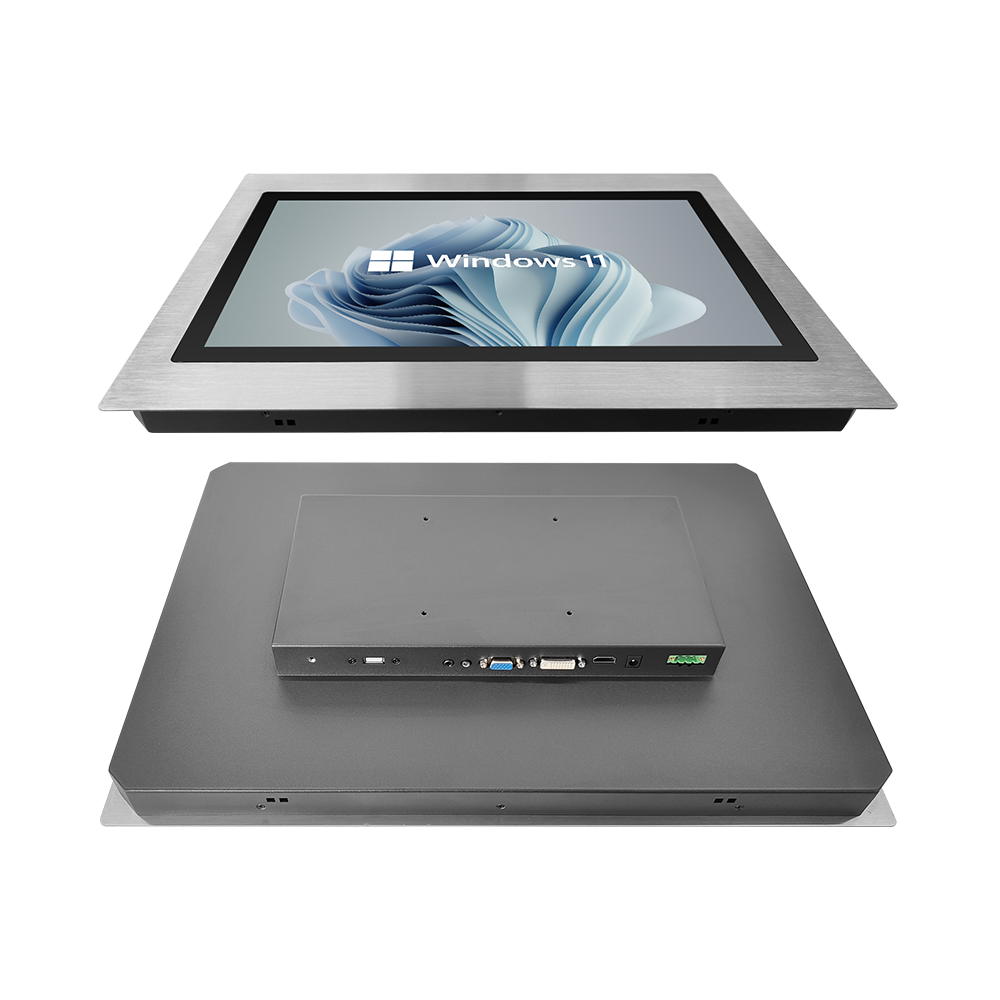
18.5″ Stainless Steel Panel Mount Touch Monitor
Designed for pharmaceutical compounding suites, food packaging skids, and sanitary control cabinets. Features a solid SUS304/SUS316L stainless steel front bezel, 18.5″ Full HD widescreen display, high-recovery silicone perimeter gasket, and IP65 washdown sealing.
2. 18.5″ Widescreen Spatial Ergonomics & 1080p Process Visualization
Upgrading from traditional square screens to an 18.5-inch widescreen form factor provides substantial operational benefits for process engineers:
- 16:9 Full HD Pixel Real Estate: Displays 1920×1080 resolution with a 0.213 mm pixel pitch, allowing complex process schematics, multi-variable trend charts, and real-time camera feeds to be monitored without horizontal scrolling.
- Austenitic Stainless Steel Construction (SUS304/SUS316L): Resists continuous chemical exposure to chlorinated cleansers, caustic CIP foams, and organic acids, preventing pitting corrosion across decades of service.
- Chemically Hardened 7H Front Glass: The flush front glass surface resists abrasive scratching from sanitation brushes and metal tool contact, maintaining 90% optical light transmission.
Sanitary Panel-Mount Monitor Comparison Matrix
| Engineering Parameter | Commercial Aluminum Panel Screen | Engineered 18.5″ Stainless Monitor |
|---|---|---|
| Front Bezel Material | Anodized aluminum (Corrodes in caustic wash) | Solid SUS304 / SUS316L electropolished stainless |
| Gasket Relaxation Resilience | Standard EPDM tape (>45% stress loss) | Closed-cell medical silicone (<17% stress loss) |
| Mounting Clamp Mechanism | Plastic clips (Distort under thermal loads) | Heavy zinc-plated steel clamps with torque stops |
| Front Ingress Protection | IP54 / light splash resistant only | Certified IP65 / NEMA 4X front washdown sealed |
| Operating Temperature Range | 0°C to +40°C (Fails in warm enclosures) | -20°C to +70°C wide temperature industrial panel |
3. Panel Cutout Installation & Torque Calibration Protocol
- Cutout Edge Deburring: Ensure all laser-cut edges of the cabinet door are fully deburred and passivated before positioning the monitor to prevent sharp sheet-metal edges from slicing through the silicone gasket.
- Symmetrical Torquing Sequence: Tighten the rear panel-mount retaining clamps using a diagonal criss-cross sequence, applying 1.2 Nm of torque to each bolt using a calibrated torque screwdriver.
- Gasket Compression Verification: Inspect the perimeter seam from the front to verify uniform 30% nominal gasket compression, confirming the absence of localized bowing along the 480 mm horizontal span.
Upgrading sanitary control panels with 18.5-inch stainless steel panel-mount touch monitors eliminates gasket relaxation leaks and provides expansive widescreen SCADA operation. Contact INNODA’s mechanical application team to request dimensional cutout templates, chemical resistance charts, and custom front-bezel branding options.