
Modern automated logistics hubs, pneumatic testing manifolds, semiconductor wafer handling equipment, and mobile robotic platforms operate within strict spatial constraints. Automated Guided Vehicles (AGVs) and Autonomous Mobile Robots (AMRs) require local operator displays to visualize battery state-of-charge, active LiDAR navigation maps, error codes, and manual override controls. In these space-critical installations, integrating a bulky 15-inch or 19-inch monitor is physically impossible.
However, deploying standard consumer 7-inch screens on mobile industrial robots results in rapid premature failure. Continuous floor vibration over warehouse dock joints shakes internal display ribbons loose, while thin plastic frames crack under accidental physical collisions. Deploying a rugged 7-inch industrial monitor requires analyzing structural extrusion damping, wide-temperature thermal dissipation, and low-power DC consumption.
1. Kinetic Vibration Damping & Fundamental Natural Frequency
Mobile AGVs traversing warehouse expansion joints and floor surface transitions at speeds of 1.5 m/s to 2.5 m/s subject onboard displays to continuous harmonic vibration (10 Hz to 150 Hz) and sudden kinetic shock pulses (up to 20G):
Fundamental Natural Frequency & Resonance Avoidance: f_n = (1 / (2 × π)) × (k_assembly / m_monitor)^0.5 Where: – Total Monitor Mass: m_monitor ≈ 0.65 kg (compact 7″ form factor). – Extruded Aluminum Profile Structural Stiffness: k_assembly ≈ 4.8 × 10^5 N/m. Natural Frequency Calculation: f_n = (1 / (2 × 3.14159)) × (4.8 × 10^5 / 0.65)^0.5 f_n ≈ 0.15915 × (738,461.5)^0.5 ≈ 0.15915 × 859.34 ≈ 136.7 Hz. Engineering Advantage: Because the monitor’s natural frequency sits at 136.7 Hz, well above typical vehicle wheel excitation frequencies (10 Hz to 45 Hz), destructive constructive resonance is physically prevented.
Because the high stiffness-to-weight ratio of extruded 6061 aluminum shifts the natural resonance frequency safely beyond operational vehicle excitation bands, internal electronic solder joints and LCD timing controller components are protected from destructive mechanical fatigue.
To deliver lasting mechanical resilience on compact automated machinery, robotics engineers deploy the 7″ Aluminum Profile VESA Industrial LCD Monitor, which combines a rugged extruded aluminum enclosure with standard VESA 75×75 mounting.
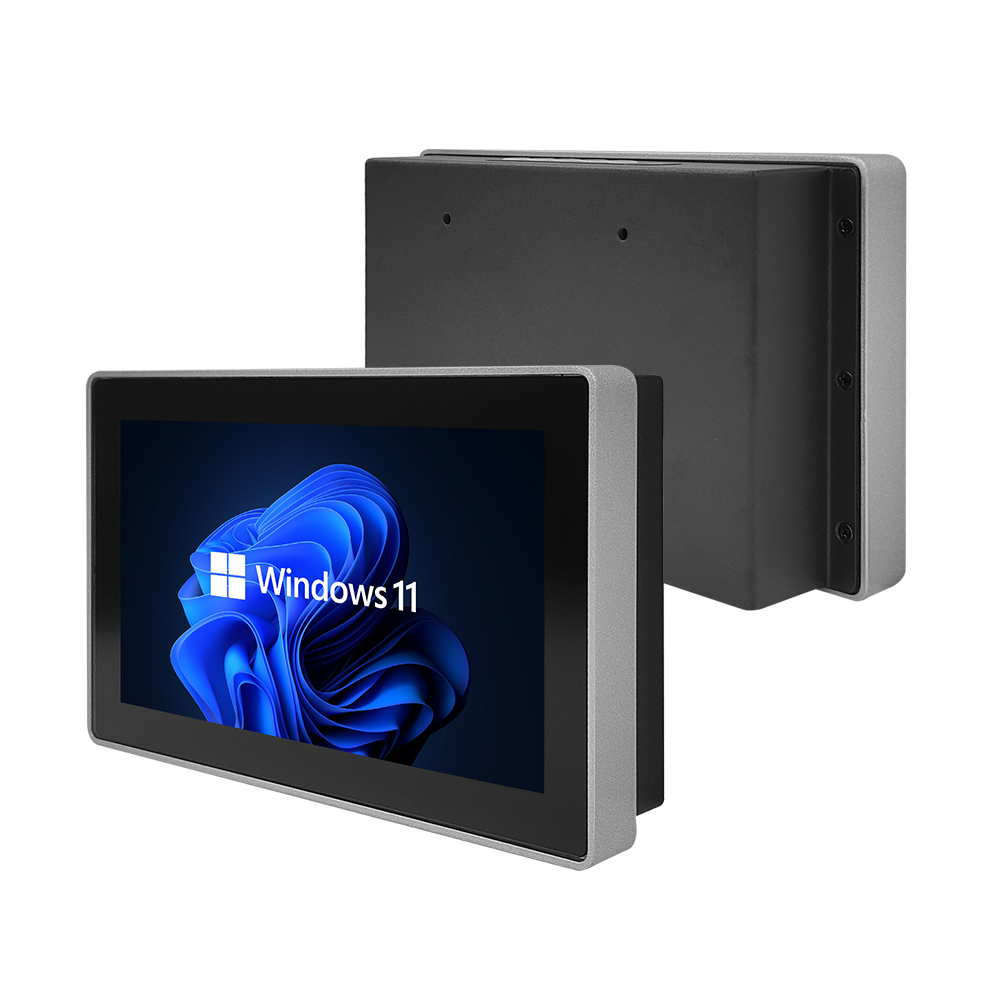
7″ Aluminum Profile VESA Industrial LCD Monitor
Designed for AGVs, mobile robotics, pneumatic test benches, and compact machine consoles. Features a rugged extruded aluminum profile housing, standard VESA 75×75 mounting, ultra-low power consumption (<6W), and high-vibration MIL-STD-810H resistance.
2. Thermal Conduction via Profile Fins & Ultra-Low Power Consumption
Operating inside compact robot chassis or unventilated testing enclosures requires optimized energy and thermal management:
- Extruded Aluminum Heatsink Profile: The rear casing incorporates integral longitudinal cooling fins that maximize natural convective heat dissipation, operating reliably across -20°C to +60°C without internal fans.
- Ultra-Low Power Footprint (≤ 6W): Consuming less than 6W of electrical power at full backlight brightness minimizes battery drain on autonomous mobile platforms, extending vehicle operational runtimes between automated charging cycles.
- Industrial Video Input Flexibility: Features robust VGA and HDMI video inputs equipped with screw-locking hardware, ensuring video signal continuity even when machinery experiences continuous vibration.
Compact AGV Operator Display Comparison
| Technical Parameter | Consumer 7″ Plastic Display | Engineered 7″ Aluminum VESA Monitor |
|---|---|---|
| Chassis Material | Molded ABS plastic (Snaps under impact) | Heavy extruded 6061 aluminum alloy profile |
| Vibration Standard | Unrated (Ribbons disconnect under 1G) | MIL-STD-810H Method 514.8 (Random 5G RMS) |
| Mounting Versatility | Flimsy desk stand or snap tabs | Integrated standard VESA 75×75 mounting holes |
| LED Backlight MTBF | 15,000 Hours (Consumer grade) | ≥ 30,000 Hours industrial-grade LED rail |
| Power Input Stage | Micro-USB 5V (Fragile connector) | Industrial DC 12V with screw-locking connector |
3. Real-World Field Case: Automated Warehouse AMR Fleet
A global logistics facility in Antwerp deployed a fleet of 45 autonomous mobile pallet jacks. Previous commercial displays suffered repeated screen flickering and broken plastic mounting tabs when vehicles drove over high-traffic floor joints. Retrofitting the fleet with 7″ Aluminum Profile VESA Industrial LCD Monitors resolved the failures, achieving zero display-related service dispatches over 14 months of continuous 24/7 warehouse operation.
Equipping space-constrained industrial machinery and mobile robotics with rugged aluminum 7-inch displays ensures long-term visualization reliability without excessive power draw. Contact INNODA’s robotics display engineering team to request 3D CAD files, mounting bracket options, and custom cable assemblies.