
Modern pharmaceutical compounding suites, vaccine fill-finish isolators, and automated dairy packaging lines require human-machine interface (HMI) terminals installed directly into stainless steel machine enclosure doors. A 15.0-inch 4:3 aspect ratio (1024×768 XGA resolution) industrial panel PC provides the global standard visual footprint for Manufacturing Execution Systems (MES) and supervisory SCADA frameworks. However, in sanitary washdown environments subject to daily chemical cleaning, the mechanical mounting profile between the computer and the enclosure door dictates hygiene compliance.
Traditional stepped-bezel panel PCs create a protruding 6 mm to 10 mm lip over the cabinet cutout. In automated washdown environments, surface tension causes caustic foam cleaners, rinse water, and organic milk residues to pool along this horizontal ledge. Over time, capillary forces draw stagnant fluids past imperfect seal seams, harboring bacterial biofilms (such as Listeria and Salmonella) that compromise cleanroom validation audits. Selecting a compliant 15-inch stainless industrial PC requires analyzing capillary pressure dynamics, electropolished surface roughness, and true-flush mounting geometries.
1. Young-Laplace Capillary Retention Mechanics & Crevice Elimination
When cleaning agents and water rinse across an enclosure door, liquid trapped in microscopic gaps between a raised display bezel and the mounting panel experiences negative capillary pressure, resisting gravity drainage:
Young-Laplace Capillary Retention Pressure: ΔP_cap = (2 × γ × cos θ) / r_gap Where: – Surface Tension of Alkaline Cleaning Detergent: γ ≈ 0.035 N/m (with surfactant). – Contact Angle on Stainless Steel: θ ≈ 35° (cos 35° ≈ 0.819). – Microscopic Step Crevice Gap: r_gap = 0.15 mm = 1.5 × 10^-4 m. Resulting Capillary Suction: ΔP_cap = (2 × 0.035 × 0.819) / (1.5 × 10^-4) ≈ 382.2 Pa. Hydrostatic Head Equivalent: h_retention = ΔP_cap / (ρ × g) = 382.2 / (1000 × 9.81) ≈ 39.0 mm of retained water column. Hygienic Risk: Capillary force holds trapped fluid permanently against the gasket edge, creating an anaerobic incubation chamber for microbial pathogens.
By engineering a true flush-mount front profile where the 7H tempered glass face aligns coplanar with the enclosure panel (elevation step ≤ 0.5 mm with a continuous 45-degree chamfered edge), capillary suction is eliminated. Washdown fluids drain instantly under natural gravity, satisfying European Hygienic Engineering & Design Group (EHEDG) requirements.
To eliminate crevice contamination on sanitary processing lines, cleanroom automation engineers deploy the 15″ Flush Panel Mount Stainless Steel Industrial PC, which integrates a precision-machined 304/316L stainless steel seamless flush bezel with continuous closed-cell silicone perimeter sealing.
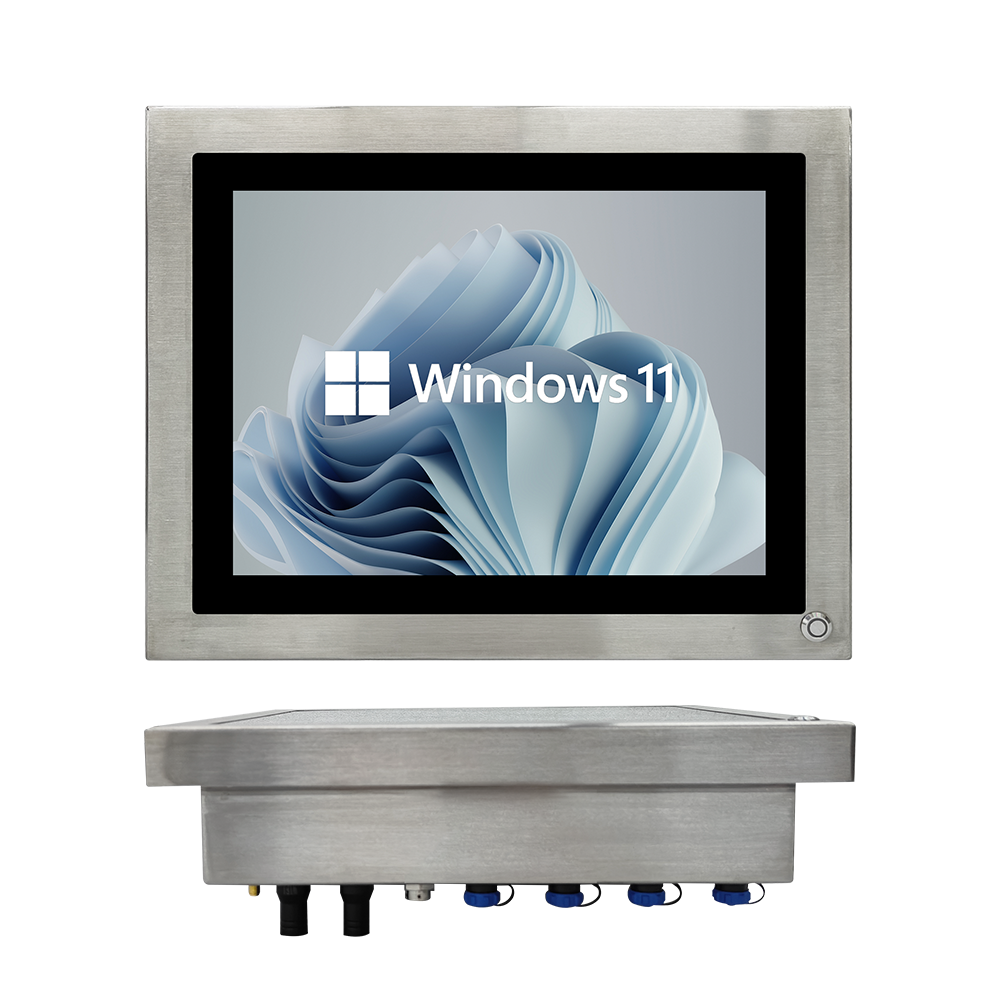
15″ Flush Panel Mount Stainless Steel Industrial PC
Designed for pharmaceutical compounding suites, cleanrooms, and food washdown enclosures. Features a true-flush electropolished SUS304/316L stainless front bezel (Ra ≤ 0.4 µm), IP66/IP69K sealing, glove-responsive PCAP touch, and 100% fanless architecture.
2. Sanitary Metallurgy: Ra ≤ 0.4 μm Electropolishing & Glove PCAP Tracking
Achieving cleanroom certification requires strict metallurgical and optical control:
- Electropolished Stainless Steel (Ra ≤ 0.4 μm): Eliminates microscopic surface fissures produced by mechanical milling, producing a chromium-rich, mirror-smooth passivation layer that resists bacterial adhesion and withstands continuous exposure to hydrogen peroxide (VHP) sterilization.
- Rear Panel-Mount Tension Studs: Stainless threaded studs welded to the rear perimeter flange allow rear clamping brackets to exert a uniform 1.2 Nm compression force across the silicone gasket, preventing sheet-metal distortion.
- Multi-Frequency PCAP Wet Glove Tracking: High-performance touch controller DSP actively discriminates between localized finger capacitance and broad conductive liquid films, maintaining high responsiveness even when operators wear double-layer sterile nitrile gloves.
Sanitary HMI Mounting Architecture Comparison
| Engineering Parameter | Standard Stepped-Bezel PC | Engineered 15″ Flush Stainless PC |
|---|---|---|
| Bezel Elevation Step | 6 mm – 10 mm raised lip (Liquid pooling ledge) | True flush coplanar (≤ 0.5 mm with 45° chamfer) |
| Surface Roughness | Mill-finished aluminum/steel (Ra > 1.2 μm) | Electropolished SUS304/316L (Ra ≤ 0.4 μm) |
| Capillary Water Ingress | Traps washdown fluid via Young-Laplace force | Zero capillary retention (100% gravity drainage) |
| Front Ingress Protection | IP65 front only (Foam degrades seal over time) | IP66 / IP69K high-pressure sanitary washdown sealed |
| Thermal Dissipation | Ventilated slots (Prohibited in cleanrooms) | 100% Fanless sealed passive conduction (-20°C to +70°C) |
3. Commissioning Guidelines for Cleanroom Panel Cutouts
- Cutout Edge Chamfering: Laser-cut cabinet door apertures must be deburred and ground to a smooth 0.5 mm radius before installation to prevent sharp burrs from severing the continuous closed-cell silicone gasket.
- Torque Calibration Sequence: Tighten rear stainless panel-mount retention nuts using a calibrated torque wrench in a cross-diagonal sequence, applying 1.2 Nm to ensure uniform 30% nominal gasket compression.
- Passivation Chemical Wipe: Following installation, wipe the exposed stainless frame and tempered glass with a 10% citric acid passivation solution to remove hand oils and restore the protective chromium oxide layer.
Standardizing cleanroom suites and dairy packaging lines on 15-inch flush panel-mount stainless steel industrial PCs eliminates bacterial harboring crevices and ensures seamless regulatory compliance. Contact INNODA’s sanitary computing engineering team to request 3D CAD cutout templates, EHEDG material test certificates, and custom rear I/O cable configurations.