
Modern pharmaceutical compounding suites, semiconductor cleanrooms, and aseptic biological barrier isolators operate under strict environmental containment classifications (ISO 14644-1 Class 5 to Class 7). In these sterile production zones, operators must communicate with external supervisors, record real-time batch video evidence, and log into Manufacturing Execution Systems (MES) using facial recognition without leaving the cleanroom. A 15.0-inch 4:3 format (1024×768 XGA resolution) Android computing terminal provides an optimal physical balance for cleanroom wall integration.
However, embedding an optical camera and acoustic microphone array inside a hermetically sealed stainless steel enclosure presents significant physical engineering trade-offs. Standard microphone openings breach cleanroom pressure boundaries and allow sterilization chemicals to enter the chassis. Conversely, completely sealing the microphone behind rigid metal blocks sound transmission. Solving this challenge requires analyzing acoustic impedance matching across micro-porous membranes and optical dispersion across protective camera windows.
1. Acoustic Impedance Matching & ePTFE Sound Transmission Loss
Transmitting vocal frequencies (300 Hz to 3,400 Hz) into an internal digital MEMS microphone while blocking liquid washdown sprays and gaseous Vaporized Hydrogen Peroxide (VHP) requires an expanded polytetrafluoroethylene (ePTFE) acoustic vent membrane:
Acoustic Membrane Sound Transmission Loss (TL) Equation: TL = 10 × log10 [ 1 + ( (ω × m_s) / (2 × Z_air) )^2 ] Where: – Sound Angular Frequency: ω = 2 × π × f (at f = 1000 Hz human vocal fundamental → ω ≈ 6,283 rad/s). – Membrane Areal Mass Density: m_s = 0.040 kg/m² (40 g/m² micro-porous ePTFE). – Characteristic Acoustic Impedance of Air: Z_air = ρ_air × c ≈ 1.204 × 343 ≈ 413 Pa·s/m. Transmission Ratio Calculation: ω × m_s / (2 × Z_air) = (6,283 × 0.040) / (2 × 413) = 251.32 / 826 ≈ 0.3043. Transmission Loss: TL = 10 × log10 [ 1 + (0.3043)^2 ] = 10 × log10 [ 1 + 0.0926 ] = 10 × log10(1.0926) ≈ 0.38 dB. Result: Acoustic insertion loss remains below 0.5 dB across vocal bands, providing crystal-clear WebRTC intercom audio while maintaining an IP66/IP67 liquid barrier.
Because the ultra-thin ePTFE acoustic membrane vibrates sympathetically with ambient sound waves, acoustic energy transfers into the internal cavity with negligible attenuation, while its sub-micron pore structure (≤ 0.2 μm) physically repels liquid water, alcohol sanitizers, and particulate contaminants.
To deliver seamless audio-visual cleanroom communication, pharmaceutical facilities deploy the 15″ Stainless Steel Android Panel PC with Camera & Mic, which combines an ePTFE-protected acoustic chamber with an optically aligned Full HD camera aperture.
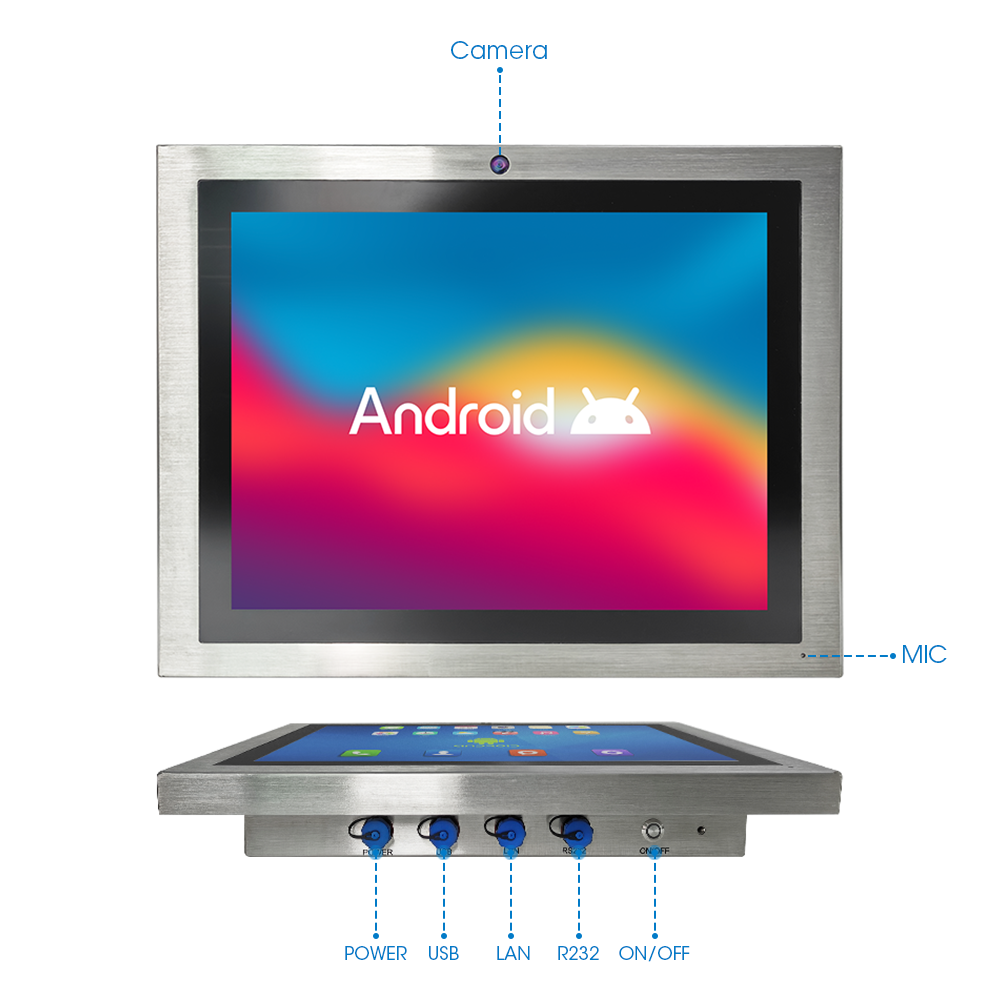
15″ Stainless Steel Android Panel PC (Camera & Mic)
Designed for pharmaceutical compounding suites, cleanroom intercoms, and aseptic barrier MES. Features an integrated Full HD camera, ePTFE-protected acoustic microphone, electropolished SUS304/316L housing, full IP65/IP67 washdown sealing, and responsive Android OS.
2. Optical Aperture Dispersion & Android Edge WebRTC Processing
Integrating a video inspection camera behind protective cover glass requires strict optical alignment:
- Sapphire-Hardened Optical Aperture: The camera lens looks through a dedicated optical-grade borosilicate or sapphire window with double-sided broadband anti-reflective (BBAR) coating, eliminating internal lens flare and chromatic aberration.
- Hardware DSP Echo Cancellation: The Android computing engine executes real-time Acoustic Echo Cancellation (AEC) and background pump noise suppression via a dedicated audio DSP, preventing audio feedback squeals during hands-free cleanroom intercom calls.
- VHP Sterilization Immunity: The electropolished SUS304/SUS316L front bezel and flush-bonded optical window withstand repeated exposure to gaseous Vaporized Hydrogen Peroxide (VHP) concentrations exceeding 1,000 ppm without clouding or surface embrittlement.
Cleanroom Audio-Visual Terminal Comparison
| Engineering Parameter | External Add-On Webcam & Speaker | Engineered 15″ Integrated AV Stainless PC |
|---|---|---|
| Acoustic Seal Barrier | Open microphone holes (Leaks room pressure) | Hermetic ePTFE acoustic membrane (IP66/IP67 sealed) |
| VHP Chemical Resistance | Plastic lens yellows and fogs after 5 cycles | Optical glass & SUS304/316L (Resists >1,000 VHP cycles) |
| Bacterial Harboring Risk | Exposed cables and joints harbor pathogens | True-flush hygienic front face (Ra ≤ 0.4 μm) |
| Audio Intercom Quality | Severe room echo and background pump noise | Hardware DSP echo cancellation + noise gating |
| OS Platform & Video | High-overhead desktop OS requiring updates | Low-latency industrial Android with native WebRTC |
3. Cleanroom Wall Mount Commissioning Guidelines
- Acoustic Membrane Integrity Inspection: Inspect the micro-porous acoustic port visually before installation to ensure the protective membrane is free from particulate clogs or puncture tears.
- Camera Optical Focus Alignment: Using the onboard Android camera diagnostic utility, verify that the fixed-focus wide-angle lens achieves sharp facial recognition focus at standard cleanroom operator distances (0.5 m to 1.2 m).
- Sanitization Wipe Technique: Clean the optical camera window and front bezel using sterile lint-free cleanroom wipes dampened with 70% IPA, moving unidirectionally from center to edge. Avoid abrasive dry wiping.
Upgrading pharmaceutical cleanrooms and biological isolation suites with integrated audio-visual stainless steel Android panel PCs streamlines operator communications and eliminates unsealed peripheral contamination. Contact INNODA’s cleanroom systems engineering team to request WebRTC integration guides, VHP chemical compatibility datasheets, and custom mounting flange drawings.