
Modern electrical power generation dispatch centers, petrochemical refinery Distributed Control System (DCS) rooms, and naval vessel operations centers rely on standard EIA-310 19-inch equipment racks to consolidate mission-critical processing hardware. Within these high-density 19-inch server cabinets (occupying 7U to 8U of rack height), operators require 19.0-inch 5:4 aspect ratio displays (1280×1024 SXGA resolution) to monitor multi-loop PID controllers, electrical substation single-line diagrams, and real-time gas turbine telemetry. The native 5:4 aspect ratio provides native pixel-to-pixel mapping for legacy SCADA architectures without distorted font stretching.
However, integrating high-luminance displays inside crowded 19-inch server cabinets presents severe thermal and visual challenges. Operating in brightly illuminated control rooms or glass-walled bridge wings requires boosting backlight luminance to 1000 nits. Driving an LED matrix to 1000 nits dissipates approximately 35 Watts of continuous thermal power inside a confined 7U rack cavity. Without engineered convective airflow channels and high Ambient Contrast Ratio (ACR) optics, internal cabinet heat accumulates, accelerating LED backlight decay. Overcoming these hurdles requires calculating convective CFM airflow requirements and optical contrast performance.
1. Enclosure Thermal Airflow Sizing (CFM) & Ambient Contrast Ratio (ACR)
In a sealed or semi-enclosed 19-inch server rack cabinet containing multiple server modules, power supplies, and displays, total power dissipation elevates internal cavity temperatures. Calculating required convective airflow (CFM) ensures internal air temperatures remain within safe operational limits:
Enclosure Convective Airflow Sizing Equation: CFM = (3.16 × P_total) / ΔT_allowable Where: – Display Total Electrical Power Dissipation: P_total = 35.0 Watts. – Maximum Allowable Temperature Rise inside 7U Cavity: ΔT_allowable = 10.0°C (e.g., from 30°C room to 40°C internal). Required Ventilation Airflow: CFM = (3.16 × 35.0) / 10.0 = 110.6 / 10.0 ≈ 11.06 CFM continuous filtered airflow. Ambient Contrast Ratio (ACR) under 50,000 Lux Control Room Glare: Equivalent Glare Luminance: L_ambient = (50,000 / π) × R_surface With Optical Wet Bonding & Anti-Reflective Glass (R_surface ≤ 0.5% = 0.005): L_reflected = (50,000 / 3.14159) × 0.005 ≈ 15,915 × 0.005 ≈ 79.58 cd/m². Display Peak Luminance: L_on = 1000 cd/m²; Black State Luminance: L_off = 1.5 cd/m². ACR = (L_on + L_reflected) / (L_off + L_reflected) = (1000 + 79.58) / (1.5 + 79.58) = 1079.58 / 81.08 ≈ 13.31 : 1. Optical Advantage: An ACR of 13.3:1 guarantees razor-sharp text and high-contrast graphical telemetry under intense overhead fluorescent lighting or sunlit bridge windows.
Because the open-frame chassis facilitates unobstructed natural and forced convective airflow while delivering an Ambient Contrast Ratio exceeding 13:1, operators can track critical process alarms without visual fatigue or thermal overheating risks.
To deliver high optical contrast and flexible cabinet integration, control room engineers standardize on the 19″ 1000 Nits Rackmount Open Frame Monitor, which combines a 1000-nit high-luminance panel with heavy-gauge steel rackmount flanges and open-frame side mounting brackets.
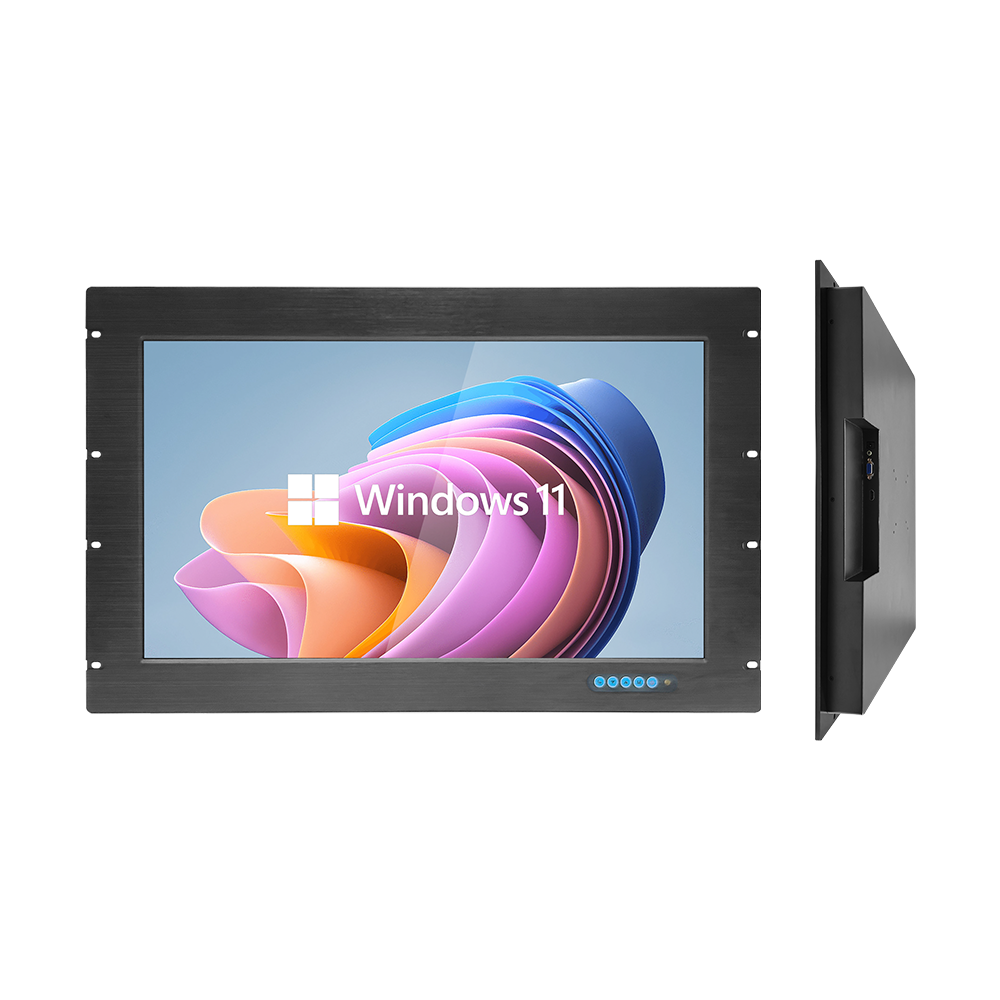
19″ 1000 Nits Rackmount Open Frame Monitor
Designed for EIA-310 19-inch server cabinets, power utility dispatch rooms, and marine bridge consoles. Features 1000 nits sunlight readability, native 5:4 SXGA resolution (1280×1024), 50,000-hour LED MTBF, and dual rackmount/open-frame mounting versatility.
2. EIA-310 7U Mechanical Mounting & Multi-Drop Video Compatibility
Integrating display hardware into industrial control cabinets requires robust mechanical versatility:
- Dual Mounting Architecture (Rackmount Flanges + Open-Frame Ears): Ships with standard EIA-310 19-inch rackmount ears for front cabinet fastening, as well as adjustable side-mounting L-brackets for recessing flush behind custom architectural consoles.
- 0% to 100% Deep Night Dimming: Marine navigation and darkened dispatch rooms require dimming backlight output below 1 nit to preserve operator scotopic night vision, adjustable via external hardware rotary potentiometers.
- Heavy Galvannealed Steel Enclosure: Resists mechanical cabinet racking forces and provides continuous 360-degree electromagnetic shielding against high-power relays and UPS battery backup systems.
Control Room Rackmount Monitor Comparison Matrix
| Diagnostic Checkpoint | Commercial Office Monitor | Engineered 19″ 1000 Nits Monitor |
|---|---|---|
| Peak Screen Luminance | 250 – 300 Nits (Dim in sunlit control rooms) | 1000 Nits daylight-viewable industrial WLED |
| Mechanical Form Factor | Plastic desktop casing (Requires custom tray) | Native EIA-310 7U rackmount + open frame |
| LED Backlight MTBF | ≈ 25,000 Hours (Consumer grade) | ≥ 50,000 Hours continuous 24/7/365 operation |
| Dimming Dynamic Range | Bottoms out at 20% (≈50 nits, blinds crew) | Smooth PWM dimming down to < 1 nit (Night safe) |
| Chassis Material | Molded ABS plastic (Prone to cracking) | Heavy zinc-coated galvannealed steel |
3. Real-World Field Case: Hydroelectric Dispatch Center
A regional hydroelectric control station in Grenoble, France operated continuous supervisory consoles inside a sunlit glass-roofed dispatch hall. Commercial 300-nit desktop screens mounted on rack trays suffered severe midday glare washouts, leading to operator eye strain and delayed valve telemetry readings. After upgrading the racks to 19″ 1000 Nits Rackmount Open Frame Monitors, the facility achieved zero glare complaints and 100% telemetry legibility across 18 consecutive months of 24/7 continuous operation.
Standardizing mission-critical dispatch centers and maritime bridge consoles on 19-inch 1000-nit rackmount open-frame monitors ensures high visual contrast and eliminates thermal overheating downtime. Contact INNODA’s control room display engineering team to request EIA-310 7U dimensional templates, optical test reports, and custom mounting flange drawings.