
Modern Computer Numerical Control (CNC) lathe skids, automated wire-EDM cells, and high-speed robotic press consoles rely on compact 12.1-inch operator terminals integrated directly into enclosure cabinet doors. Across these industrial metalworking cells, machine operators interact with 12.1-inch 4:3 displays (1024×768 XGA resolution) to supervise multi-axis toolpaths, spindle speed overrides, and real-time PLC I/O status. The classic 4:3 aspect ratio provides native pixel rendering for standard machine tool software without distorted font scaling.
However, factory floor environments subject machine console hardware to severe mechanical and chemical hazards. Ambient cutting oil aerosols, pressurized water-soluble coolant sprays, and continuous machine vibrations (from 15 Hz to 60 Hz) quickly destroy commercial-grade computers. Many legacy units utilize thin stamped sheet-metal enclosures (1.2 mm thickness) that flex when operators press virtual pushbuttons, breaking perimeter gaskets and allowing cutting coolant to penetrate internal electronics. Maintaining 24/7 reliability across modern embedded panel pc skids requires analyzing structural flexural stiffness, closed-cell gasket maintenance, and fanless passive thermal care.
1. Structural Flexural Stiffness: Solid CNC Aluminum vs. Stamped Sheet Metal
When an operator presses a touchscreen with high force (up to 30 N during rapid machine setting inputs), the front bezel resists mechanical bending deflection. Comparing the flexural stiffness (E × I) of a 5.5 mm CNC-machined 6061-T6 aluminum bezel against a standard 1.2 mm stamped sheet steel housing illustrates the mechanical advantage:
Beam Flexural Stiffness & Deflection Resistance Equation: Flexural Rigidity: S = E × I_area Where Area Moment of Inertia for Rectangular Cross-Section (Width b): I_area = (b × t^3) / 12 – Stamped Commercial Sheet Steel: Modulus E_steel ≈ 205 GPa, Thickness t_steel = 1.2 mm = 0.0012 m. – Monolithic CNC 6061-T6 Aluminum: Modulus E_al ≈ 68.9 GPa, Thickness t_al = 5.5 mm = 0.0055 m. Stiffness Ratio Calculation: S_al / S_steel = [ E_al × (t_al)^3 ] / [ E_steel × (t_steel)^3 ] S_al / S_steel = [ 68.9 × (5.5)^3 ] / [ 205 × (1.2)^3 ] = [ 68.9 × 166.375 ] / [ 205 × 1.728 ] S_al / S_steel = 11,463.24 / 354.24 ≈ 32.36. Mechanical Conclusion: The 5.5 mm solid CNC aluminum front bezel delivers 32.4 times higher flexural stiffness than standard 1.2 mm stamped sheet steel, completely preventing bezel deflection and preserving gasket compression under heavy operator touch force.
Because the CNC aluminum bezel is over 32 times stiffer than stamped steel, operator touch forces transfer into the rigid enclosure frame rather than flexing the underlying LCD glass, eliminating premature glass micro-fractures and preventing perimeter seal unseating.
To execute rapid machine retrofits with high structural durability, automation builders deploy the 12.1″ Full IP65 CNC Waterproof Panel PC, which combines a solid 6061-T6 aluminum front frame with an energy-efficient fanless architecture designed for standard cabinet apertures.
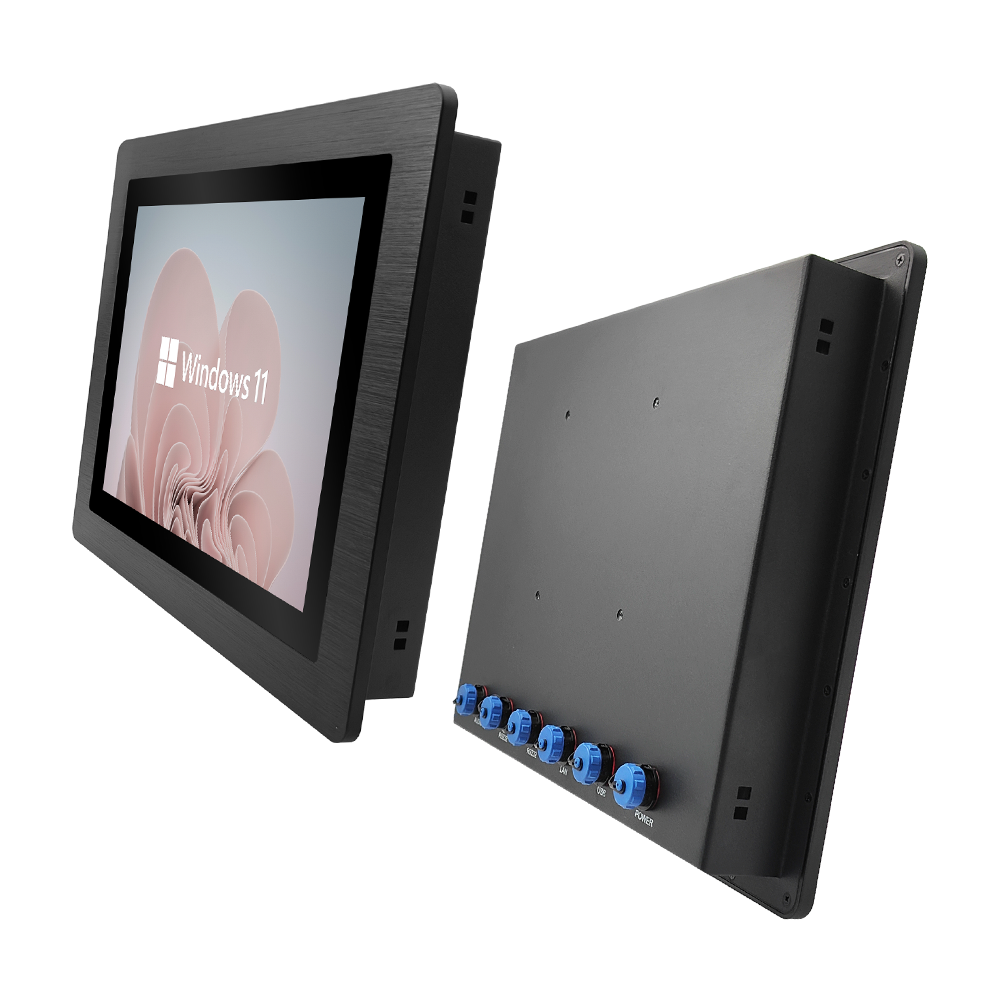
12.1″ Full IP65 CNC Waterproof Panel PC
Designed as a modern drop-in replacement for CNC machine tool consoles and automated test skids. Features a solid 6061-T6 CNC aluminum front bezel (32x higher flexural stiffness), 100% fanless passive cooling, certified IP65 cutting-fluid sealing, and classic 4:3 XGA resolution.
2. Closed-Cell Gasket Preload & Solder Joint Fatigue Prevention
Preserving long-term field reliability requires managing physical vibrations and cabinet environmental seals:
- Perimeter Gasket Elastic Recovery: The closed-cell neoprene panel-mount gasket isolates internal cabinet electronics from cutting fluids. Inspect gasket compression during annual overhauls, verifying retaining clamps maintain 1.0 Nm torque to prevent cabinet dust ingress.
- Vibration-Isolated Component Mounting: Machine tool spindle vibration (10 Hz to 55 Hz) induces mechanical fatigue across surface-mount solder joints. Solid-state chassis designs eliminate moving fans, providing high shock tolerance up to 30G (MIL-STD-810H).
- Wide DC Voltage Power Rail Conditioning: Industrial 24V DC power buses experience voltage sags when large inductive motors cycle. Onboard wide-voltage converters (DC 9V to 36V) clamp transients and filter ripple, preventing unexpected system reboots.
Machine Console Panel PC Maintenance Diagnostic Matrix
| Diagnostic Checkpoint | Inspection Procedure | Corrective Maintenance Action |
|---|---|---|
| Front IP65 Gasket | Inspect perimeter seal for cutting oil embrittlement | Re-torque panel clamps to 1.0 Nm; replace degraded seal |
| Rear Heatsink Fins | Check fin channels for accumulated shop dust and oil film | Blow clean using dry filtered compressed air (< 2 bar) |
| Processor Core Temperature | Monitor CPU junction sensor during peak machine cycles | If T_j > 80°C at 40°C ambient, refresh internal TIM |
| I/O Connector Screw Locks | Verify DB9 serial and VGA/DVI retention thumbscrews | Torque screws to 0.4 Nm to maintain continuous ground shield |
| Chassis Ground Bonding | Measure resistance between chassis ground stud and cabinet | Ensure resistance ≤ 0.1 Ω to bleed high-frequency ESD |
3. Scheduled Semi-Annual Maintenance Checklist
- External Heatsink Decontamination: Blow dry, filtered compressed air through the exterior aluminum cooling fins to remove shop dust. For oily deposits, wipe surfaces using cleanroom wipes dampened with 70% IPA.
- DC Power Rail Ripple Measurement: Measure input DC voltage ripple using an oscilloscope during machine motor startups, verifying that peak-to-peak ripple remains under 200 mV.
- Touchscreen Calibration & Surface Cleaning: Clean the front 7H tempered glass with pure isopropyl alcohol, checking that 10-point capacitive tracking responds accurately across all four display corners.
Standardizing automated machine tool consoles on 12.1-inch CNC aluminum waterproof panel PCs ensures high structural rigidity and eliminates cutting coolant downtime. Contact INNODA’s machine automation engineering team to request 3D STEP replacement templates, panel cutout drawings, and custom I/O bracket options.