
Modern high-speed automotive body stamping presses, robotic blanking lines, and heavy progressive die skids operate under severe kinetic shock and continuous harmonic excitation. As massive 2,000-ton hydraulic presses cycle at 30 to 60 strokes per minute, high-amplitude mechanical shockwaves transmit through machine columns and concrete foundations directly into operator control consoles. Press operators rely on 19.0-inch displays (5:4 aspect ratio / 1280×1024 SXGA resolution) to monitor die tonnage curves, sheet-metal lubrication flow, and real-time press stroke timing.
However, deploying standard stamped sheet-metal monitors on heavy metal stamping machinery leads to premature electronic failure. Thin sheet steel exhibits low internal material damping, allowing mechanical vibrations to amplify at natural resonant frequencies (15 Hz to 80 Hz). This structural ringing shakes internal surface-mount components loose, causes timing controller ribbon connectors to back out, and micro-fractures internal solder joints. Deploying a reliable terminal within high-vibration touch panel pc and monitor skids requires analyzing ADC12 aluminum specific damping capacity, resonance quality factors, and monolithic die-cast frame stiffness.
1. Specific Damping Capacity (SDC) & Harmonic Resonance Quality Factor (Q)
Mechanical vibration attenuation in metals is governed by Specific Damping Capacity (SDC), defined as the ratio of vibrational energy dissipated per cycle (ΔU) to the total elastic strain energy (U):
Specific Damping Capacity & Resonance Quality Factor Equation: Resonance Quality Factor: Q = (2 × π) / SDC Where: – Cold-Rolled Commercial Sheet Steel: SDC_steel ≈ 0.008 (Low internal damping). – High-Pressure Die-Cast ADC12 Aluminum Alloy: SDC_adc12 ≈ 0.045 (High eutectic silicon damping). Resonance Amplification Factor Calculation: Q_steel = (2 × 3.14159) / 0.008 ≈ 6.283 / 0.008 ≈ 785.4. Q_adc12 = (2 × 3.14159) / 0.045 ≈ 6.283 / 0.045 ≈ 139.6. Vibration Attenuation Ratio: Decay Ratio = Q_steel / Q_adc12 = 785.4 / 139.6 ≈ 5.63. Engineering Implication: When subjected to a sudden stamping press shock pulse, the monolithic ADC12 die-cast aluminum frame dampens structural ringing 5.6 times faster than standard sheet steel, dissipating destructive kinetic vibrations before they transfer to internal LCD glass and solder joints.
Because the high-silicon ADC12 alloy absorbs mechanical vibrations through internal thermoelastic dissipation, resonant amplification is cut by over 80%. This prevents harmonic vibration build-up, protecting electronic connections during continuous three-shift press operation.
To eliminate vibration-induced component dropouts in press shops, automotive tier-1 suppliers standardize on the 19″ Die-Cast Aluminum Industrial Touch Monitor, which combines a monolithic high-pressure die-cast ADC12 frame with vibration-isolated LCD cell mounting.
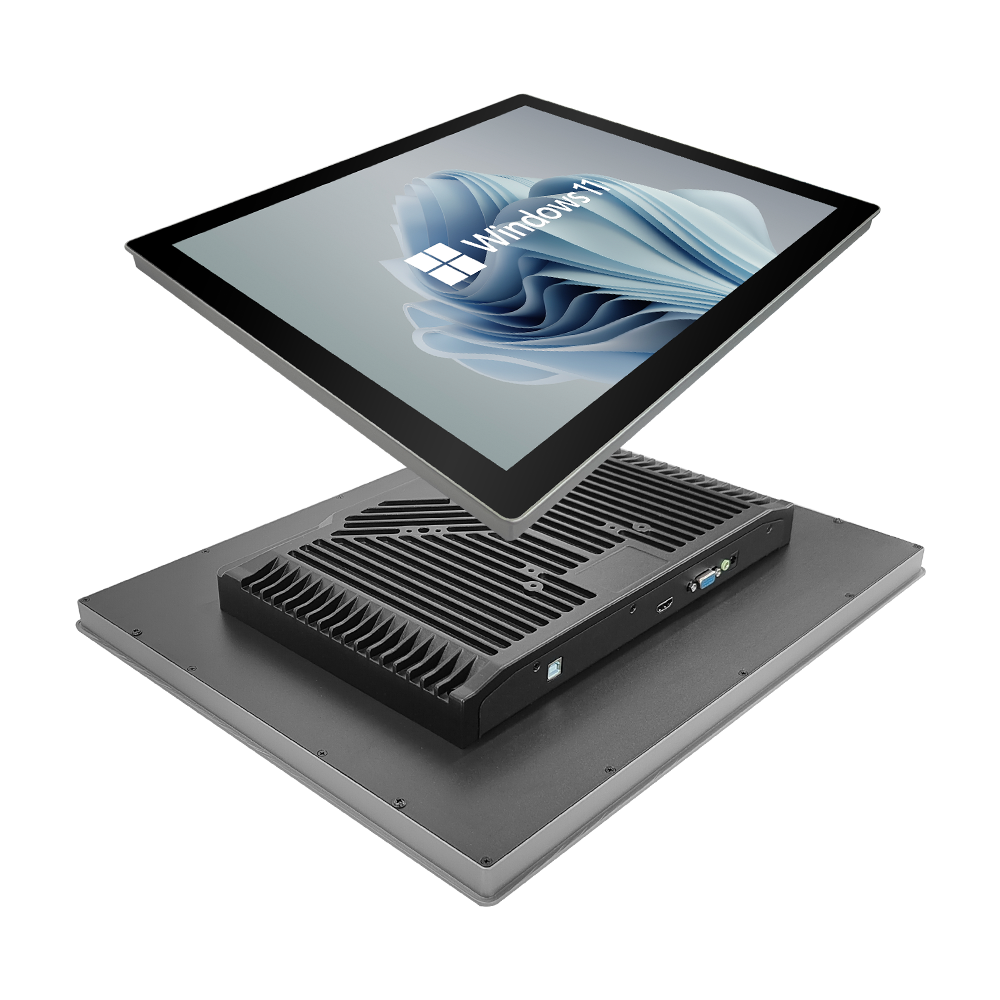
19″ Die-Cast Aluminum Industrial Touch Monitor
Built for high-vibration automotive stamping lines, heavy hydraulic presses, and industrial machining skids. Features a monolithic ADC12 die-cast aluminum frame with 5.6x faster vibration decay, native 5:4 SXGA resolution (1280×1024), IP65 front sealing, and triple video inputs.
2. Monolithic Die-Cast Rigidity & True-Flat Front Protection
Surviving heavy press shop factory environments requires comprehensive mechanical protection:
- Monolithic ADC12 High-Pressure Die-Casting: Front bezel and rear structural ribs are cast as single continuous metal forms, eliminating riveted seams that loosen under severe cyclic mechanical fatigue.
- True-Flat IP65 Front Face with 7H Chemically Hardened Glass: Protects the underlying LCD from flying metal burrs, stamping lubricant sprays, and aggressive operator cleaning with solvent wipes.
- Industrial Multi-Video Interfacing (HDMI + DVI + VGA): Accepts digital and analog video signals from central industrial PCs, fitted with locking thumbscrews to prevent cable dislodgement during continuous press cycling.
Stamped Sheet-Metal vs. Engineered 19″ Die-Cast Monitor Comparison
| Diagnostic Checkpoint | Commercial Stamped Steel Monitor | INNODA 19″ Die-Cast Touch Monitor |
|---|---|---|
| Chassis Construction | Folded sheet steel with plastic bezels | Monolithic high-pressure die-cast ADC12 aluminum |
| Vibration Damping Capacity | Low damping (Rings at 25 Hz to 60 Hz) | 5.6x Faster vibration decay (High SDC silicon matrix) |
| Front Ingress Protection | IP50 (Coolant and oil penetrate bezel) | Certified IP65 dust-tight and lubricant sealed |
| Front Surface Durability | 3H PET film (Scratched by metal chips) | 7H chemically strengthened aluminosilicate glass |
| Mounting Versatility | Weak sheet-metal VESA tabs (Crack over time) | Reinforced structural VESA 75/100 mounting bosses |
3. Real-World Field Case: Automotive Body Stamping Plant
An automotive body stamping plant in Wolfsburg, Germany experienced recurring monitor failures on its 2,500-ton transfer press line. Commercial sheet-metal monitors suffered internal PCB track fractures and ribbon disconnections every 4 to 6 months due to continuous press stroke shock pulses. Following the replacement of all operator stations with 19″ Die-Cast Aluminum Industrial Touch Monitors, the plant recorded zero display failures and zero touch jitter across 18 consecutive months of high-volume three-shift production.
Equipping high-shock metal stamping presses and automotive welding lines with 19-inch die-cast aluminum industrial touch monitors eliminates vibration-induced component failures. Contact INNODA’s automotive automation engineering team to request 3D CAD mounting drawings, vibration test reports, and customized swing-arm bracket options.