
Commercial fishing fleet operators, sportfishing boat builders, and marine electronics retrofitting yards face a major challenge when outfitting vessels of varying hull lengths: maintaining uniform optical quality, control interfaces, and environmental sealing across multiple helm stations. Whether equipping a compact 24-foot center-console bay boat with a 12.1-inch screen or outfitting a 65-foot offshore trawler bridge with dual 21.5-inch displays, standardized hardware across 12-inch, 15-inch, 18.5-inch, and 21.5-inch formats simplifies wiring, spares management, and crew training.
⚡ Engineering Executive Summary (Fleet & Helm Highlights):
- Full Size Scalability (12″ / 15″ / 18.5″ / 21.5″): Unified electrical pinouts, 1500-nit optical stacks, and mounting architectures simplify multi-vessel fleet standardization.
- 10.33:1 Tropical Sun Contrast: Solid LOCA wet optical bonding cuts internal reflection below 0.5%, ensuring crisp sonar fish arches under 100,000-lux midday sun.
- Universal Black-Box Compatibility: HDMI, DVI, VGA, and composite video inputs connect seamlessly to Furuno, Simrad, Garmin, and PC-based TimeZero sonar modules.
However, operating repeater monitors on open fishing decks exposes displays to intense tropical glare, salt-spray mist, and rough sea vibrations. Deploying a high-reliability fleet standard within modern rugged marine display installations requires combining 1500-nit luminance with full LOCA optical wet lamination and isolated wide-voltage marine power stages.
1. 1500 Nits + LOCA Wet Bonding Contrast Under 100,000 Lux Ocean Glare
Direct sunlight reflecting off open ocean swells creates extreme ambient illuminance (100,000 lux). Standard unbonded screens suffer heavy internal air-gap reflection, washing out subtle side-scan sonar bottom contours:
Ambient Contrast Ratio (ACR) Mathematical Comparison under Tropical Sun: Ambient Direct Solar Illuminance: E_amb = 100,000 lux → Solar Glare Luminance L_amb = E_amb / π ≈ 31,831 cd/m². Display Peak Luminance: L_on = 1500 cd/m²; Black State Luminance: L_off = 1.5 cd/m². Case A: Unbonded Air-Gap Screen (Fresnel Surface Reflectance R_air ≈ 4.5% = 0.045): L_reflected = 31,831 × 0.045 ≈ 1,432.4 cd/m². ACR_unbonded = (1500 + 1432.4) / (1.5 + 1432.4) = 2932.4 / 1433.9 ≈ 2.04 : 1 (Washed out, unreadable). Case B: Solid LOCA Wet Optical Bonding + Anti-Reflective Glass (R_loca ≤ 0.5% = 0.005): L_reflected = 31,831 × 0.005 ≈ 159.2 cd/m². ACR_bonded = (1500 + 159.2) / (1.5 + 159.2) = 1659.2 / 160.7 ≈ 10.33 : 1 (Crisp, sharp sonar arches). Optical Result: LOCA wet lamination boosts outdoor contrast by over 500%, eliminating internal condensation fogging and maximizing fishfinder clarity.
Because solid LOCA resin fills the entire gap between the toughened cover glass and the TFT-LCD cell, moisture cannot condense inside the screen during rapid dawn-to-noon temperature swings.
To standardize sonar and chartplotter displays across diverse hull sizes, marine electronics installers deploy the Marine Fishing Touch Monitor Sonar Chartplotter (12″ / 15″ / 18.5″ / 21.5″), which offers unified 1500-nit optical bonding across four versatile screen sizes.
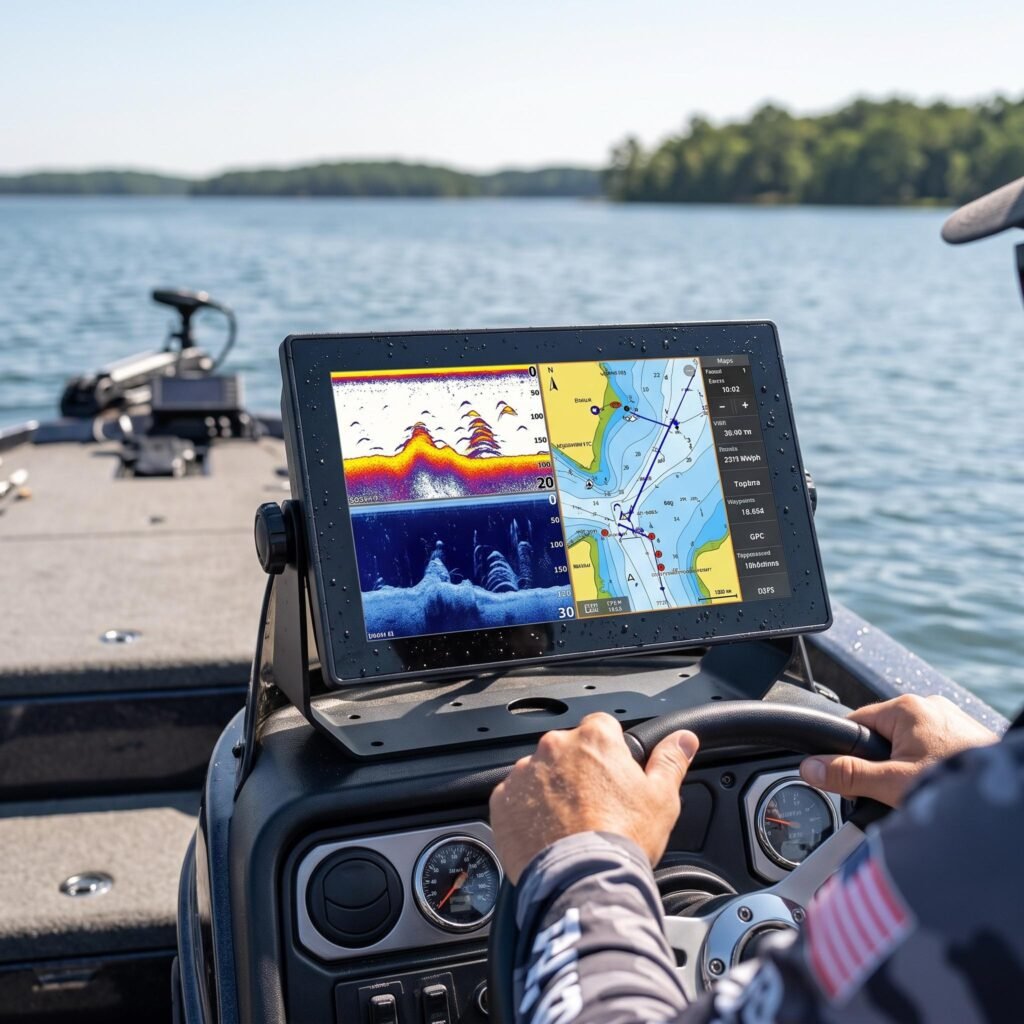
Marine Fishing Touch Monitor & Chartplotter (12″-21″)
Available in 12.1″, 15″, 18.5″, and 21.5″ formats for commercial fishing vessels and sportfishing helms. Features 1500 nits sunlight readability, full solid LOCA optical wet bonding, saline-calibrated PCAP touch, 0-100% deep night dimming, and universal video inputs.
2. Universal Black-Box Sonar Compatibility & Salt-Water Touch Control
Outfitting commercial and sportfishing helms requires flexible signal and mechanical engineering:
- Multi-Signal Video Matrix (HDMI + DVI + VGA + BNC): Interfaces simultaneously with black-box CHIRP sonar modules, marine radar processors, engine-room CCTV cameras, and navigation PCs.
- Saline-Calibrated PCAP Multi-Touch: Differential mutual-capacitance firmware rejects conductive saltwater splashes and rain droplets while tracking wet fingers or deck gloves accurately.
- 0% to 100% Deep Night Dimming: Smooth hardware PWM dimming lowers backlight output below 1 nit for night navigation, preserving captain scotopic night vision.
Multi-Size Marine Chartplotter Monitor Selection Matrix
| Display Size | Aspect & Resolution | Recommended Vessel & Helm Application |
|---|---|---|
| 12.1 Inch | 4:3 / 1024×768 XGA | Center-console bay boats, tuna towers, & cockpit repeaters |
| 15.0 / 15.6 Inch | 4:3 XGA / 16:9 FHD | Mid-size sportfishing helms & commercial gillnetter consoles |
| 18.5 Inch | 16:9 / 1920×1080 FHD | Split-screen chartplotter + CHIRP sonar offshore cruisers |
| 21.5 Inch | 16:9 / 1920×1080 FHD | Large trawler bridges, yacht main helms, & multi-radar stations |
3. Real-World Field Case: Commercial Charter Fleet in Cabo San Lucas
A marine charter operator managing 14 sportfishing boats ranging from 28 to 54 feet standardized its fleet refit program on INNODA’s 12.1-inch, 15.6-inch, and 21.5-inch marine fishing touch monitors. Previously, mixed OEM screens suffered from midday glare washouts and inconsistent mounting cutouts. Following the fleet-wide upgrade, captains reported 100% daylight sonar clarity, zero internal condensation fogging, and a 40% reduction in spare parts inventory across 18 months of continuous Pacific charter operations.
Standardizing fishing vessels and commercial workboats on 12-inch to 21.5-inch 1500-nit marine touch monitor chartplotters simplifies fleet maintenance and maximizes offshore visibility. Contact INNODA’s marine fleet engineering team to request multi-size CAD cutout templates, optical bonding test reports, and fleet volume pricing.