
Self-service kiosk OEMs, automated fare collection (AFC) turnstile manufacturers, and financial ATM integrators face a recurring cabinet packaging challenge: integrating a full-featured computing terminal into custom sheet-metal kiosks while simultaneously driving multiple serial and USB peripherals without messy external power bricks. Selecting a 15.0-inch 4:3 open frame industrial panel PC (1024×768 XGA resolution) equipped with 5x DB9 serial COM ports, dual Gigabit LAN, and an internal AC 100-240V power supply streamlines kiosk assembly and eliminates field power-adapter failures.
⚡ Commercial & Engineering Executive Summary (Buyer Takeaways):
- Built-In AC 100-240V Industrial PSU: Eliminates dangling plastic power bricks and loose DC barrel plugs, reducing input current by 16.9x (0.30 A vs. 5.0 A) for rock-solid 24/7 kiosk power.
- Single-Board Peripheral Density: Dual-sided I/O matrix provides 5x DB9 COM ports (RS-232/485), 4x USB ports (2x USB 3.0 + 2x USB 2.0), and 2x Gigabit LAN to drive printers, bill validators, and NFC readers directly.
- True-Flat Rear-Mount Open Frame: Multi-hole side mounting flanges bolt directly behind kiosk faceplates with zero front bezel protrusion.
When specifying computing cores across modern embedded panel pc kiosk architectures, eliminating external power adapters and USB-to-Serial hubs drastically cuts warranty service calls. For a broader comparison of chassis styles, see our engineering guide on snap-in clip vs. flange panel mounting enclosure selection.
1. Built-In AC 100-240V Power Architecture vs. External Plastic Power Bricks
In unattended retail kiosks, parcel lockers, and transit ticket machines, external 12V desktop power bricks frequently vibrate loose from DC barrel jacks or overheat inside unventilated lower cabinets. Integrating an industrial switching power supply directly inside the steel chassis eliminates low-voltage plug losses:
AC Direct Input vs. 12V DC External Brick Contact Heating Equation: System Full-Load Power Draw: P_load = 60.0 Watts. Case A: External 12V DC Adapter with Oxidized Barrel Plug (Contact Resistance R_plug = 0.08 Ω): – DC Input Current: I_dc = 60.0 / 12.0 = 5.00 Amperes. – Voltage Drop Across Plug: ΔV_drop = I_dc × R_plug = 5.00 × 0.08 = 0.40 Volts. – Localized Contact Joule Heating: P_heat = (I_dc)^2 × R_plug = (5.00)^2 × 0.08 = 2.00 Watts at the connector pin (Accelerates plastic housing melting & intermittent reboots). Case B: Built-In Industrial AC 100-240V Switching Power Supply (at 220V AC, PF = 0.92): – AC Input Current: I_ac = 60.0 / (220.0 × 0.92) ≈ 0.296 Amperes (16.9x lower current draw). – Secured via locking 3-pin IEC C14 AC inlet (with optional DC 12V / 9-36V terminal block backup).
Because the internal power module uses industrial 105°C-rated Japanese electrolytic capacitors and conformal-coated PCBs, the terminal operates continuously across -10°C to +60°C (with -20°C to +70°C wide-temperature options) without external power bricks.
To simplify internal kiosk wiring and drive every payment and ticketing peripheral natively, kiosk OEMs deploy the 15″ Open Frame Industrial Panel PC (5x COM, Dual LAN, Built-In AC), which combines a true-flat 10-point PCAP touchscreen with dual-sided industrial I/O.
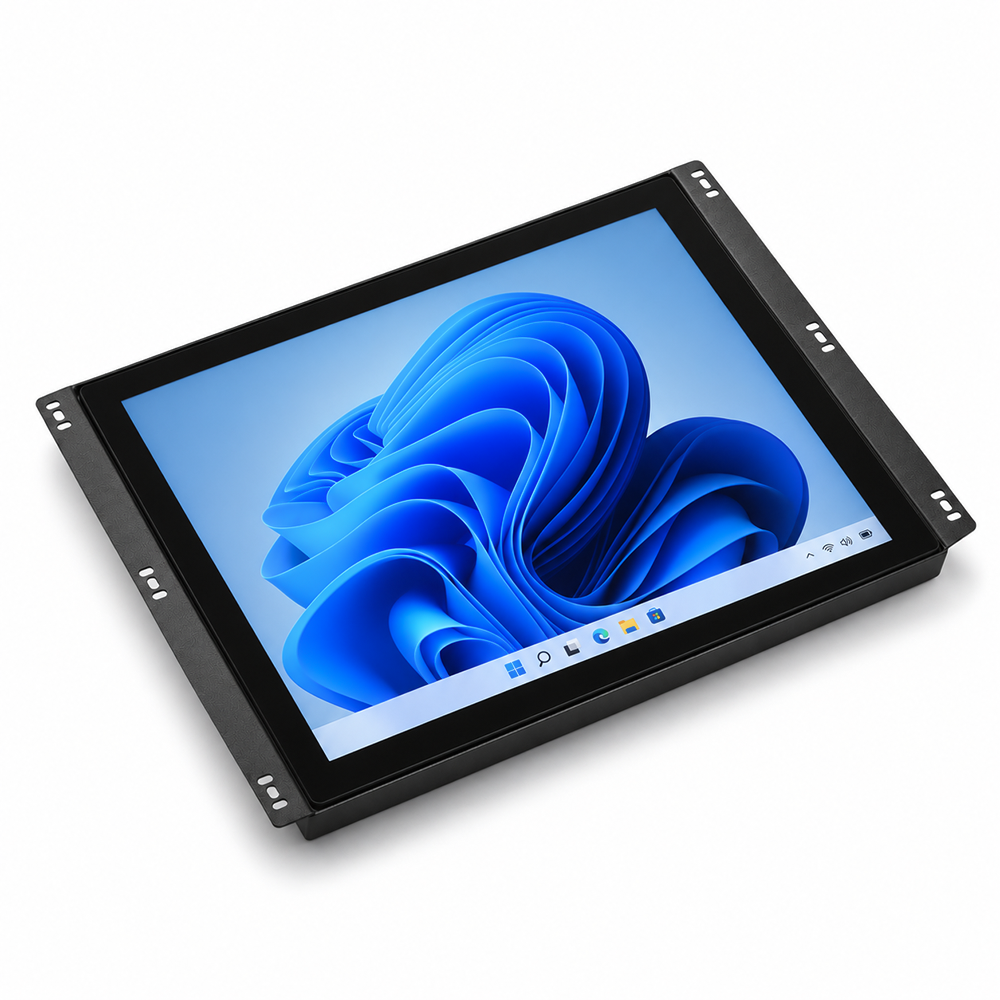
15″ Open Frame Industrial Panel PC (5x COM, Built-In AC)
Purpose-built for self-service kiosks, AFC ticketing gates, and industrial cabinets. Features a 15″ 4:3 XGA true-flat display, 5x DB9 serial COM ports, 4x USB, dual Gigabit LAN, built-in AC 100-240V industrial PSU, and slotted side mounting flanges.
Standard Consumer Monitor/PC vs. INNODA 15″ Open Frame Kiosk Panel PC
| Kiosk Integration Factor | Standard Panel PC + External Brick | INNODA 15″ Open Frame Kiosk PC |
|---|---|---|
| Power Supply Design | Dangling external 12V brick (Unplugs/overheats) | Built-in AC 100-240V PSU + DC 12V/9-36V option |
| Serial & USB Peripheral I/O | 1-2 COM ports (Requires unstable USB hubs) | 5x DB9 COM (RS232/485) + 4x USB + 2x GbE |
| Cabinet Mounting Style | Thick front bezel protrudes from kiosk door | True-flat Open Frame with multi-hole side ears |
| Touchscreen Options | Single touch technology only | 7H 10-point PCAP or 5-wire resistive selectable |
| Chassis Construction | Lightweight plastic or thin sheet casing | Powder-coated cold-rolled steel + VESA 75/100 |
2. Frequently Asked Questions (Engineering & Procurement FAQ)
Q1: Can the 5x DB9 serial ports simultaneously drive a thermal receipt printer, bill acceptor, QR scanner, and turnstile gate controller?
Yes. All five DB9 serial ports connect directly to onboard hardware UART controllers supporting RS-232 and RS-485 protocols, allowing deterministic simultaneous polling of payment validators, printers, and gate relays without USB driver conflicts.
Q2: How does the open-frame chassis mount inside custom sheet-metal kiosks?
The cold-rolled steel enclosure features slotted mounting flanges along both left and right sides, allowing OEMs to bolt the unit directly onto rear weld studs behind the kiosk glass cutout. Standard VESA 75×75 and 100×100 threaded holes are also included on the rear cover.
Q3: Can we customize the side mounting bracket hole pitch to match our existing kiosk cutout?
Yes. INNODA offers rapid OEM sheet-metal customization for side flange dimensions, mounting hole pitch, and custom front cover glass silk-screen logos with low minimum order quantities.
Standardizing self-service kiosks, AFC transit gates, and industrial control cabinets on 15-inch open frame industrial panel PCs with 5x COM ports and built-in AC power cuts assembly labor and eliminates external adapter failures. Contact INNODA’s Kiosk OEM engineering team to request 3D STEP packaging files, flange cutout drawings, and custom OS pre-loading.