
Modern commercial meat processing plants, refrigerated dairy bottling halls, and chemical CIP washdown skids rely on 15.6-inch widescreen stainless steel panel PCs (16:9 Full HD 1920×1080 resolution) equipped with all-metal industrial I/O connectors. Operating directly on the plant floor, these sealed computing terminals endure daily sanitation regimens where 80°C hot water and caustic foam lances blast equipment immediately before chilled room air (15°C to 20°C) cools the housing rapidly.
⚡ Engineering Executive Summary (Preventative Maintenance Protocol):
- Thermal Shock Vacuum Defense: Cooling rapidly from 80°C CIP steam to 20°C room air generates a 17.22 kPa internal vacuum; keeping the rear ePTFE breather valve unobstructed prevents moisture suction.
- All-Metal M12 Torque Standard: Calibrating stainless M12 aviation connector nuts to 0.6 Nm preserves Viton O-ring compression without crushing internal pin insulators.
- Passivation Film Longevity: Semi-annual 10% citric acid wipe-downs restore the chromium oxide barrier against brine and chlorine pitting.
Without disciplined preventative maintenance, thermal shock vacuum cycles and mechanical connector loosening compromise even the strongest enclosures. Maintaining 24/7 reliability across modern waterproof panel pcs installations requires understanding ideal-gas thermal vacuum dynamics, ePTFE breather valve care, and calibrated M12 connector torque protocols.
1. CIP Thermal Shock Vacuum Suction & ePTFE Breather Valve Physics
When a sealed 15.6-inch stainless enclosure heats up to 80°C during hot water sanitation and subsequently cools down to 20°C in a refrigerated processing hall, the trapped internal air contracts according to Gay-Lussac’s Ideal Gas Law:
Thermal Shock Vacuum Differential Equation: ΔP_vacuum = P_ambient × [ 1 – (T_cold / T_hot) ] Where: – Standard Atmospheric Pressure: P_ambient = 101.325 kPa. – Hot CIP Washdown Enclosure Temperature: T_hot = 80.0°C = 353.15 K. – Chilled Processing Hall Temperature: T_cold = 20.0°C = 293.15 K. Resulting Internal Vacuum Differential (if unvented): ΔP_vacuum = 101.325 × [ 1 – (293.15 / 353.15) ] = 101.325 × (1 – 0.8301) ≈ 17.22 kPa (~2.50 PSI inward suction). Moisture Ingress Risk: A 17.22 kPa vacuum pulls residual rinse water droplets past aged cable glands directly onto internal power converters. Hydrophobic ePTFE Breather Valve Solution: The rear-mounted metallic breather valve incorporates a 0.2 μm micro-porous ePTFE membrane (airflow ≥ 16 ml/min/cm² at 7 kPa), equalizing pressure immediately while blocking liquid water droplets (> 100 μm).
Keeping the rear breather membrane clean of dried soap film and food grease ensures continuous barometric pressure equalization, completely neutralizing vacuum-induced water suction across perimeter gaskets.
To ensure long-term washdown durability across harsh processing lines, maintenance managers deploy the 15.6″ Full IP67 Stainless Steel Panel PC (Metal I/O), which integrates a rear hydrophobic breather valve alongside all-metal thread-locking M12 circular ports.
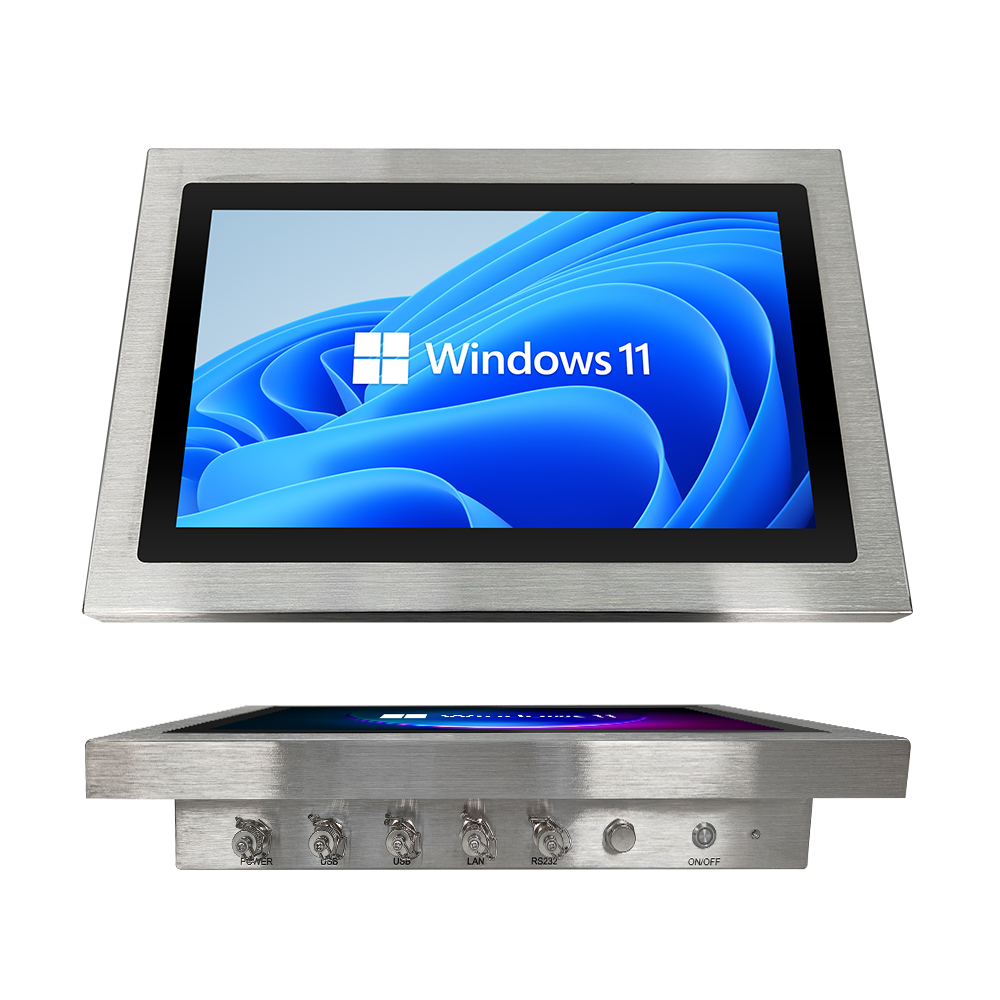
15.6″ Full IP67 Stainless Steel Panel PC (Metal I/O)
Built for meat processing plants, dairy bottling halls, and severe CIP washdown environments. Features a 15.6″ Full HD display, electropolished SUS304/316L housing (Ra ≤ 0.4 µm), full IP67 immersion sealing, rear ePTFE breather valve, and all-metal M12 aviation connectors.
2. All-Metal M12 Connector Torque & Viton O-Ring Preservation
Preserving full IP67 immersion integrity across all-metal M12 circular ports requires strict mechanical maintenance:
- Calibrated 0.6 Nm M12 Coupling Torque: Under-tightening M12 connector collars leaves gaps for high-pressure spray penetration, while over-tightening with pliers crushes internal Viton O-rings. Always use a calibrated 0.6 Nm open-end torque wrench.
- Food-Grade Silicone O-Ring Lubrication: Apply a thin film of NSF H1 food-grade silicone grease to internal M12 receptacle O-rings every 6 months to prevent elastomeric dry-rotting and ease thread engagement.
- 10% Citric Acid Surface Passivation: Exogenous iron particles from plant tools can settle on stainless housings and cause superficial “tea-staining.” Wiping exterior surfaces semi-annually with 10% citric acid dissolves free iron and regenerates the passive chromium oxide film.
15.6″ Stainless Panel PC Preventative Maintenance Matrix
| Maintenance Checkpoint | Inspection Procedure | Corrective Action & Standard |
|---|---|---|
| Rear ePTFE Breather Valve | Check membrane vent for dried fat or soap film | Rinse gently with warm deionized water (< 1 bar) |
| All-Metal M12 Aviation Ports | Inspect Viton O-rings and check collar tightness | Lubricate with NSF H1 silicone; torque to 0.6 Nm |
| Perimeter Dovetail Seal | Measure O-ring compression set during annual overhaul | Replace fluorosilicone O-ring if compression set > 30% |
| SUS304/316L Exterior Skin | Inspect for chloride tea-staining or weld discoloration | Apply 10% citric acid passivation wipe; rinse clean |
| Chassis Star Grounding | Measure resistance to facility ground bus | Confirm resistance ≤ 0.1 Ω to bleed washdown static |
3. Scheduled Semi-Annual Preventative Maintenance Checklist
- Breather Vent Clearing: Inspect the rear pressure-equalization breather valve every 90 days, flushing away accumulated detergent residue with low-pressure warm water to preserve unrestricted airflow.
- M12 Pin & Shield Inspection: Uncouple external M12 Ethernet and power cables semi-annually to verify gold-plated pins remain bright and free of moisture oxidation before re-torquing to 0.6 Nm.
- Front 7H Glass Decontamination: Clean the front projected capacitive glass using cleanroom microfiber wipes dampened with 70% IPA, verifying multi-touch tracking responsiveness across all four screen corners.
Implementing a structured preventative maintenance protocol for 15.6-inch full IP67 stainless steel panel PCs prevents vacuum moisture ingress and maximizes multi-year uptime across harsh washdown facilities. Contact INNODA’s field maintenance engineering team to request replacement O-ring service kits, M12 torque tools, and chemical passivation guides.