
As commercial residential communities, corporate research laboratories, and automated manufacturing gates adopt facial recognition for contactless access, security engineers face an evolving threat landscape: Biometric Presentation Attacks (Spoofing). Malicious actors utilize printed high-resolution color photographs, smartphone screen video playbacks, and 3D silicone masks to bypass entry checkpoints.
Deploying single-lens 2D RGB consumer webcams leaves entry gates completely vulnerable to presentation spoofing. Securing high-traffic public access portals requires deploying advanced anti-spoofing optics: comparing Binocular Dual-Lens WDR Systems with Infrared (IR) Liveness Detection against 3D Structured Light Sensors.
Biometric Anti-Spoofing Optical Architecture Comparison
| Optical Parameter | Standard Single 2D RGB Camera | Binocular Dual-Lens (RGB + IR) WDR | 3D Structured Light Depth Sensor |
| Depth Perception Method | None (Flat 2D image analysis only) | Optical disparity between dual lenses | Infrared dot matrix projection pattern |
| Photo & Video Screen Rejection | Extremely vulnerable to photo replays | 100% rejection via active IR reflection | 100% rejection via sub-millimeter 3D mesh |
| Direct Sunlight Immunity | Fails; lens washes out in bright backlighting | Superior (>120 dB Wide Dynamic Range) | Poor; strong outdoor solar IR blinds pattern |
| Target Recognition Range | 0.5 m to 1.0 m | 0.5 m to 2.5 m (Broad recognition cone) | Strictly restricted (0.3 m to 1.0 m) |
| Optimal Operating Zone | Low-security indoor office doors only | Outdoor estate gates, speed turnstiles, kiosks | Indoor banking teller kiosks, mobile phones |
How Binocular Dual-Lens (RGB + IR) Detects Real Human Liveness
Outdoor access kiosks encounter blinding midday sun and shifting shadows that wash out generic image sensors:
- RGB Visual Verification: The primary optical sensor captures high-definition color textures to recognize facial landmarks (interpupillary distance, jawline geometry, and nose bridge contours).
- Near-Infrared (NIR) Reflectance Analysis: Concurrently, a secondary infrared sensor with matched 850 nm / 940 nm IR LEDs pulses invisible light onto the subject. Living human skin exhibits a unique, known infrared absorption and reflectance curve. In contrast, paper printouts, tablet screens, and silicone masks reflect infrared light with completely different signatures, flagging spoof attempts instantly.
- Parallax Depth Triangulation: By analyzing the physical disparity between the two offset lenses, the algorithm constructs an instant depth map, verifying that the visitor possesses natural 3D facial curvature rather than a flat surface.
- Integrating this dual-lens optical architecture into heavy-duty kiosks—such as the 7″ to 15.6″ CNC Aluminum Smart Video Intercom System—ensures sub-second authentication while preventing photo spoofing across exterior gates.
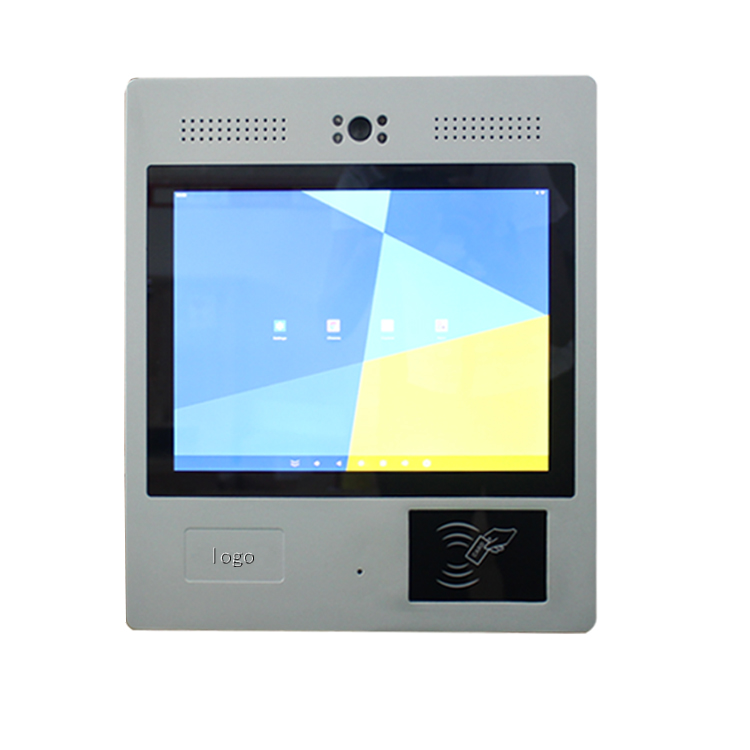
7″ to 15.6″ CNC Aluminum Smart Video Intercom System
Equipped with binocular dual-lens WDR facial recognition, IR liveness anti-spoofing, dual-frequency RFID/NFC, IK09 vandal-proof CNC unibody, and open SIP 2.0 architecture.
Why 3D Structured Light Struggles Outdoors
While 3D structured light sensors deliver exceptional depth accuracy on consumer smartphones, they struggle in outdoor commercial deployments:
- Structured light systems project thousands of microscopic infrared dots onto the face. Under direct outdoor sunlight, ambient solar infrared radiation completely overwhelms the projected dot matrix, causing false rejections.
- Binocular WDR sensors with hardware-level True WDR (>120 dB) balance extreme backlighting, allowing visitors standing in direct sunlight to be identified without visual silhouette clipping.
- For indoor security checkpoints where physical contact authentication is preferred, hardware like the 10.1″ Biometric Fingerprint Industrial Panel PC combines multi-spectral fingerprint scanning with recessed I/O cable routing to prevent physical wiring tampering.
Engineering Recommendations for Access Specifiers
- Specify Binocular RGB + IR Liveness Optics for all outdoor perimeter gates, parking bollards, and unshaded commercial turnstiles.
- Ensure the camera module supports Hardware True WDR (≥ 120 dB) to prevent morning and afternoon solar washout.
- Verify that the processing core executes liveness verification locally at the edge (sub-500 ms) rather than relying on high-latency cloud servers.
Need biometric SDK integration libraries, camera optical test curves, or custom facial recognition firmware? Contact INNODA’s security hardware engineering team for technical specifications and evaluation samples.