
Deploying large widescreen 17.3-inch human-machine interfaces (HMIs) inside outdoor control stations, maritime deck monitoring kiosks, or mining vehicle cabs requires complete hermetic protection against dust, water submersion, and salt spray. However, sealing an enclosure to Full IP67 (IEC 60529) standards creates an airtight thermal chamber with zero convective air exchange.
When selecting embedded processing platforms such as the Intel Elkhart Lake Celeron J6412 (10W TDP quad-core architecture), thermal engineers must ensure that conductive paths pull heat efficiently away from the silicon die. Understanding the difference between monolithic CNC-machined aluminum billets and stamped sheet metal housings is essential to prevent thermal throttling under high ambient temperatures.
1. Conduction Heat Transfer & The Thermal Resistance Network
In a sealed fanless computing chassis, thermal energy generated by processor cores conducts through a series of thermal interfaces before dissipating into ambient air:
Theta_JA = Theta_JC + Theta_TIM + Theta_Chassis + Theta_Radiation/Convection
Where $\Theta_{JA}$ represents total junction-to-ambient thermal resistance (°C/W). Stamped sheet metal enclosures rely on thin wall gauges (1.2mm to 1.5mm) and mechanical screw seams, introducing multiple contact interfaces with high thermal contact resistance ($\Theta_{interface} > 0.8\text{ °C/W}$). Under continuous CPU load at 50°C ambient, heat pools around the processor core, triggering CPU clock throttling down to base frequencies.
In contrast, deploying a monolithic architecture such as the 17.3″ Full IP67 CNC Aluminum Industrial Panel PC (J6412) provides a direct thermal bridge. Machined from a solid block of 6063 aerospace-grade aluminum, the unibody housing acts as an integrated heatsink with high material thermal conductivity (k ≈ 200 W/m·K). Heat conducts rapidly across the entire exterior chassis, keeping silicon junction temperatures well below the 105°C $T_{j,max}$ limit even under sustained 100% computational load.
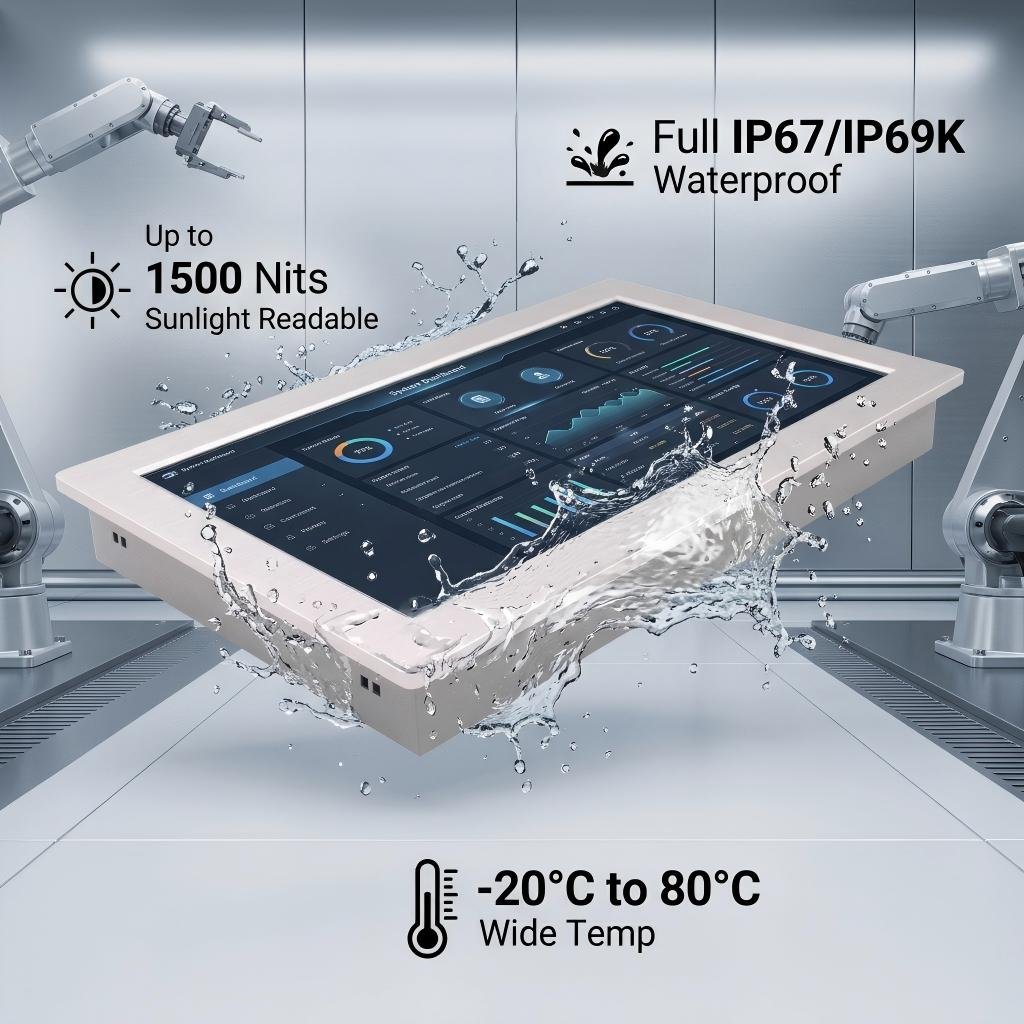
17.3″ Full IP67 CNC Aluminum Industrial Panel PC (J6412)
Engineered for severe outdoor monitoring and washdown machinery. Built with a solid CNC-machined aluminum billet enclosure, Intel Celeron J6412 processor, fanless passive thermal architecture, and 360-degree IP67 sealed M12 connectors.
2. Structural Integrity & Gasket Planarity Across Large Spans
A 17.3-inch widescreen format spans over 420mm in width. Under direct solar heating, differential thermal expansion between front glass and metal housings can bow thin sheet-metal bezels. Solid CNC billet housings provide superior structural rigidity (moment of inertia), maintaining uniform linear compression along perimeter fluorosilicone seals and preventing seal gap openings during extreme temperature swings (-20°C to 60°C).
Thermal & Structural Material Matrix
| Parameter | Stamped Sheet Metal Housing | Solid CNC Billet Aluminum Unibody |
|---|---|---|
| Material Conductivity (k) | 45 – 50 W/m·K (Cold-rolled carbon steel) | 190 – 210 W/m·K (Aerospace Aluminum 6063) |
| Internal Contact Resistance | High; multi-piece bolted joints | Minimal; integral machined heat block |
| Bezel Deflection Resistance | Prone to bowing across 17″+ spans | Rigid billet flange maintains gasket planarity |
| Ingress Lifespan | Degrades under thermal deformation | Continuous IP67 sealed submersion barrier |
Looking to integrate a widescreen, fanless IP67 computing console for high-ambient industrial machinery? Contact INNODA’s thermal and mechanical engineering team for FloTHERM computational thermal simulation reports and structural CAD models.