
Modern industrial automation systems increasingly demand convergence between Operational Technology (OT) on the factory floor and enterprise Information Technology (IT) networks. Human-machine interfaces installed on CNC machining cells, automated packaging machines, and SCADA supervisory stations must execute deterministic motion and sensor telemetry while concurrently logging production batch records to cloud-based Manufacturing Execution Systems (MES).
However, connecting an industrial PC directly to an unfiltered enterprise corporate network introduces severe cyber vulnerability risks and network broadcast storm hazards. In multi-axis manufacturing environments, broadcast storms saturate Ethernet buffers, causing microsecond latency spikes that drop PLC motion synchronization. Safeguarding continuous plant productivity requires physical network segregation combined with rigorous thermal maintenance.
1. Physical Dual-Subnet Segregation: OT vs. IT Network Architecture
Deploying an industrial panel PC with dual independent hardware Gigabit Ethernet controllers (e.g., dual Intel I210/I211 GbE PHY chips on dedicated PCIe lanes) allows system architects to maintain total physical isolation between mission-critical control loops and corporate office domains:
Network Subnet Isolation Topology: – LAN 1 (Dedicated Machine OT Bus): Subnet 192.168.10.X → Connects directly to PLC, remote I/O blocks, and servo drives via unrouted static IP. Zero Internet access. – LAN 2 (Plant Enterprise IT Bus): Subnet 10.20.0.X → Connects to corporate MES/ERP databases via hardware firewall with dynamic DHCP / TLS encryption. Hardware Firewalling Rule: Kernel-level IP forwarding disabled in Windows/Linux OS: net.ipv4.ip_forward = 0 → Completely prevents cross-subnet malware or broadcast traffic bridging.
Single-port computers bridged via consumer network switches expose factory PLCs to corporate ransomware vectors and broadcast packet storms. A broadcast burst exceeding 5,000 packets/second consumes processor interrupt cycles, causing real-time machine vision drops and SCADA communication timeouts.
To establish bulletproof network segregation on the factory floor, system integrators standardize on the 15″ Industrial Panel PC Intel Core i5-6200U (Dual LAN) , which features two physically isolated Intel Gigabit LAN controllers supported by hardware-level surge isolation.
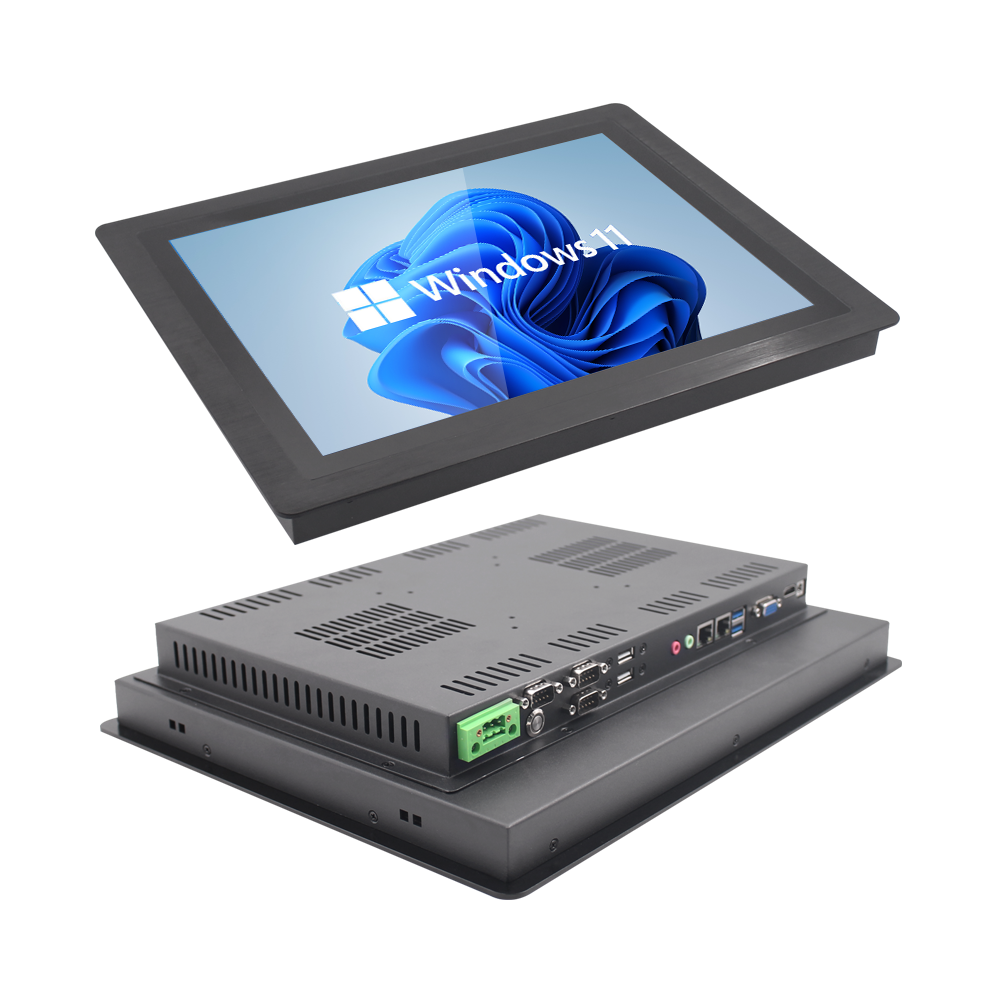
15″ Industrial Panel PC Intel Core i5 (Dual LAN)
Engineered for factory automation, CNC cell control, and SCADA gateways. Features a high-performance Intel Core i5 processor, dual independent Intel Gigabit LAN ports for OT/IT subnet isolation, robust fanless thermal cooling, and an IP65 aluminum front bezel.
2. Arrhenius Thermal Aging & Heatsink Maintenance Physics
Operating a fanless panel PC with an Intel Core i5 processor (15W TDP) inside a sealed NEMA 4/12 electrical cabinet requires managing passive heat conduction pathways. The operating lifetime (MTBF) of internal electrolytic capacitors and semiconductor gate oxide layers degrades exponentially as operating junction temperatures rise:
Arrhenius Component Aging Acceleration Factor: AF = exp [ (E_a / k_B) × ( (1 / T_operational) – (1 / T_baseline) ) ] Where: – Activation Energy E_a ≈ 0.7 eV (typical silicon semiconductor failure mechanism). – Boltzmann Constant k_B = 8.617 × 10^-5 eV/K. Resulting Component Impact: For every 10°C increase in internal operating temperature above 55°C, the failure rate doubles, cutting power supply capacitor lifespan by 50%.
In dirty factory environments, airborne oil mists and conductive metallic dust accumulate across the rear aluminum heatsink fins. A 1.5 mm layer of oil-dust sludge acts as an insulative thermal blanket, cutting heat sink convective efficiency by up to 40% and pushing core temperatures into thermal throttling ranges.
Commercial PC vs. Dual-LAN Industrial Panel PC Comparison
| Engineering Parameter | Standard Commercial Panel PC | Engineered 15″ i5 Dual-LAN Panel PC |
|---|---|---|
| Network Architecture | Single Realtek LAN port (Shared OT/IT traffic) | Dual independent Intel Gigabit LAN controllers |
| Chassis Construction | Thin stamped sheet metal with internal fan | CNC aluminum front bezel + finned passive heatsink |
| Operating Temperature | 0°C to +40°C (Thermal throttles in closed cabinets) | -20°C to +60°C wide continuous operation |
| Thermal Dissipation Type | Active fan (Clogs with oil and dust within months) | 100% Fanless solid copper conduction cooling |
| Legacy Serial Support | Zero or virtual USB-COM ports (Unstable drivers) | Multiple native hardware COM ports (RS232/RS485) |
3. Preventative Maintenance Checklist for 15″ Industrial HMIs
- Thermal Fin Degreasing: Every 6 months, clean accumulated oil sludge and carbon dust from the rear aluminum heatsink fins using an industrial residue-free solvent wipe or low-pressure dry air (< 2 bar).
- Thermal Interface Compound Refresh: During planned 5-year overhaul intervals, replace the internal phase-change thermal interface material (TIM) between the CPU spreader plate and the chassis to maintain low thermal contact resistance.
- Front Bezel Gasket Compression Check: Verify panel mount clamping screws maintain 0.8 Nm to 1.0 Nm torque to prevent cabinet vibration from loosening the front IP65 liquid seal.
Standardizing factory production cells on dual-LAN fanless industrial panel PCs provides robust OT/IT cyber segregation and minimizes thermal maintenance downtime. Contact INNODA’s industrial network support team for custom BIOS settings, panel cutout dimensions, and SCADA driver configurations.