Heavy bulk materials handling facilities, open-pit aggregate mines, and commercial truck weighbridges operate around the clock in extreme outdoor conditions. Truck driver self-service kiosks and axle-scale terminals must provide clear visual guidance, gross weight verification, and digital signature capture directly under direct mid-day sunlight. In outdoor desert quarries and high-altitude mining sites, solar illuminance frequently exceeds 90,000 to 110,000 lux.
Under these intense lighting conditions, commercial 300-nit to 400-nit screens appear as dark, reflective mirrors. Drivers cannot read gross tonnage numbers without leaving their truck cabs, creating logistics bottlenecks. Furthermore, unconditioned outdoor kiosks experience rapid internal temperature rises, driving unbonded LCD panels into solar blackouts.
1. Direct Sunlight Ambient Contrast Ratio (ACR) Mathematical Modeling
Maintaining clear legibility under intense outdoor sunlight requires analyzing perceived Ambient Contrast Ratio (ACR). ACR measures the ratio between active screen light emission and reflected ambient glare striking the operator’s eye:
Ambient Contrast Ratio (ACR) Equation: ACR = (L_on + L_ambient_reflected) / (L_off + L_ambient_reflected) Where: – Ambient Reflected Luminance: L_ambient_reflected = (E_ambient / π) × R_total. – Under Peak Solar Illuminance: E_ambient = 100,000 lux → E_ambient / π ≈ 31,830 cd/m². Comparison: Case A (Standard 350-nit panel, unbonded air-gap with R_total ≈ 4.5%): L_reflected = 31,830 × 0.045 ≈ 1,432 cd/m². ACR = (350 + 1,432) / (0.35 + 1,432) = 1,782 / 1,432.35 ≈ 1.24 : 1 (Completely unreadable, whiteout). Case B (Engineered 1500-nit panel, LOCA optical bonding + AR coating with R_total ≤ 0.5%): L_reflected = 31,830 × 0.005 ≈ 159.15 cd/m². ACR = (1500 + 159.15) / (1.5 + 159.15) = 1,659.15 / 160.65 ≈ 10.33 : 1 (Crisp, high-contrast readability).
Human factor engineering standards require an ACR of at least 5:1 for quick alphanumeric legibility without squinting. As proven by the mathematical model, achieving this threshold under 100,000 lux illumination requires combining 1500-nit LED backlighting with full optical wet bonding.
To ensure continuous logistics throughput at automated weighbridges, infrastructure operators deploy the 15″ 1500 Nits High Brightness Touch Industrial Monitor, which pairs high-efficiency constant-current LED arrays with refractive index-matched optical bonding.
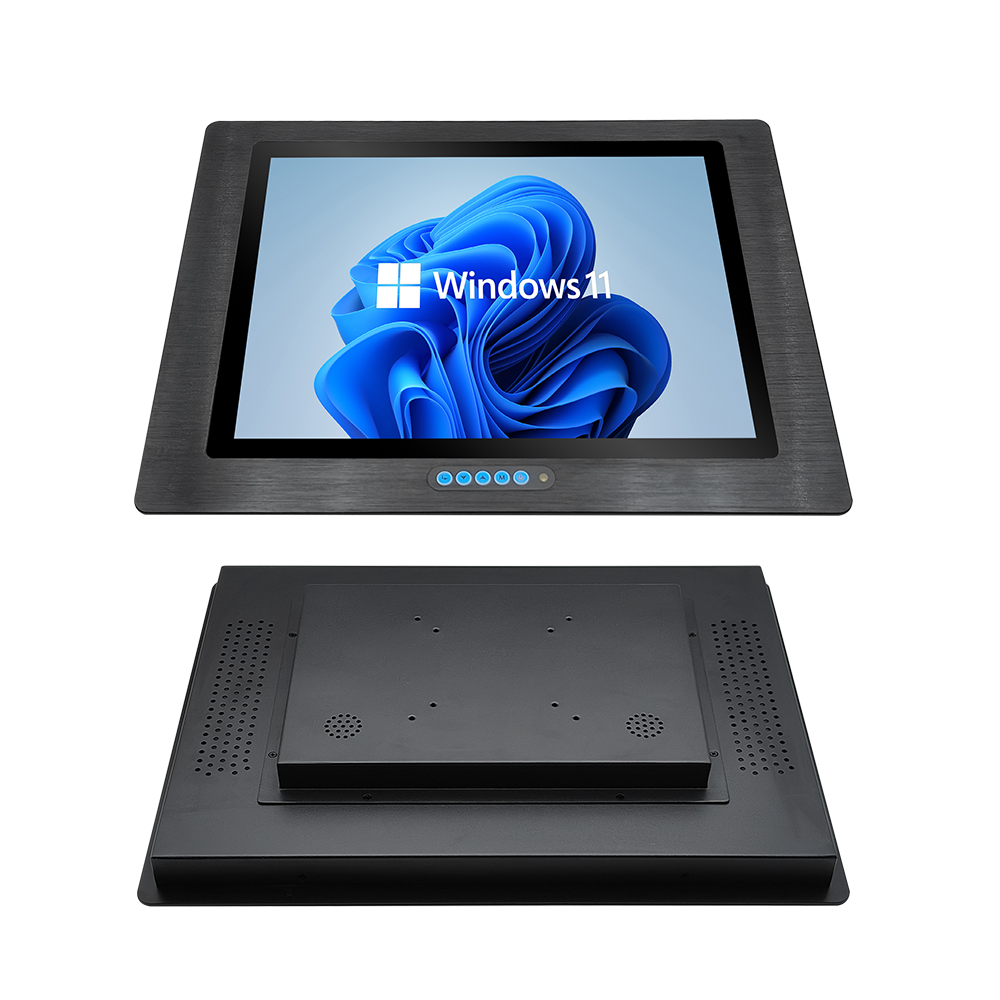
15″ 1500 Nits High Brightness Touch Industrial Monitor
Built for outdoor mining weighbridges, self-service fuel kiosks, and roadside toll plazas. Features 1500 nits sunlight readability, full LOCA optical wet bonding, 105°C anti-solar blackening liquid crystal fluid, and an IP65 waterproof aluminum front bezel.
2. Thermal Headroom & Solar Clearing Point Prevention
Generating 1500 nits of continuous luminous flux requires driving high-density LED strips with approximately 25W to 35W of electrical power. In outdoor kiosks exposed to ambient summer temperatures of 40°C, solar thermal loading adds substantial radiant heat:
- High Clearing-Point Liquid Crystals (T_ni ≥ 105°C): Standard consumer liquid crystal fluid undergoes a phase transition from nematic to isotropic state around 70°C to 75°C, causing sudden, dark blotches across the display. Industrial-grade panels utilize wide-temperature LC fluids that remain stable up to 105°C, preventing solar blackening.
- Conductive Aluminum Backchassis Heat Spreader: The LED backlight rail is mechanically coupled directly to the heavy-gauge aluminum rear casing via high-conductivity thermal interface pads (k ≥ 3.0 W/(m·K)), conducting heat outward into cabinet convection paths.
- Photodiode Automatic Ambient Dimming: An integrated front-bezel light sensor automatically scales backlight output from 1500 nits down to 50 nits at night, preventing driver glare and doubling LED operational lifespan.
Outdoor Weighbridge Display Specification Comparison
| Technical Parameter | Standard Commercial Monitor | Engineered 15″ 1500 Nits Monitor |
|---|---|---|
| Backlight Luminance | 300 – 400 cd/m² (Fades in direct sun) | 1500 cd/m² daylight-viewable WLED matrix |
| Optical Bonding | Air gap (Fogging and 4.5% glare reflection) | Full wet optical bonding (LOCA resin, ≤0.5% glare) |
| Solar Blackening Resistance | Blacks out above 70°C (T_ni ≈ 75°C) | High-temperature LC fluid (T_ni > 105°C) |
| Front Enclosure Ingress | IP40 / IP50 (Dust penetrates LCD layers) | IP65 dust-tight and water-jet sealed front bezel |
| LED Backlight MTBF | 30,000 Hours (Thermal degradation) | > 50,000 Hours with constant-current control |
3. Real-World Field Case: Australian Iron Ore Weighbridge
An automated iron ore haulage facility in Western Australia experienced chronic scale delays because truck drivers could not read check-in screens during peak daylight hours. Previous 450-nit screens routinely overheated and developed black blotches when ambient temperatures hit 42°C. Following the installation of 15″ 1500 Nits High Brightness Industrial Monitors with optical bonding, the facility achieved 100% check-in legibility and eliminated solar overheating failures across an entire summer season, improving daily truck throughput by 14%.
Upgrading outdoor weighbridge terminals with optically bonded 1500-nit touch displays guarantees sunlight legibility and eliminates thermal downtime. Contact INNODA’s outdoor display engineering team to request optical performance curves, dimensional drawings, and custom kiosk bezel integration support.