
Container handling port cranes, open-pit mining excavators, and heavy construction equipment rely on real-time operator vision systems to manage blind spots and ensure safe rigging operations. Operator cabs installed on rotating gantry superstructures require large, daylight-readable video displays. An 18.5-inch widescreen (16:9 / 1366×768 or 1920×1080) format provides expansive visualization for multi-camera feeds, allowing operators to view blind-spot camera angles simultaneously.
Unlike standard Ethernet IP surveillance systems that introduce latency (typically 150 ms to 300 ms compression delay), Analog High Definition (AHD/TVI/CVI) technology transmits uncompressed 1080p video over coaxial lines with zero frame buffering delay. However, routing analog high-frequency video signals across 50 to 100 meters of flexible festoon cables on heavy machinery introduces severe coaxial attenuation and ground potential interference.
1. Coaxial Skin Effect & High-Frequency Amplitude Attenuation
AHD 1080p video signals modulate high-frequency carrier waveforms spanning frequencies up to 35 MHz to 45 MHz over standard 75-Ohm coaxial cabling (such as RG-59 or RG-6). At these frequencies, electrical current does not distribute uniformly across the copper conductor cross-section, but concentrates within a thin outer boundary known as the skin depth:
Skin Depth (δ) and High-Frequency Attenuation Formula: δ = [ ρ / (π × f × μ) ]^0.5 Where: – Copper Resistivity ρ = 1.68 × 10^-8 Ω·m. – Carrier Frequency f = 40 MHz (AHD 1080p signal burst). – Magnetic Permeability μ = 1.257 × 10^-6 H/m. Calculated Skin Depth: δ = [ 1.68×10^-8 / (π × 40×10^6 × 1.257×10^-6) ]^0.5 ≈ 1.03 × 10^-5 m = 10.3 μm. Result: The effective AC resistance of a 100m RG-59 cable increases by > 800% compared to DC resistance, causing high-frequency color burst amplitude to attenuate by over 14 dB, leading to desaturated, blurry video at the monitor.
When long cable runs degrade high-frequency video carriers, lower-tier monitors lose color burst synchronization, causing the video stream to drop into grainy monochrome or display severe horizontal color banding.
To compensate for transmission losses across long machine booms, heavy-duty equipment operators deploy the 18.5″ 1000 Nits Industrial AHD Monitor, which integrates an automatic adaptive cable equalizer and high-brightness 1000-nit backlight visible under direct cabin glare.
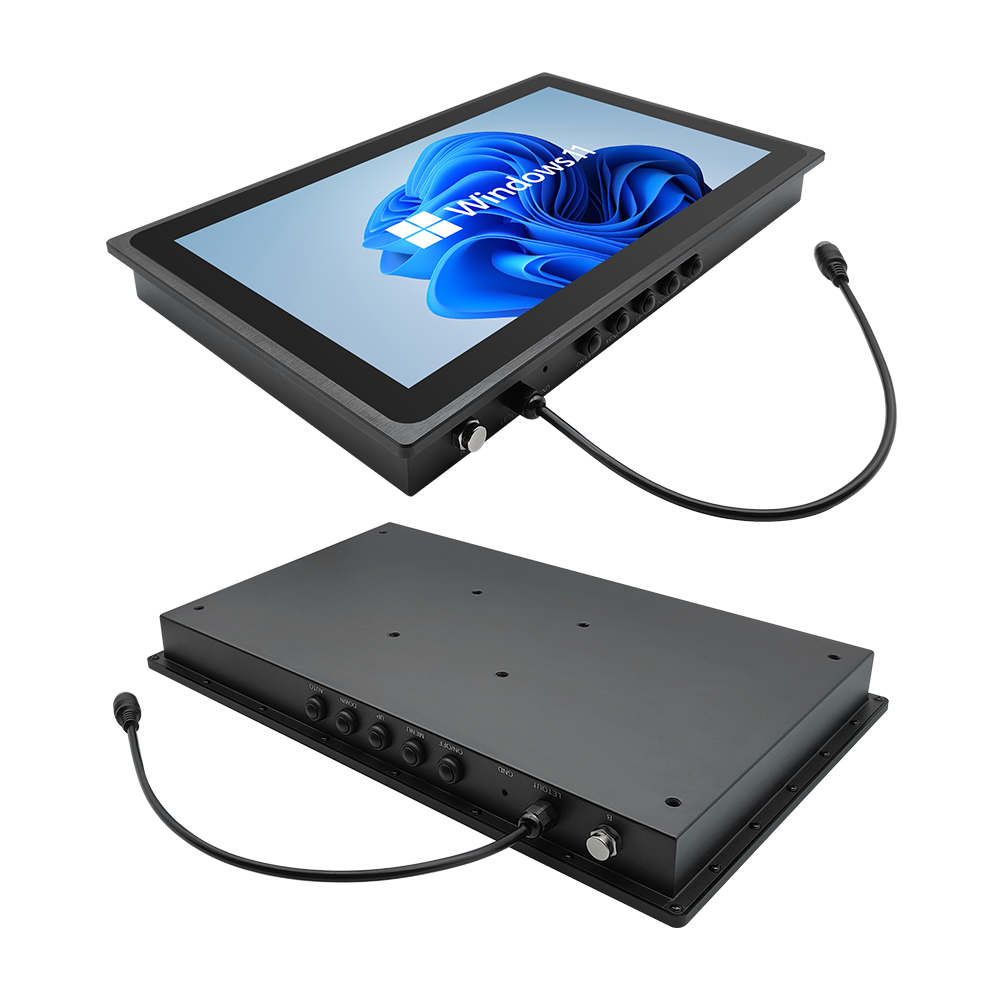
18.5″ 1000 Nits Industrial AHD Monitor
Engineered for port cranes, heavy mining excavators, and industrial vehicle cabs. Features zero-latency AHD/TVI/CVI analog video inputs, 1000 nits daylight readability, adaptive cable equalization, and wide 9V-36V DC power input.
2. Ground Loop Hum Bars and Isolation Transformers
Heavy cranes and mining excavators generate high electrical noise. Spindle drives, hoist motors, and hydraulic pumps return hundreds of amperes through the machine chassis. If an AHD camera mounted on the crane boom and the 18.5″ monitor in the operator cab are grounded at different chassis points, a significant ground voltage differential (ΔV_gnd) forms across the coaxial shield:
- Horizontal Rolling Hum Bars: A 50 Hz / 60 Hz AC ground loop current flowing through the 75-Ohm coaxial shield superimposes a low-frequency hum voltage onto the video signal, appearing on-screen as broad, rolling dark horizontal bars.
- Galvanic Video Ground Isolation: Installing a passive magnetic ground-loop video isolator (isolation transformer) breaks the conductive ground path, eliminating ground loop currents while allowing high-frequency AHD differential signals to pass unhindered.
- True 75-Ohm BNC Termination: Connecting an AHD signal to an improper 50-Ohm BNC connector creates an impedance mismatch, causing signal reflections that manifest as severe ghost images and double edges on vehicle monitors.
Heavy Machinery Vision Monitor Comparison
| Diagnostic Checkpoint | Standard CCTV Consumer Monitor | Engineered 18.5″ Industrial AHD Monitor |
|---|---|---|
| Video Signal Latency | 150 – 300 ms (IP camera compression lag) | Zero latency (< 1 ms real-time analog stream) |
| Daylight Legibility | 250 Nits (Unreadable inside glazed cabs) | 1000 Nits high-luminance sunlight-viewable LED |
| Long-Distance Equalization | None (Color drops out beyond 30m cable) | Adaptive cable equalizer (Clear video up to 500m) |
| Vibration Hardening | Plastic housing cracks under cab vibration | Heavy metal chassis rated for MIL-STD-810H shock |
| Power Sourcing Architecture | Narrow 12V DC ±5% (Shuts off on crane start) | Wide DC 9V to 36V with load-dump surge clamp |
3. Preventative Field Maintenance Checklist for Port Cranes
- Coaxial Festoon Cable Inspection: Inspect moving festoon cable bends every 6 months for outer jacket chafing or shield braid fatigue, which alters cable characteristic impedance and introduces video reflections.
- BNC Connector Center-Pin Verification: Check BNC plug center pins for gold plating wear or oxidation. A high-resistance contact adds series attenuation, degrading color saturation.
- DC Power Ground Continuity: Confirm that the monitor’s DC negative input is bonded to the operator cab’s common equipotential earth stud with a resistance of less than 0.05 Ω.
Standardizing heavy machinery and port crane operator cabs on zero-latency 1000-nit AHD industrial monitors ensures situational awareness and prevents costly rigging collisions. Contact INNODA’s vehicle display support team for custom AHD camera kits, mounting arm specifications, and wide-voltage integration guides.