
Automated automotive assembly plants, electric vehicle (EV) battery pack manufacturing skids, and heavy robotic welding cells operate under severe operational conditions. Within these production environments, operators and process technicians rely on large-format 21.5-inch human-machine interfaces to oversee high-speed manufacturing processes. A 21.5-inch Full HD (1920×1080) visual interface provides the screen canvas necessary to display real-time weld seam quality data, robotic arm joint telemetry, and plant-wide MES work orders simultaneously.
However, robotic welding cells present intense electromagnetic interference (EMI) challenges. Medium-frequency direct-current (MFDC) resistance spot welding guns and alternating-current TIG/MIG welding arcs discharge thousands of amperes within milliseconds, creating intense transient electromagnetic fields. Standard commercial touchscreens installed near welding stations suffer erratic cursor jumping, unregistered touches, and frequent video signal loss.
1. High-Current Welding Arc Radiated EMI & Differential PCAP Immunity
During automated robotic welding, discharge currents reaching 10 kA to 25 kA create rapid electromagnetic field transitions (dB/dt), inducing high common-mode voltages across nearby metallic structures and cabling:
Faraday Induced Common-Mode Noise Voltage: V_induced = -M_mutual × (dI_weld / dt) Where: – Peak Welding Current Surge: dI_weld = 15,000 A in Δt = 2.0 ms → dI/dt = 7.5 × 10^6 A/s. – Mutual Inductive Coupling Factor: M_mutual ≈ 8.5 × 10^-8 H (at 1.5m separation). Induced Voltage Spike across Single-Ended Touch Lines: V_induced = (8.5 × 10^-8) × (7.5 × 10^6) ≈ 0.638 V = 638 mV. Signal-to-Noise Ratio (SNR) Impact: Because standard single-ended capacitive touch operates at 3.3V logic with a sensing window of ~200 mV, a 638 mV induced noise spike completely overwhelms the sensor threshold, causing continuous false clicks (“ghost touches”).
To operate reliably in high-current welding environments, touch displays require differential drive architectures. By scanning adjacent drive electrodes with 180-degree out-of-phase balanced signals, radiated electromagnetic noise induces identical voltage across both sensing lines, canceling out at the differential amplifier.
To eliminate welding arc interference in automated automotive plants, systems integrators deploy the 21.5″ CNC Panel Mount Touch Industrial Monitor, which combines a solid CNC-machined 6061 aluminum front bezel with high-SNR differential projected capacitive touch controllers.
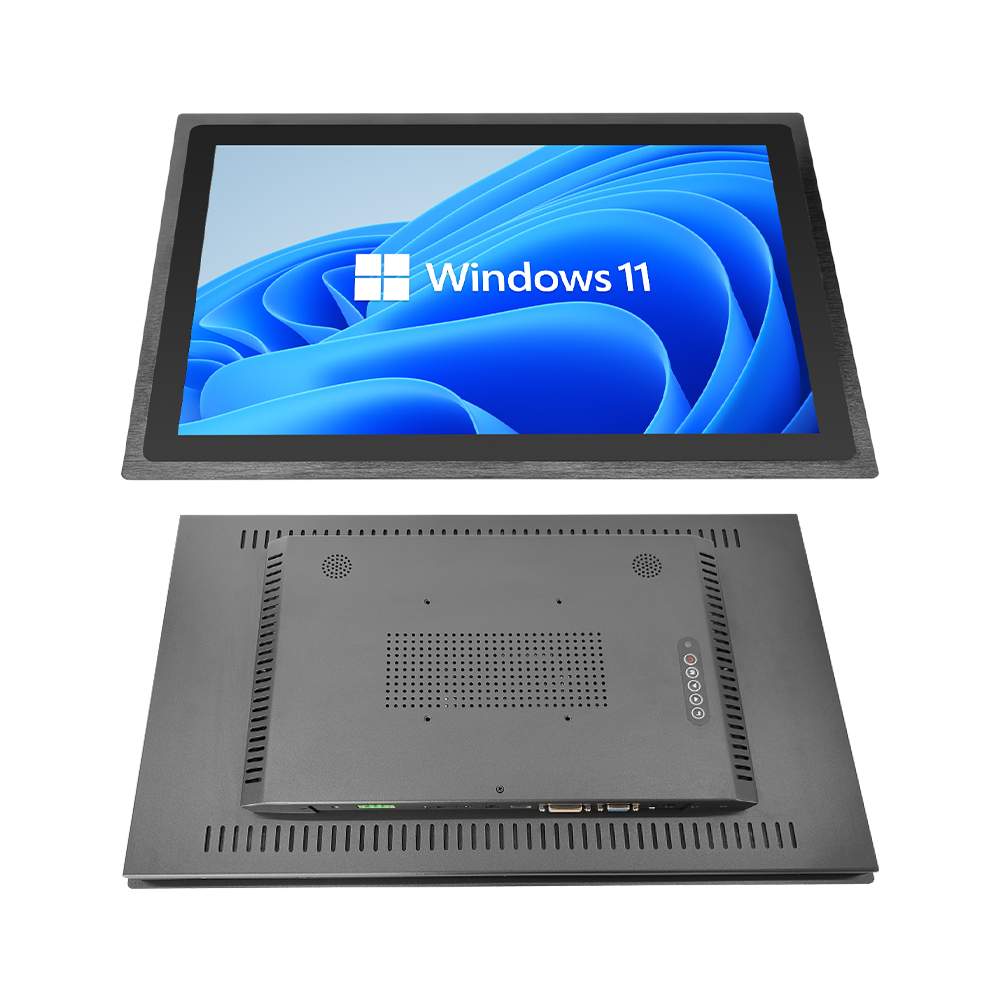
21.5″ CNC Panel Mount Touch Industrial Monitor
Built for automotive MES stations, robotic welding cells, and industrial SCADA control panels. Features an expansive 21.5″ Full HD display, solid CNC 6061-T6 aluminum front bezel, advanced differential PCAP noise immunity, and IP65 washdown front sealing.
2. Monolithic CNC Bezel Structural Rigidity & Wide-Span Clamping
Integrating a large 21.5-inch monitor flush into an electrical enclosure door requires high mechanical stiffness across its 530 mm horizontal span:
- Monolithic CNC 6061-T6 Aluminum Construction: Machined from solid aerospace billet aluminum, the front bezel eliminates the structural flexing common to stamped sheet metal, ensuring uniform gasket sealing across large cutouts.
- Internal Rear Indium Tin Oxide (ITO) Ground Shield: A grounded conductive shielding layer situated behind the touch sensor intercepts parasitic capacitive emissions from internal high-voltage LED backlight drivers.
- Multi-Point Panel Clamp Array: Ten perimeter heavy-gauge steel clamps provide uniform clamping distribution, preventing enclosure door vibration from breaking the IP65 front water and dust seal.
Automotive Robotic Cell Touch Display Comparison
| Diagnostic Checkpoint | Commercial Stamped Monitor | Engineered 21.5″ CNC Panel Monitor |
|---|---|---|
| Welding Arc EMI Immunity | Ghost touches and cursor lockups during weld cycles | Differential PCAP DSP with auto frequency hopping |
| Front Bezel Rigidity | Stamped sheet steel bows under clamping preload | Solid billet CNC aluminum (Zero span deflection) |
| Front Ingress Protection | IP50 (Welding spatter mist penetrates seams) | True IP65 dust-tight and liquid-sealed front face |
| Surface Glass Hardness | 3H PET film (Damaged by weld spatter slag) | 7H chemically tempered glass (Anti-scratch) |
| Industrial Power Stage | Unshielded external 12V plastic power brick | Integrated wide DC 12V-36V with 2.5 kV surge clamp |
3. Real-World Field Case: EV Battery Pack Assembly Line
An electric vehicle battery pack manufacturing plant in Wolfsburg experienced continuous touchscreen lockups across its automated laser welding stations. Standard commercial touchscreens registered false button actuations whenever the 6 kW laser welding heads initiated seams, halting indexing conveyors. After standardizing operator stations on 21.5″ CNC Panel Mount Touch Industrial Monitors featuring differential PCAP noise rejection, the line recorded zero ghost touches across 12 months of continuous production, increasing overall equipment effectiveness (OEE) by 4.2%.
Upgrading robotic cells and MES stations with CNC panel-mount industrial touch monitors ensures deterministic operator tracking and eliminates electromagnetic downtime. Contact INNODA’s automotive automation team to request EMI test certificates, 3D CAD cutout models, and customized video input configurations.