
Modern smart food processing facilities, commercial agriculture sorting terminals, and digital pharmaceutical packaging lines are increasingly deploying dedicated lightweight operating frameworks. While legacy industrial automation historically relied on resource-intensive x86 Windows platforms, modern cloud-connected Manufacturing Execution Systems (MES) and industrial IoT edge applications are shifting toward power-efficient ARM-based Android and embedded Linux platforms. A 15.6-inch widescreen (16:9 Full HD 1920×1080) Android terminal delivers responsive graphical visualization, high web-browser rendering speeds, and native multi-touch gesture support.
However, deploying commercial consumer tablets or standard plastic-cased smart screens in industrial washdown environments results in immediate failure. Daily Clean-in-Place (CIP) sanitation protocols, caustic alkaline foams (pH 11 to 13), and high-pressure hot water sprays penetrate consumer tablet enclosures within minutes. Procuring a dependable 15.6-inch Android terminal requires evaluating thermal dissipation inside hermetically sealed IP65 cavities, ARM SoC power dynamics, and water-rejection capacitive touch tracking.
1. Sealed Cavity Thermal Dissipation & ARM SoC Energy Efficiency
In a completely sealed full IP65 enclosure without ventilation slots or internal fans, all thermal energy must dissipate outward through convective heat transfer across the outer metal casing. High-performance x86 desktop processors typically dissipate 15W to 28W Thermal Design Power (TDP), creating intense internal thermal build-up. In contrast, industrial ARM System-on-Chips (SoCs) execute identical web-HMI tasks while consuming only 5W to 8W:
Hermetic Cavity Steady-State Temperature Rise Equation: ΔT_internal = P_total × Θ_ca Where: – Enclosure Convective Thermal Resistance: Θ_ca = 1 / (h_conv × A_surface) – Outer Aluminum Chassis Surface Area: A_surface ≈ 0.28 m² (15.6″ enclosure). – Convection Heat Transfer Coefficient: h_conv ≈ 8.5 W/(m²·°C) (stagnant ambient air). Thermal Resistance Calculation: Θ_ca = 1 / (8.5 × 0.28) ≈ 0.42 °C/W. Internal Cavity Thermal Comparison: – Standard x86 Solution (P_total = 25W): ΔT = 25 × 0.42 ≈ 10.5°C internal temperature rise. – Industrial ARM Solution (P_total = 6W): ΔT = 6 × 0.42 ≈ 2.52°C internal temperature rise. Headroom Margin: The low thermal footprint of the ARM platform ensures internal components remain well below 60°C even when the plant floor ambient reaches 50°C.
Because the industrial ARM architecture generates minimal waste heat, internal component temperatures remain stable across 24/7 operating cycles. This prevents capacitor dry-out and battery-less RTC drift, while allowing the enclosure to maintain complete IP65 fluid-tight sealing without risking thermal throttling.
To deliver high energy efficiency and true washdown protection in food packaging lines, plant engineers deploy the 15.6″ Full IP65 Waterproof Android Industrial Panel PC, which combines a low-power multi-core ARM processor with a monolithic CNC aluminum front bezel and continuous closed-cell silicone sealing.
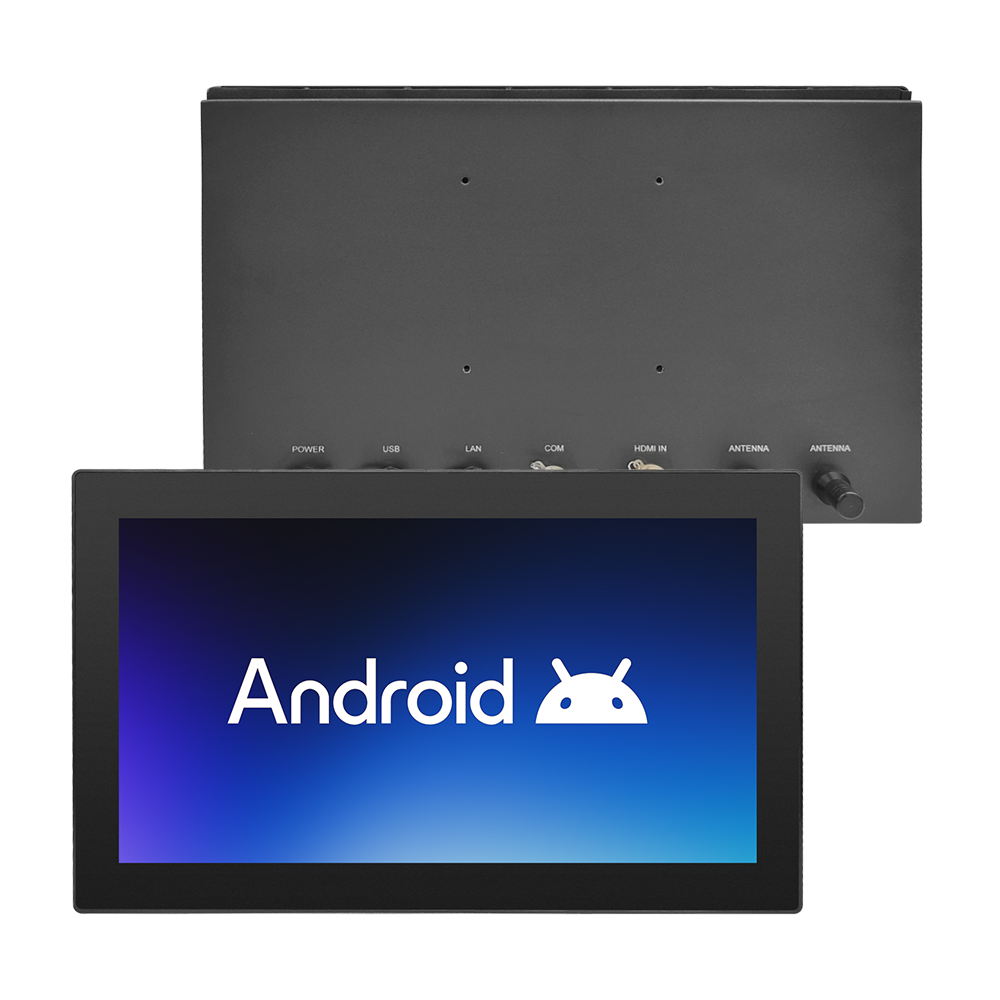
15.6″ Full IP65 Waterproof Android Industrial Panel PC
Designed for food processing, cleanrooms, and automated packaging MES stations. Powered by a high-efficiency multi-core ARM processor, full IP65 waterproof sealing, 15.6″ Full HD widescreen display, all-metal M12 aviation I/O, and industrial Android OS.
2. Android Edge Determinism & Industrial M12 Connectivity
Integrating an Android terminal into industrial factory automation requires addressing operating system determinism and physical connectivity:
- Industrial Android Kiosk Lockdown: Enterprise Android firmware features an immutable system image, hardware watchdog auto-reboot timers, and restricted kiosk launchers that prevent unauthorized operator tampering or accidental software updates.
- Seamless All-Metal M12 I/O Connectors: External connections (DC power, Gigabit Ethernet, USB, and RS232/RS485 fieldbus) interface through heavy-duty M12 circular connectors, preventing liquid ingress and cable pull-out under heavy washdowns.
- Multi-Touch PCAP Water-Film Rejection: The 10-point projected capacitive touch surface utilizes mutual-capacitance scanning algorithms to cancel out false touch coordinates caused by conductive sanitation water pools, supporting continuous operation with wet nitrile gloves.
Industrial Android vs. Consumer Tablet Comparison
| Engineering Parameter | Consumer Commercial Tablet | Engineered 15.6″ Full IP65 Android PC |
|---|---|---|
| Ingress Protection Level | IP52 / Unsealed (Liquid penetrates speaker holes) | Full IP65 (Front, rear chassis, and M12 glands) |
| Chemical Detergent Resistance | Polycarbonate housing crazes under alcohol | Anodized aluminum & tempered glass (pH 1-13 proof) |
| Power Sourcing Architecture | 5V USB battery-backed (Thermal swell risk) | Direct DC 12V / 9V-36V battery-free industrial supply |
| OS Lifecycle & Security | Consumer OS with disruptive consumer updates | Long-term stable Android/Linux BSP with root access |
| Mounting Versatility | Plastic dock or magnetic cradle (Vibration prone) | VESA 75/100 + rigid machine-mount swing bracket |
3. Commissioning Guidelines for MES Workstations
- M12 Connector Preload Calibration: Hand-tighten all M12 circular connector rings until seated, then apply a final calibrated torque of 0.6 Nm to ensure Viton O-rings compress evenly against the chassis receptacles.
- Static IP & Ethernet Configuration: Utilize the onboard hardware Gigabit Ethernet M12 port for primary MES communication to ensure deterministic line reporting, avoiding latency spikes associated with factory Wi-Fi congestion.
- Breather Vent Clearance: Verify that the hydrophobic ePTFE pressure-equalization vent located on the rear chassis remains unobstructed, allowing the sealed enclosure to breathe during rapid sanitation temperature drops.
Standardizing digital packaging and food sorting workstations on full IP65 Android industrial panel PCs provides low-power computing performance without risking washdown downtime. Contact INNODA’s embedded computing engineering team to request Android BSP documentation, 3D STEP packaging models, and custom peripheral integration options.