
Modern automotive body-in-white sub-assembly stations, electronics testing lines, and robotic vision guidance cells demand expansive widescreen graphical interfaces. A 17.3-inch Full HD (1920×1080 native 16:9) display provides an optimal spatial canvas for operators to monitor complex assembly steps, live optical inspection feeds, and interactive digital work instructions side-by-side. Operating these demanding visual interfaces requires combining responsive computing hardware with high structural chassis rigidity.
When engineering teams deploy large-screen touch computers on vibrating production machinery, two primary engineering failure modes emerge: excessive input latency in Android graphic pipelines that causes operator input errors, and structural flexing across wide display spans that damages internal TFT glass substrates. Solving these challenges requires analyzing touch-to-photon latency pipelines and monolithic CNC chassis deflection physics.
1. Touch-to-Photon Latency Pipeline & Android Hardware Composer (HWC)
In high-speed production environments, operator interaction speed directly influences cycle efficiency. Touch-to-photon latency represents the elapsed time from a physical finger contact on the cover glass to the corresponding pixel update rendered on the LCD screen:
Touch-to-Photon Pipeline Delay Equation: T_total = t_scan + t_dsp + t_driver + t_render + t_vsync + t_response Where: – PCAP Electrode Matrix Scan Time: t_scan ≈ 4.0 ms (250 Hz scan rate). – Onboard Touch DSP Coordinate Filtering: t_dsp ≈ 2.5 ms. – Linux Kernel Input Event Dispatch: t_driver ≈ 1.5 ms. – GPU Scene Rendering (Direct HWC Overlay): t_render ≈ 8.0 ms. – LCD Frame VSYNC Quantization (60 Hz): t_vsync ≈ 8.33 ms (average half-frame). – Liquid Crystal G-to-G Optical Response: t_response ≈ 16.0 ms. Calculated Total Latency: T_total = 4.0 + 2.5 + 1.5 + 8.0 + 8.33 + 16.0 = 40.33 ms. Optimization Advantage: Standard consumer Android stacks route through SurfaceFlinger framebuffers, adding 2 to 3 buffering frames (T_total > 85 ms). Utilizing Hardware Composer (HWC) zero-copy overlays reduces input lag by over 50%, providing instantaneous operator feedback.
By bypassing software compositing layers and routing UI graphics directly through dedicated 2D/3D hardware overlays, industrial Android terminals achieve real-time responsiveness, eliminating the perceived lag that causes operators to repeatedly press virtual machine stop buttons.
To deliver rapid tactile response on complex automation lines, equipment builders deploy the 17.3″ CNC Android Industrial Touch Panel PC, which pairs a multi-core ARM computing core with an optimized low-latency Android touch pipeline.
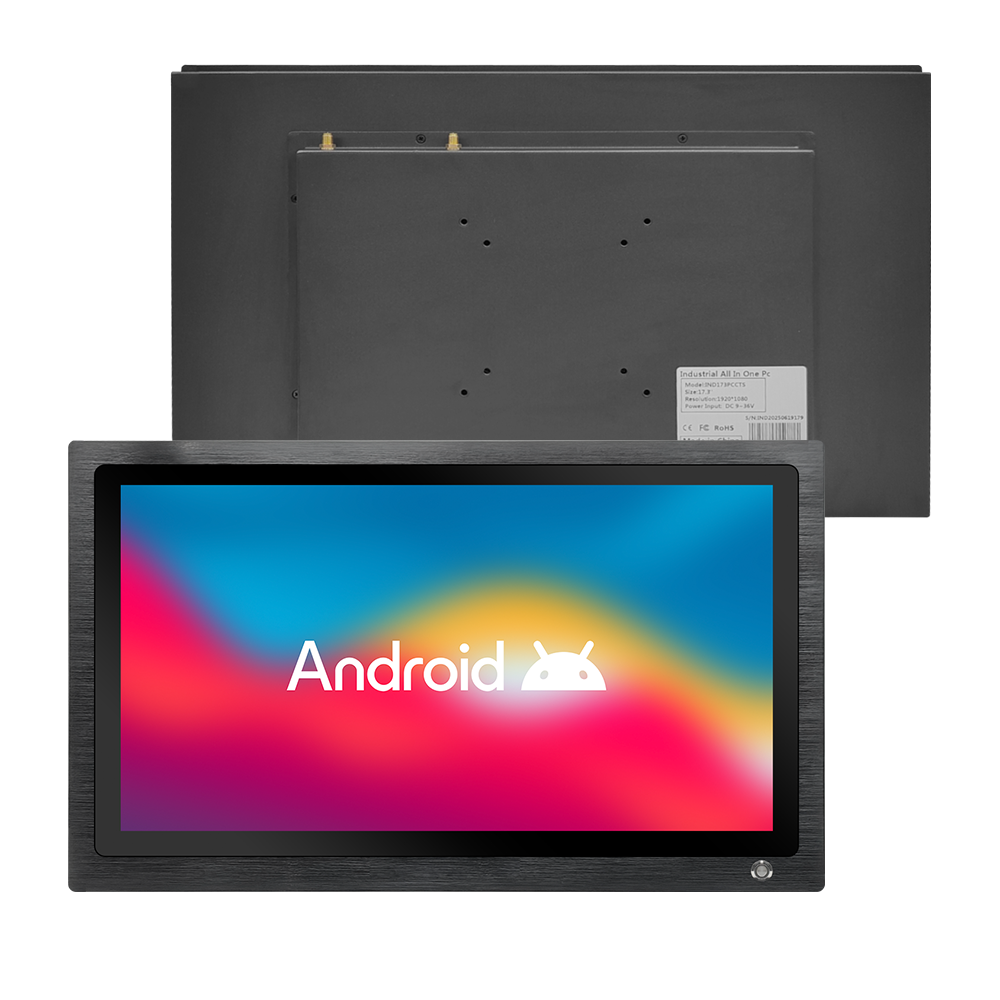
17.3″ CNC Android Industrial Touch Panel PC
Designed for automotive assembly lines, robotic testing cells, and digital MES workstations. Features a monolithic 6061-T6 CNC aluminum chassis, 17.3″ Full HD display, low-latency Android touch pipeline, IP65 front sealing, and wide 9V-36V DC power input.
2. CNC Monolithic Chassis Rigidity Across 17.3″ Horizontal Spans
A 17.3-inch display features an active horizontal width exceeding 382 mm. When mounted on machinery experiencing continuous kinetic excitation, the structural frame must resist bending deflections:
- Flexural Rigidity of CNC 6061-T6 Aluminum: Machined from solid aerospace aluminum billet, the monolithic front frame achieves an area moment of inertia (I) over 12 times greater than standard folded sheet metal, preventing torsional twisting under heavy corner touches.
- Vibration-Isolated Internal Mounting: The LCD cell and projected capacitive sensor are isolated from the outer metal housing via elastomeric silicone dampeners, absorbing mechanical vibrations up to 5G RMS (MIL-STD-810H).
- True-Flat Front Bezel with IP65 Sealing: The seamless edge-to-edge chemically strengthened 7H glass front face eliminates debris-trapping crevices while providing front-panel washdown resistance.
17.3″ Industrial Android HMI Comparison Matrix
| Engineering Parameter | Commercial Sheet-Metal HMI | Engineered 17.3″ CNC Android PC |
|---|---|---|
| Chassis Manufacturing | Stamped sheet steel with plastic trim | Solid billet CNC-machined 6061-T6 aluminum |
| Touch-to-Photon Latency | > 85 ms (SurfaceFlinger triple buffering) | ≤ 42 ms with Direct Hardware Composer overlay |
| Mechanical Bending Stiffness | Flexes noticeably under 20 N corner loads | Zero measurable deflection across 382 mm span |
| Front Ingress Protection | IP50 / IP54 (Mist penetrates bezel gap) | True IP65 dust-tight and water-jet sealed front face |
| Industrial Power Input | Narrow 12V DC input (Drops out on motor start) | Wide DC 9V to 36V with reverse-polarity protection |
3. Electrical Integration & Grounding Guidelines
- Chassis Star Grounding: Connect the dedicated grounding stud on the rear CNC chassis to the electrical control cabinet’s primary ground bus using a heavy braided copper strap (≥ 6 mm²) to shunt electrostatic discharge (ESD) transients.
- Serial Bus Termination: When utilizing the onboard RS485 serial port to interface with legacy PLCs, ensure that 120-Ohm termination resistors are engaged at the physical endpoints of the transmission line.
- Panel Mount Clamp Sequence: Tighten panel-mount retention brackets in a cross-diagonal sequence to 1.0 Nm of torque to maintain uniform perimeter gasket pressure against the enclosure cutout.
Upgrading automated assembly lines with CNC-machined 17.3-inch Android industrial touch panel PCs ensures low-latency operator interaction and lasting structural reliability. Contact INNODA’s industrial automation team to request BSP source trees, 3D STEP packaging models, and customized I/O configurations.