
Modern pharmaceutical packaging cells, automated meat packing sorting conveyors, and electronic component manufacturing lines require seamless automated data capture directly at the operator workstation. Integrating a 1D/2D optical barcode and QR code scanner directly into the bezel of a 15-inch stainless steel industrial panel PC eliminates external handheld scan guns, trailing cords, and unsealed USB dongles. A unified terminal streamlines batch lot verification, operator badge sign-in, and component serial tracking.
However, embedding a high-speed optical scanning engine behind an industrial washdown front face presents complex physical challenges. The scanner’s illumination LEDs and CMOS imaging sensor must capture crisp contrast through an environmental protective glass window without suffering optical distortion or internal back-reflection glare. Simultaneously, high-frequency digital clock harmonics from the mainboard’s CPU and memory bus can radiate into the scanner’s sensitive analog video preamplifier, corrupting image decode rates.
1. Optical Window Transmittance & Fresnel Reflection Glare Suppression
An integrated barcode scanner projects structured illumination (typically 650 nm red LED or laser aiming lines) through a protective glass aperture, reading return light scattered by paper or DPM (Direct Part Mark) labels. As light passes through the protective window, refractive index boundaries produce Fresnel reflection losses:
Fresnel Reflection & Internal Glare Equation: R = [ (n_glass – n_air) / (n_glass + n_air) ]^2 Where: – Refractive Index of Protective Cover Glass: n_glass ≈ 1.52 (optical soda-lime or aluminosilicate). – Refractive Index of Ambient Air: n_air = 1.00. Single Surface Reflectance: R_single = [ (1.52 – 1.00) / (1.52 + 1.00) ]^2 = [ 0.52 / 2.52 ]^2 ≈ 0.0426 = 4.26%. Total Uncoated Double-Surface Reflection Loss: R_total = 1 – (1 – R_single)^2 ≈ 1 – (0.9574)^2 ≈ 8.34%. Optical Flare Hazard: If 4.26% of high-intensity internal aimer LED light reflects off the inner glass surface back into the CMOS sensor, it blinds the imager, washing out high-density QR code contrast. Engineering Solution: Applying multi-layer anti-reflective (AR) coatings (n_layer = (n_glass × n_air)^0.5 ≈ 1.23) reduces internal reflectance below 0.5%, preserving decode modulation contrast C ≥ 0.85.
Without optical anti-reflective coating and light-baffle isolation, internal illumination reflections saturate the CMOS sensor pixels, resulting in failed reads on curved pharmaceutical vials or reflective metallic foil packaging. Isolating the illumination path with an internal rubber optical shroud ensures crisp image capture.
To deliver rapid, 360-degree omnidirectional code reading in washdown packaging suites, system builders standardize on the 15″ Stainless Steel Panel PC with QR Barcode Scanner, which integrates an industrial-grade wide-angle 2D imager behind an optically coated sapphire-hardened window.
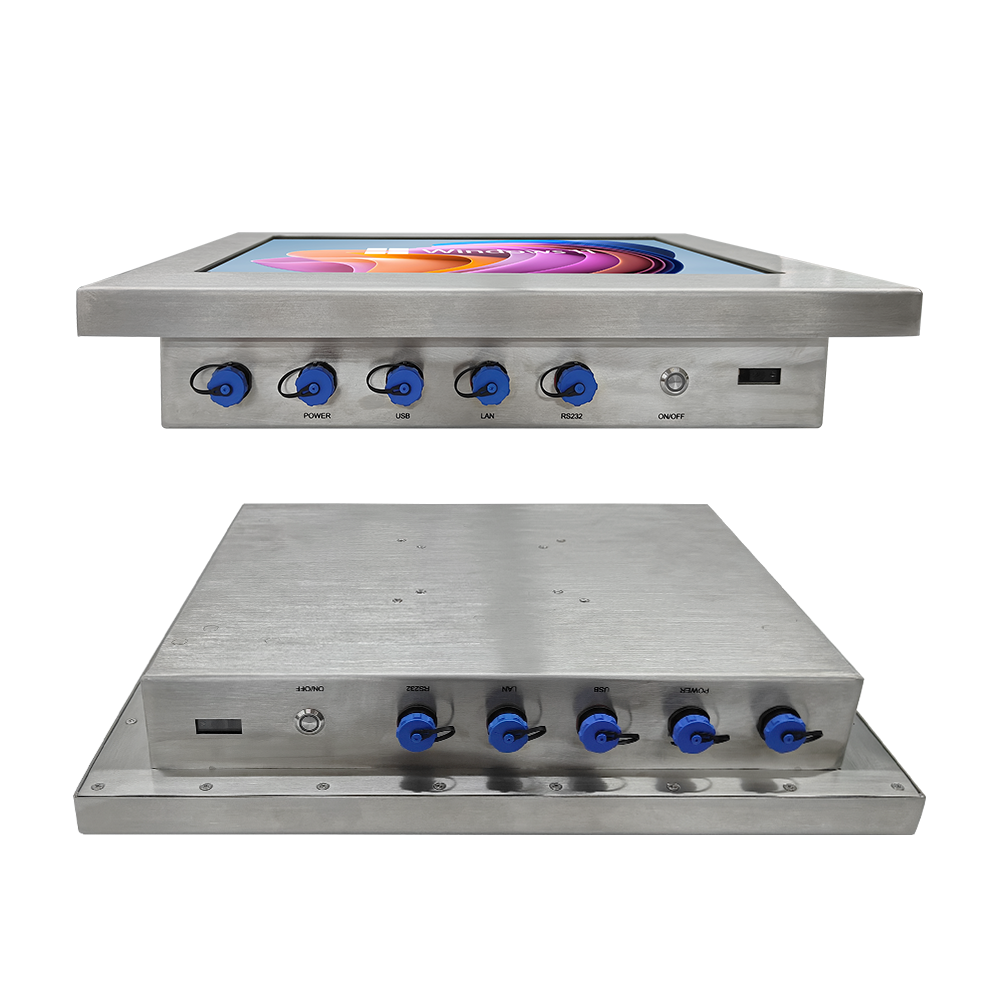
15″ Stainless Steel Panel PC with QR Barcode Scanner
Built for pharmaceutical batch tracking, meat packaging sorting, and automated cleanroom MES. Features an integrated high-speed 1D/2D QR code scanner behind an AR-coated optical window, full SUS304/316L washdown stainless housing, and glove-responsive touch.
2. Internal EMI Cavity Isolation & Electrostatic Discharge (ESD) Shunting
Protecting data integrity in harsh manufacturing environments requires careful electromagnetic design:
- Faraday Cage Optical Scanner Chamber: The integrated 2D scanning module is housed in a dedicated tin-plated copper shielding sub-enclosure. This blocks near-field electromagnetic radiation emitted by high-speed DDR memory buses and switching voltage regulators from coupling into the scanner’s image sensor.
- High-Voltage ESD Dissipation Ring (±15 kV Air): Operators frequently carry high static charges when presenting plastic pouches or tote bins. A grounded stainless steel collar around the scanning window shunts electrostatic discharge directly to chassis earth, bypassing internal electronics.
- Full IP65/IP66 Hermetic Gland Barrier: The optical window is bonded to the front stainless bezel using medical-grade UV-cured structural epoxy, ensuring high-pressure washdown chemicals cannot penetrate around the scanner aperture.
Integrated vs. Handheld Barcode Scanner Comparison
| Engineering Parameter | External Handheld USB Scanner | Engineered 15″ Integrated Scanner PC |
|---|---|---|
| Ingress Protection Level | IP42 / IP54 (Water enters trigger switch) | Full IP65/IP66 (Seamless front washdown sealed) |
| Optical Glare Management | Fixed lens prone to internal barrel flare | AR-coated optical window with internal baffling |
| Cable Fatigue Vulnerability | Coiled cord snags, stretches, and breaks | Zero external cables (Internal USB/UART bus) |
| ESD Immunity Rating | ±4 kV contact (Triggers USB disconnect) | ±15 kV air / ±8 kV contact discharge protection |
| Sanitary Cleanability | Plastic crevices trap organic pathogens | Solid SUS304 electropolished face (Ra ≤ 0.4 μm) |
3. Commissioning Guidelines for Automated Traceability Stations
- Aiming Focal Distance Calibration: Position production tote bins or product presentation fixtures between 120 mm and 280 mm from the front scanning window to ensure barcodes fall within the optical imager’s sharpest Depth of Field (DoF).
- Illumination Glare Angle Setting: When scanning high-gloss plastic pouches or metallic blister packs, mount the panel PC at a 10-degree tilt relative to the presentation plane to redirect specular reflection away from the CMOS camera axis.
- Window Cleaning Protocol: Clean the optical scanning window daily using optical-grade lint-free wipes dampened with 70% IPA. Avoid abrasive dry cloths that could micro-scratch the anti-reflective surface coating.
Upgrading packaging and sorting workstations with integrated barcode-scanning stainless steel panel PCs eliminates broken handheld cables and accelerates lot-tracking throughput. Contact INNODA’s automated data capture engineering team to request barcode decode engine SDKs, 3D envelope CAD files, and sample evaluation units.