
Commercial seafood processing trawlers, automated salmon filleting lines, and brine-curing packaging facilities represent some of the most aggressive operating environments for industrial electronics. High-salinity brine aerosols, continuous fish slime washdowns, and ambient temperatures hovering near 0°C to 4°C create severe corrosion risks. Across these high-volume processing lines, plant supervisors rely on large 21.5-inch widescreen displays (16:9 Full HD 1920×1080) to monitor automated vision-grading lines, weight sorting carousels, and high-speed packaging telemetry.
Operating a display terminal in wet seafood processing requires meeting the rigorous requirements of IEC 60529 IP67 (submersion up to 1 meter depth for 30 minutes). When processing equipment undergoes deep shift-end tank washdowns or temporary deck flooding, water surrounds the entire enclosure. Without structural glass calculation and hermetic O-ring engineering, hydrostatic pressure deflects large 21.5-inch front glass panels, breaking perimeter seal contact and destroying internal timing controller electronics.
1. Submersible Hydrostatic Pressure & Large-Span Glass Plate Deflection
Under the IEC 60529 IP67 verification standard, an enclosure submerged under 1.0 meter of seawater experiences uniform inward hydrostatic head pressure across all six faces:
Hydrostatic Fluid Pressure & Plate Deflection Equation: p_hydro = ρ_seawater × g × h_depth Where: – Seawater Density ρ_seawater ≈ 1025 kg/m³. – Gravitational Constant g = 9.81 m/s². – Immersion Depth h_depth = 1.00 m. Hydrostatic Head: p_hydro = 1025 × 9.81 × 1.00 ≈ 10,055 Pa ≈ 0.1006 bar. Total Inward Hydraulic Force on 21.5″ Screen Area (A ≈ 0.138 m²): F_hydraulic = p_hydro × A = 10,055 × 0.138 ≈ 1,387.6 N inward compressive load. Maximum Center Deflection of Simply Supported Rectangular Glass Plate: w_max = α × (p_hydro × b^4) / D Where Flexural Rigidity D = (E × t^3) / [ 12 × (1 – ν^2) ]. – Modulus of Elasticity E ≈ 72 GPa, Poisson’s ratio ν = 0.22, short span b ≈ 0.27 m. Comparison: – Standard 2.0 mm Glass: D ≈ 50.4 N·m → w_max ≈ 1.42 mm (Excessive flex lifts perimeter gasket). – Engineered 4.0 mm Chemically Toughened Glass: D ≈ 403.5 N·m → w_max ≈ 0.18 mm (Zero seal lift).
Because flexural plate rigidity (D) scales with the cube of glass thickness (t^3), upgrading from 2.0 mm to 4.0 mm chemically toughened glass increases structural stiffness by 800%. This limits central deflection to a negligible 0.18 mm under 1,387 N of hydraulic force, preserving uniform gasket compression along every millimeter of the perimeter seal.
To eliminate submersion leakage risks across open seafood lines, marine equipment builders deploy the 21.5″ Full IP67 Stainless Steel Touch Industrial Monitor, which combines 4.0 mm tempered glass with a heavy-gauge electropolished SUS304/SUS316L housing.
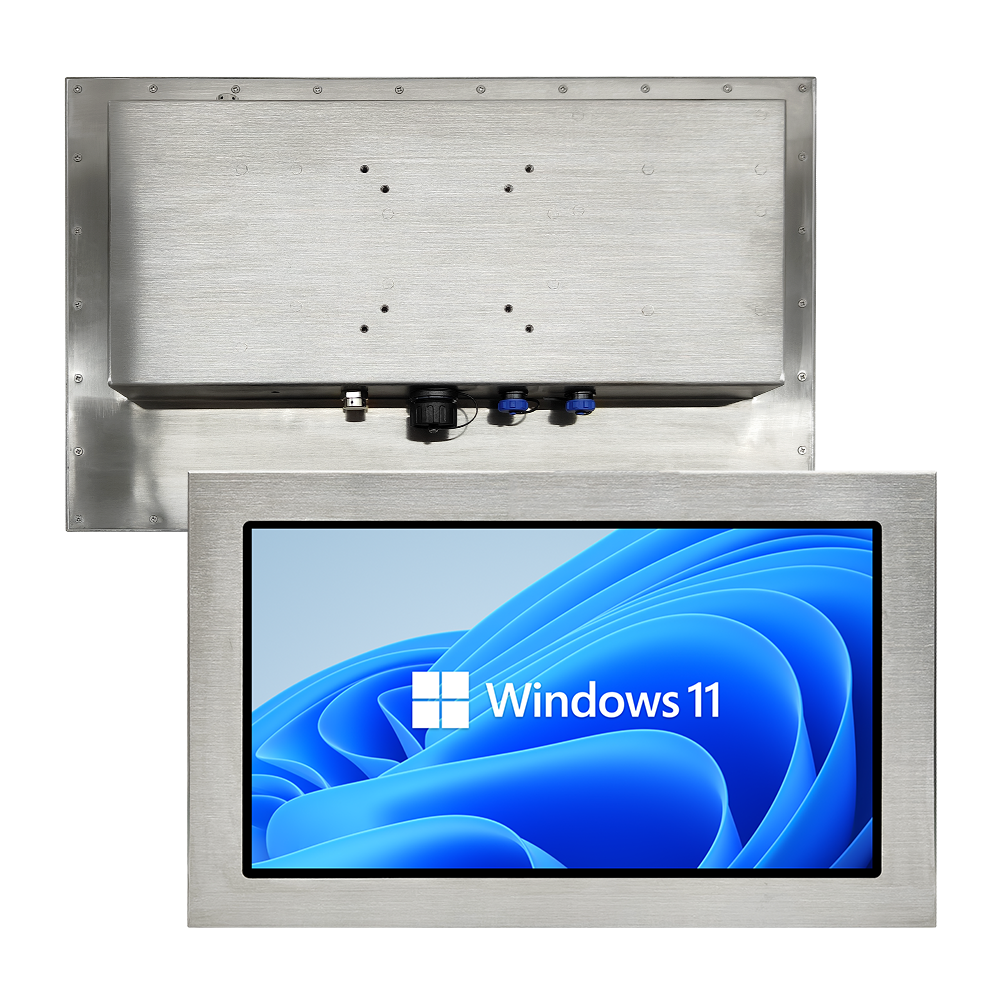
21.5″ Full IP67 Stainless Steel Touch Industrial Monitor
Engineered for seafood processing, meat packaging lines, and chemical washdown suites. Features an expansive 21.5″ Full HD display, certified full IP67 submersion sealing, electropolished SUS304/316L stainless steel housing, and all-metal M12 aviation I/O.
2. Saline Pitting Resistance & All-Metal M12 Signal Architecture
Operating in high-salinity brine environments demands advanced metallurgical and cabling defenses:
- Molybdenum Passivation in SUS316L: In high-salt brine curing rooms (NaCl concentration > 5%), standard metals suffer rapid crevice pitting. Specifying SUS316L stainless steel (with 2.0% to 2.5% Molybdenum) raises the Pitting Resistance Equivalent Number (PREN ≥ 23), preventing micro-pitting attacks.
- Thread-Locking Stainless M12 Aviation Connectors: External video (HDMI, VGA) and touch USB signals route through heavy-gauge stainless steel M12 circular connectors, eliminating unsealed RJ45 or USB ports that corrode in marine salt air.
- Mutual-Capacitance Salt Water Rejection: High-salinity brine is highly conductive. Advanced touch DSP algorithms analyze spatial charge distributions, ignoring pooling saline films while accurately tracking operators wearing heavy insulated neoprene gloves.
Seafood Processing Display Comparison Matrix
| Diagnostic Checkpoint | Standard Commercial Monitor | Engineered 21.5″ IP67 Stainless Monitor |
|---|---|---|
| Ingress Protection Rating | IP54 / IP65 front face only | Full IP67 (Certified 1m continuous water submersion) |
| Saline Corrosion Resistance | Painted steel rusts within 3 months in brine | Electropolished SUS304/SUS316L (PREN ≥ 23) |
| Glass Submersion Deflection | Thin 2.0mm glass flexes, causing perimeter leak | 4.0mm Chemically tempered glass (<0.2mm deflection) |
| Conductive Brine Touch | Freezes or registers erratic false clicks | DSP mutual-capacitance saline water rejection |
| I/O Connectivity Type | Unsealed consumer HDMI & USB ports | All-metal screw-locking M12 circular connectors |
3. Real-World Field Case: North Atlantic Salmon Processing Skid
An automated salmon processing trawler operating off the coast of Norway experienced recurring operator display failures across its gutting and filleting conveyors. Commercial IP65 monitors repeatedly suffered seal breaches and corroded video ports when processing decks were flooded during shift sanitation washdowns. Following the fleet installation of 21.5″ Full IP67 Stainless Steel Touch Industrial Monitors, the facility recorded zero ingress failures across 14 months of continuous sea operations, eliminating unscheduled processing stoppages.
Standardizing wet seafood and protein packaging lines on full IP67 stainless steel touch monitors ensures continuous SCADA visibility and eliminates saline washdown downtime. Contact INNODA’s washdown display engineering team to request submersion test certifications, M12 cable pinouts, and custom stainless swing-arm brackets.