
Modern naval defense vessels, harbor tug wheelhouses, open-pit mining digger consoles, and outdoor payment kiosks require operator displays that remain legible under direct solar illumination. The 15.0-inch 4:3 display format (1024×768 XGA resolution) represents the international standard for marine navigation radar screens and heavy equipment telemetry. However, operating a display under unshaded midday sunlight reaching 100,000 lux presents severe optical and thermal challenges that standard 300-nit office or factory monitors cannot survive.
Driving screen luminance up to 1500 nits requires injecting high electrical power into the white LED backlight array, generating concentrated thermal flux along display edges. In a sealed IP65 chassis exposed to outdoor ambient heat, unmanaged backlight temperatures rapidly trigger liquid crystal isotropic transition (clearing point T_ni), causing temporary dark solar blotches across the screen. Overcoming these hurdles requires combining high-efficiency constant-current LED drivers with Liquid Optical Clear Adhesive (LOCA) lamination and conductive aluminum thermal spreaders.
1. Ambient Contrast Ratio (ACR) under 100,000 Lux Direct Solar Irradiation
Under direct solar illumination, human eye perceived readability is dictated not by raw luminance alone, but by the Ambient Contrast Ratio (ACR). Comparing an unbonded air-gap display against a LOCA wet-laminated display reveals the critical optical impact of refractive index matching:
Ambient Contrast Ratio (ACR) Mathematical Analysis: ACR = (L_on + L_reflected) / (L_off + L_reflected) Where: – Direct Solar Ambient Illuminance: E_amb = 100,000 lux. – Equivalent Solar Glare Luminance: L_amb = E_amb / π ≈ 31,831 cd/m². – Display Peak White Luminance: L_on = 1500 cd/m² (Nits); Black State Luminance: L_off = 1.5 cd/m². Case A: Unbonded Air-Gap Construction (Surface Reflectance R_air ≈ 4.5% = 0.045): Reflected Glare Luminance: L_reflected = 31,831 × 0.045 ≈ 1,432.4 cd/m². ACR_unbonded = (1500 + 1432.4) / (1.5 + 1432.4) = 2932.4 / 1433.9 ≈ 2.04 : 1 (Faded, washed out). Case B: LOCA Optical Wet Bonding + Multi-Layer AR Glass (Reflectance R_loca ≤ 0.5% = 0.005): Reflected Glare Luminance: L_reflected = 31,831 × 0.005 ≈ 159.2 cd/m². ACR_bonded = (1500 + 159.2) / (1.5 + 159.2) = 1659.2 / 160.7 ≈ 10.33 : 1 (Crisp, sharp industrial contrast).
Because full optical wet bonding eliminates internal air-glass boundaries, internal reflections drop by 89%. The resulting 10.33:1 contrast ratio far exceeds the international standard 5:1 threshold for safe outdoor operator legibility, ensuring radar contours and warning icons remain crisp.
To ensure high visual legibility across open cockpits and sunlit bridge consoles, marine automation engineers specify the 15″ 1500 Nits High Brightness Touch Industrial Monitor, which combines a 1500-nit high-luminance LED matrix with solid LOCA wet lamination.
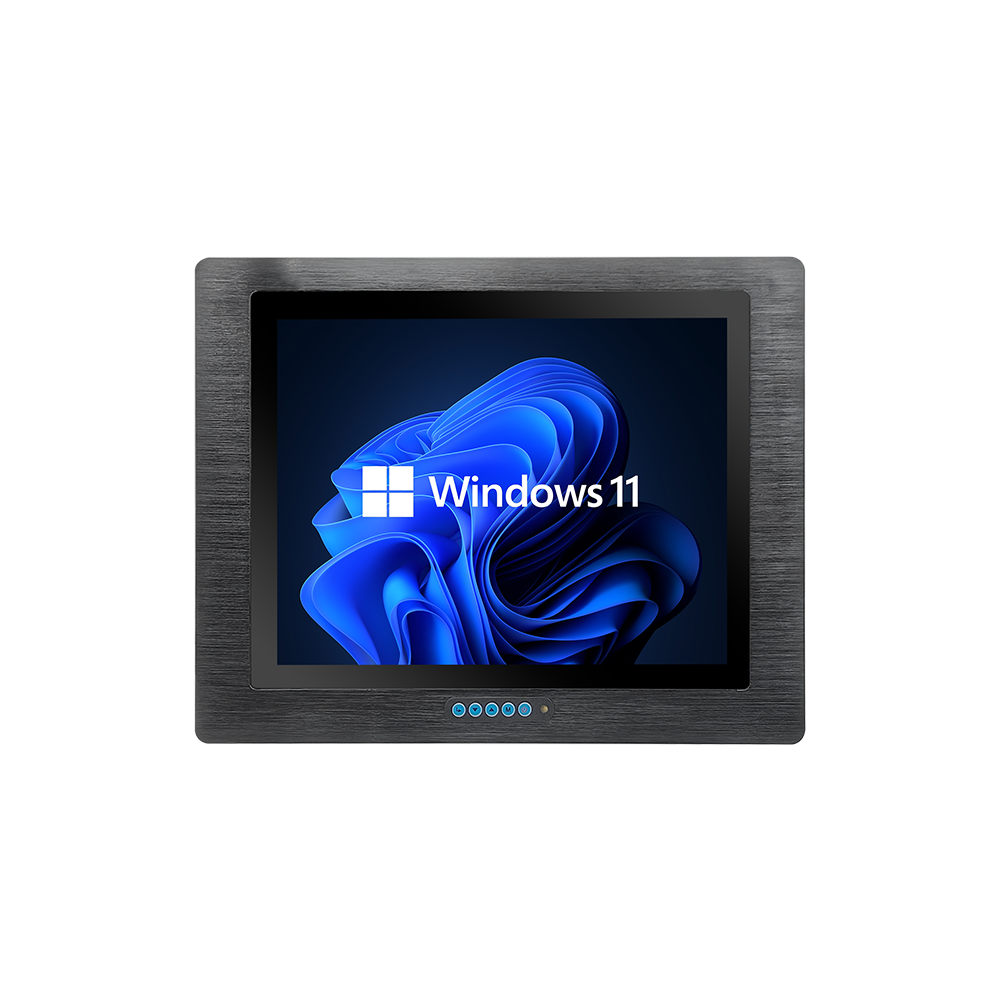
15″ 1500 Nits High Brightness Touch Monitor
Built for maritime bridge consoles, open-pit mining diggers, and outdoor payment kiosks. Features 1500 nits daylight readability, full solid LOCA optical wet bonding, ACR > 10:1 under 100,000 lux, 0-100% deep night dimming, and IP65 waterproof front sealing.
2. 22W Backlight Heat Spreading & Anti-Isotropic Liquid Crystals
Maintaining high luminance without premature LED degradation requires strict thermal engineering:
- Aluminum Core PCB (MCPCB) Backlight Rails: High-efficiency WLED diodes are mounted to metal-core printed circuit boards directly coupled to the outer aluminum chassis, dissipating 22 Watts of backlight power passively without hotspots.
- High-Clearing-Point (T_ni ≥ 105°C) Industrial LC Fluid: Specialized liquid crystal fluid prevents solar isotropic blackening up to 105°C, preventing dark solar blotches when displays sit in unshaded desert or tropical environments.
- 0% to 100% Flicker-Free Hardware PWM Dimming: Allows smooth dimming from full 1500-nit daylight down to less than 1 nit for night operations, preserving operator scotopic night vision during harbor navigation.
Sunlight-Readable Industrial Monitor Comparison Matrix
| Engineering Parameter | Standard Factory Touchscreen | Engineered 15″ 1500 Nits Monitor |
|---|---|---|
| Peak Screen Luminance | 300 – 400 Nits (Unreadable in full sun) | 1500 Nits constant-current industrial WLED |
| Optical Bonding Stack | Air gap (Internal reflection > 4.5%) | Full solid LOCA wet resin optical lamination |
| Solar Blackening Resistance | Fails at 75°C (Forms black solar spots) | High-clearing-point liquid crystal (T_ni ≥ 105°C) |
| Night Watch Dimming | Bottoms out at 15% (≈50 nits, blinds crew) | Smooth hardware PWM dimming down to < 1 nit |
| Front Enclosure Ingress | IP54 / light spray resistant only | Certified IP65 waterproof and dust-tight front |
3. Bridge Console Commissioning Guidelines
- Rotary Potentiometer Integration: Connect an external 10k-Ohm marine rotary potentiometer to the dedicated rear dimming header to provide bridge crew with instantaneous tactile brightness adjustment without OSD menus.
- Power Line Current Sizing: Ensure the 12V DC power feeder provides at least 3.5 Amps continuous current capacity (≥ 42 Watts) to comfortably handle full-luminance daylight operation without voltage sag.
- Optical Glass Care: Clean the multi-layer anti-reflective front glass using optical-grade lint-free wipes dampened with 70% pure isopropyl alcohol. Avoid ammonia window cleaners that could degrade surface coatings.
Upgrading outdoor mining kiosks and marine bridge consoles with 15-inch 1500-nit high-brightness touch industrial monitors guarantees high optical contrast and eliminates solar heat downtime. Contact INNODA’s optical engineering team to request spectrophotometer reflectance plots, thermal dissipation data, and custom mounting flange drawings.