
Modern container port gantry cranes (STS), heavy industrial bulk loaders, and overhead steel mill cranes operate under demanding conditions where operators sit in elevated glass cabs up to 60 meters above the dock. Crane operators rely on multi-camera closed-circuit television (CCTV) feeds to guide heavy container spreader locks into shipboard container cells with sub-inch precision. Across these heavy material handling consoles, operators require an 18.5-inch widescreen display (16:9 Full HD 1920×1080 resolution) capable of displaying live camera feeds without transmission lag.
However, deploying digital IP network video across long moving crane festoon cable tracks introduces critical operational failure modes. Digital IP video encoders introduce 150 ms to 300 ms of compression latency, creating a hazardous visual lag where container swing movements appear delayed on screen. Furthermore, moving festoon cables run hundreds of meters alongside high-power 480V crane hoist motors that emit intense electromagnetic interference (EMI). Resolving these challenges requires deploying Analog High Definition (AHD) uncompressed video transmission, analyzing coaxial cable high-frequency skin depth attenuation, and ensuring 1000-nit daylight readability inside sunlit glass cabs.
1. High-Frequency Coaxial Skin Effect & 500-Meter Transmission Loss
Analog High Definition (AHD) modulates 1080p uncompressed video signals across frequency bands reaching 30 MHz to 45 MHz. At these high frequencies, alternating electrical current crowds toward the outer perimeter of the coaxial copper center conductor due to the skin effect:
Coaxial Skin Depth & High-Frequency Attenuation Modeling: Skin Depth Equation: δ = [ ρ_cu / (π × f × μ_0) ]^0.5 Where: – Copper Resistivity: ρ_cu = 1.72 × 10^-8 Ω·m. – Magnetic Permeability of Vacuum: μ_0 = 4π × 10^-7 H/m ≈ 1.2566 × 10^-6 H/m. – AHD 1080p Carrier Frequency: f = 30.0 MHz = 3.0 × 10^7 Hz. Skin Depth Calculation: δ = [ (1.72 × 10^-8) / (3.14159 × 3.0 × 10^7 × 1.2566 × 10^-6) ]^0.5 δ = [ (1.72 × 10^-8) / (118.43) ]^0.5 = (1.452 × 10^-10)^0.5 ≈ 1.205 × 10^-5 m ≈ 12.05 μm. Transmission Loss over 500-Meter RG6 Coaxial Cable Run: Because current flows exclusively through a 12.05 μm thin outer skin, effective RF resistance increases: At 30 MHz, high-grade RG6 coaxial cable exhibits ≈ 4.50 dB attenuation per 100 meters. Total Line Attenuation across 500m Festoon Run: A_total = 5 × 4.50 = 22.50 dB. Receiver Compensation: The monitor’s onboard analog front-end (AFE) features adaptive equalizers with +26 dB gain compensation, restoring crisp 1080p edge sharpness with zero frame latency (≤ 1 ms).
Because AHD video requires zero compression encoding, visual latency remains under 1 millisecond. Operators observe container spreader positions in real time, completely eliminating the dangerous delay associated with IP network cameras.
To deliver real-time CCTV monitoring in sunlit crane cabs, port operators standardize on the 18.5″ 1000 Nits Industrial AHD Monitor, which combines direct BNC AHD video inputs with a 1000-nit sunlight-readable panel.
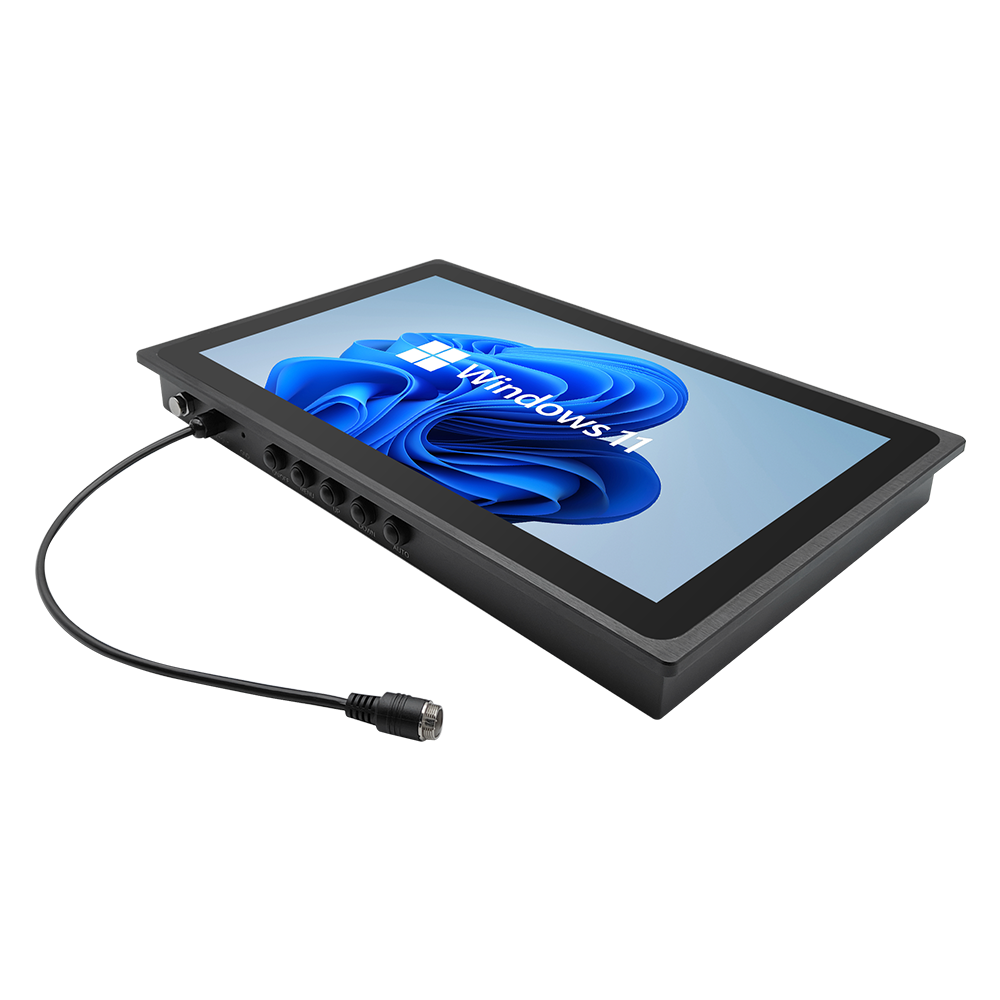
18.5″ 1000 Nits Industrial AHD Monitor
Built for harbor gantry cranes, mining excavators, and heavy material handling cabs. Features 1000 nits sunlight readability, native 1080p uncompressed AHD video with zero frame latency (<1 ms), 500m coaxial transmission support, and IP65 front protection.
2. 1000 Nits Daylight Visibility & Robust Festoon Cable Immunity
Harbor crane operation demands tailored optical and electrical protection:
- 1000 Nits High-Luminance Panel: High-output LED backlights ensure container alignment marks and twistlock indicator lights remain clearly visible through glass cab floors under direct noon sunlight glare.
- Isolated BNC Coaxial Video Ports: Galvanic ground isolation on BNC inputs breaks ground loops between distant trolley cameras and the operator cab, preventing horizontal video hum bars caused by hoist motor VFDs.
- Heavy-Gauge Aluminum Chassis with VESA 75/100: Ruggedized metal construction isolates internal timing controllers from severe crane boom vibrations and mechanical dock impacts.
Harbor Crane Video Technology Comparison Matrix
| Operational Metric | Digital IP Network Video Screen | Engineered 18.5″ AHD Industrial Monitor |
|---|---|---|
| Video Display Latency | 150 – 300 ms (Noticeable lag during hoists) | ≤ 1 ms uncompressed (Zero real-time latency) |
| Peak Screen Luminance | 250 – 350 Nits (Washed out in glass cabs) | 1000 Nits daylight-viewable industrial WLED |
| Maximum Cable Run | 100 meters (Requires active repeaters) | Up to 500 meters over RG59/RG6 coaxial cable |
| Video Input Interface | RJ45 Ethernet with packet buffering | Threaded BNC (AHD / TVI / CVI / CVBS) + HDMI |
| VFD Motor Noise Immunity | Packet loss and video freezing | Continuous analog sync with ground isolation |
3. Real-World Field Case: Rotterdam Container Terminal
A major container logistics hub in Rotterdam experienced recurring operator near-miss incidents during spreader positioning. Digital IP video monitors exhibited up to 250 ms lag, making precise container alignment difficult during high-speed crane operations. Following the retrofit of 18.5″ 1000 Nits Industrial AHD Monitors connected directly to 400-meter festoon coaxial runs, the terminal recorded zero video latency, zero dropped video feeds, and a 6.2% increase in container moves per hour across 14 consecutive months.
Standardizing harbor gantry cranes and heavy industrial loading skids on 18.5-inch 1000-nit industrial AHD monitors delivers zero-latency visual control and eliminates midday glare washouts. Contact INNODA’s crane display engineering team to request AHD cable attenuation charts, 3D STEP packaging files, and custom cab mounting brackets.