
Modern naval defense vessels, offshore patrol cutters, and commercial cargo ships require large-format bridge navigation displays. Within modern Integrated Bridge Systems (IBS), watchstanders rely on expansive 27.0-inch widescreen displays (16:9 Full HD 1920×1080 resolution) to consolidate S-band and X-band ARPA radar sweeps, Electronic Chart Display and Information Systems (ECDIS), and forward-looking infrared (FLIR) cameras onto a single tactical screen. Operating inside glass-enclosed wheelhouses exposes displays to intense solar radiation and high ambient reflections.
However, deploying standard bare stainless steel or commercial desktop monitors in naval bridge consoles creates critical operational hazards. Shiny metallic bezels generate blinding specular reflections into the captain’s eyes, while low-luminance screens wash out under tropical midday sun. Furthermore, bare metals exhibit low radiative thermal emissivity (ε ≈ 0.15), trapping heat inside sealed bridge consoles. Resolving these challenges within modern sunlight readable hmi fleets requires analyzing chemical black oxide surface passivation, 1500-nit LOCA optical bonding, and sub-nit hardware PWM night dimming.
1. Black Oxide Surface Emissivity & 1500 Nits Ambient Contrast Ratio (ACR)
Applying an electrochemical black oxide conversion coating to marine-grade SUS316L stainless steel eliminates blinding metallic glare while dramatically boosting radiative thermal heat dissipation:
Thermal Radiative Emissivity & Daylight Contrast Modeling: Stefan-Boltzmann Radiative Heat Rejection: Q_rad = ε × σ × A_chassis × (T_surface^4 – T_ambient^4) Surface Emissivity Comparison: – Bare Polished Stainless Steel: ε_bare ≈ 0.15 (Poor radiative cooling). – Chemical Black Oxide Passivated Stainless Steel: ε_black ≈ 0.82 (High radiative cooling). Radiation Enhancement Ratio: ε_black / ε_bare = 0.82 / 0.15 ≈ 5.47 × higher radiative thermal heat dissipation. Ambient Contrast Ratio (ACR) under 100,000 Lux Direct Tropical Sun: L_ambient = E_ambient / π ≈ 100,000 / 3.14159 ≈ 31,831 cd/m². With Solid LOCA Wet Optical Bonding + Anti-Reflective Etched Glass (R_surface ≤ 0.5% = 0.005): L_reflected = 31,831 × 0.005 ≈ 159.2 cd/m². Display Peak Luminance: L_on = 1500 cd/m²; Black State Luminance: L_off = 1.5 cd/m². ACR = (1500 + 159.2) / (1.5 + 159.2) = 1659.2 / 160.7 ≈ 10.33 : 1. Optical Advantage: An ACR exceeding 10:1 ensures fine radar target echoes and marine bathymetric contours remain crisp under intense tropical glare.
Because black oxide passivation enhances radiative cooling by over 500% while eliminating glare, internal LED backlight temperatures remain stable, ensuring long-term 50,000-hour MTBF reliability in unventilated bridge consoles.
To eliminate helm glare and deliver tactical radar clarity, naval systems integrators deploy the 27″ 1500 Nits Black Stainless Steel Touch Monitor, which combines a black-passivated SUS316L chassis with full solid LOCA optical wet lamination.
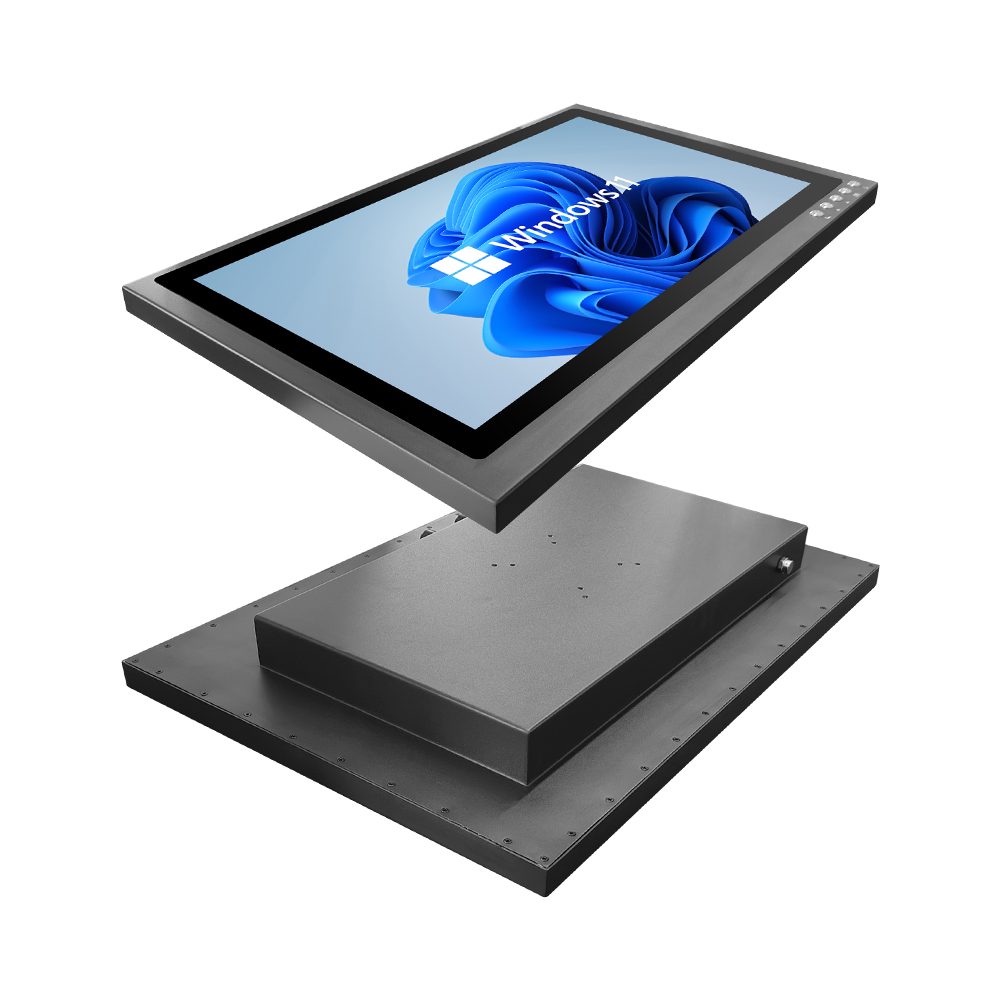
27″ 1500 Nits Black Stainless Marine Monitor
Designed for naval defense consoles, offshore patrol cutters, and commercial bridge navigation. Features 1500 nits daylight readability with LOCA optical wet bonding, non-reflective black oxide passivated SUS316L housing, 0-100% deep night dimming, and IP65 sealing.
2. Deep Night Scotopic Vision Dimming & ECDIS Multi-Signal Versatility
Navigating coastal channels at night requires tailored optical and signal control:
- Sub-Nit Deep PWM Hardware Dimming: Watchstanders require backlight output to dim smoothly below 1 nit without flickering, preventing rhodopsin bleaching in the human eye and preserving biological night vision during dark watches.
- Universal Video Interface Suite (HDMI + DVI + VGA + DP): Directly accepts digital radar processor inputs, ECDIS navigation engines, and legacy camera feeds with screw-locking thumbscrews that resist wave slamming.
- 10-Point Thick Glove PCAP Multi-Touch: Features mutual-capacitance algorithms that filter out sea mist and water condensation while responding smoothly to insulated deck gloves.
Naval Bridge Display Technology Comparison Matrix
| Diagnostic Checkpoint | Commercial Desktop 27″ Screen | Engineered 27″ Black Stainless Monitor |
|---|---|---|
| Bezel Specular Glare | High glare reflection into bridge crew eyes | Zero reflection (Matte black oxide passivation) |
| Peak Screen Luminance | 250 – 350 Nits (Unreadable in daytime sun) | 1500 Nits daylight-viewable industrial WLED |
| Optical Bonding Stack | Air gap (Fogs up and separates at sea) | Full solid LOCA wet resin optical lamination |
| Night Watch Dimming | Bottoms out at 20% (≈50 nits, blinds crew) | Smooth PWM dimming down to < 1 nit (Night safe) |
| Marine Ingress Protection | IP20 unsealed (Salt fog corrodes electronics) | Certified IP65 waterproof and salt-fog resistant |
3. Real-World Field Case: Offshore Patrol Cutter Modernization
An offshore maritime security agency retrofitted bridge navigation consoles across four 85-meter patrol cutters. Previous commercial monitors suffered severe midday glare washouts and blinded watchstanders during night patrols due to poor dimming controls. After standardizing bridge consoles on 27″ 1500 Nits Black Stainless Steel Touch Monitors, bridge officers reported 100% tactical radar clarity under direct noon sun and seamless dark adaptation during night operations across 16 consecutive months of high-seas patrols.
Upgrading naval bridge consoles and commercial vessel helms with 27-inch 1500-nit black stainless steel touch monitors ensures high daytime visibility and tactical night control. Contact INNODA’s naval marine engineering team to request ECDIS color calibration profiles, optical reflection test plots, and custom console cutout drawings.