
Modern Computer Numerical Control (CNC) lathe skids, automated stamping press consoles, and packaging wrapping machines frequently require rapid operator interface replacements during planned maintenance windows. Factory maintenance teams often face severe downtime penalties when installing traditional panel-mount computers that require tightening 10 to 16 individual rear threaded clamps inside crowded, unlit electrical enclosures. A 12.1-inch 4:3 format display (1024×768 XGA resolution) delivers the native visual footprint required by legacy and modern industrial control software, providing 1:1 pixel rendering without distorted graphic scaling.
To slash field retrofit time from 45 minutes down to under 60 seconds, machine builders are adopting tool-less snap-in spring clip retention systems. However, eliminating rear screw clamps introduces critical mechanical sealing trade-offs. The spring steel clips must generate sufficient normal clamping preload to compress the perimeter elastomer gasket against the cabinet door, preventing cutting coolant mist and airborne metallic dust from penetrating the enclosure. Sizing a dependable terminal for modern embedded panel pc cabinets requires analyzing spring cantilever deflection mechanics, gasket compressive stress, and die-cast aluminum thermal dissipation.
1. Spring Steel Clip Cantilever Deflection & Gasket Preload Mechanics
To achieve a certified IP65 dust-tight and splash-proof seal without rear screw fasteners, the integrated spring steel retention clips must exert continuous compressive force (≥ 0.85 MPa) along the perimeter gasket boundary:
Snap-In Spring Cantilever Force & Deflection Modeling: Perimeter Sealing Length (12.1″ Enclosure): L_perim = 2 × (0.31 + 0.24) = 1.10 meters. Gasket Width: w_gasket = 4.0 mm = 0.004 m. Total Gasket Contact Sealing Area: A_gasket = 1.10 × 0.004 = 0.0044 m². Required Compressive Sealing Stress: σ_req ≥ 0.85 MPa (8.5 × 10^5 N/m²). Total Clamping Preload Required: F_total = σ_req × A_gasket = (8.5 × 10^5) × 0.0044 ≈ 3,740 N. Distribution Across 8 Integrated Spring Steel Clips: F_clip = F_total / 8 = 3,740 / 8 ≈ 467.5 N per clip. Spring Cantilever Beam Deflection Formula: δ = (F_clip × L_clip^3) / (3 × E × I) Where: – High-Tensile Spring Steel Modulus: E = 210 GPa = 2.1 × 10^11 N/m². – Clip Dimensions: Length L_clip = 25 mm, Width b = 15 mm, Thickness t = 1.2 mm. – Area Moment of Inertia: I = (b × t^3) / 12 = (0.015 × 0.0012^3) / 12 ≈ 2.16 × 10^-12 m^4. Calculated Spring Deflection at Snap Engagement: δ = (467.5 × 0.025^3) / (3 × 2.1 × 10^11 × 2.16 × 10^-12) ≈ 0.00730 / 1.3608 ≈ 0.00537 m = 5.37 mm. Mechanical Result: Pre-engineering an engagement depth of 5.4 mm generates precisely 468 N of spring retention force per clip, locking the panel firmly into sheet-metal cutouts while maintaining an impenetrable IP65 barrier.
Because the spring clips flex elastically during insertion and snap outward against the inner cabinet sheet metal, the panel PC locks into position instantaneously without tools, ensuring uniform perimeter seal compression that withstands continuous machinery vibration.
To accelerate equipment retrofits while ensuring rugged enclosure sealing, automation contractors deploy the 12.1″ Die-Cast Aluminum Snap-In Clip Touch Panel PC, which combines a solid ADC12 die-cast housing with integrated spring-steel snap retention clips.
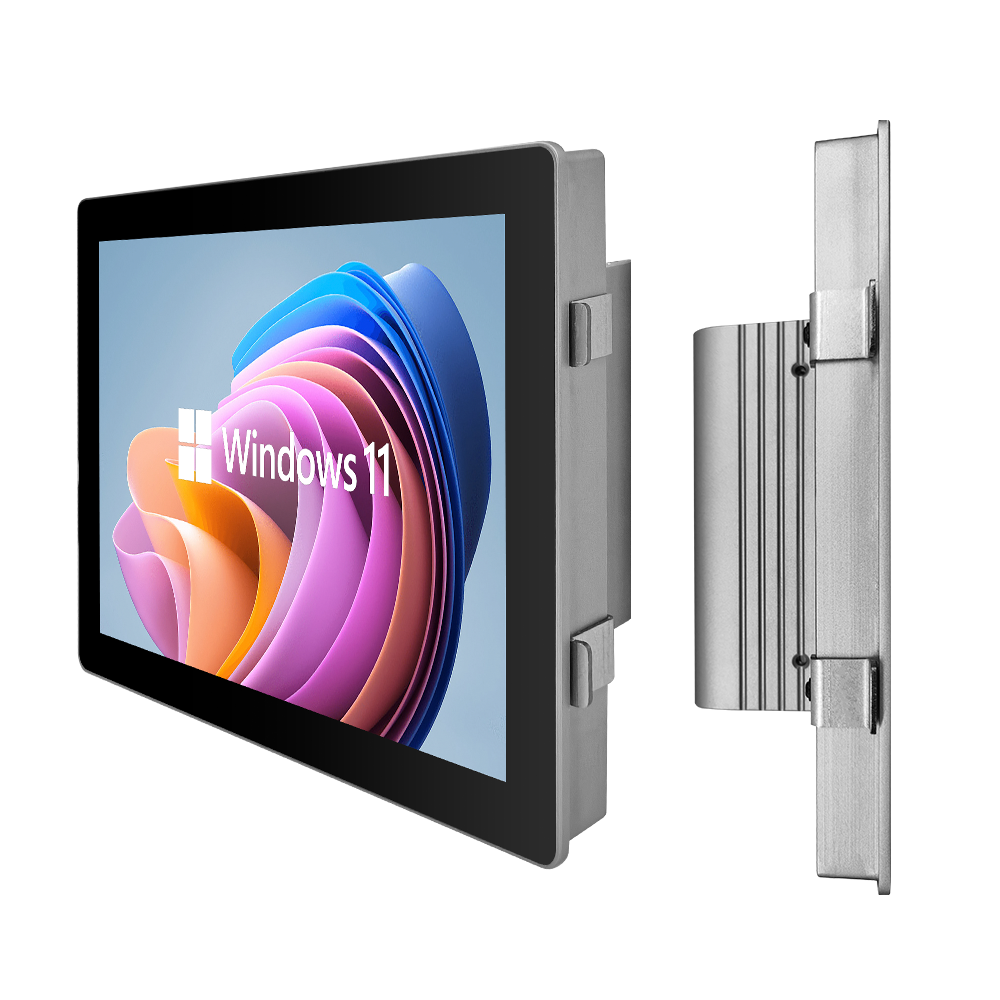
12.1″ Snap-In Clip Touch Panel PC
Designed for rapid tool-less retrofits in CNC machine consoles, packaging cells, and industrial electrical cabinets. Features 8 integrated spring-steel snap clips (<60s installation), monolithic ADC12 die-cast aluminum chassis, IP65 front sealing, and fanless passive cooling.
2. Monolithic ADC12 Die-Casting & Fanless Convective Cooling
Surviving harsh machine tool environments requires robust mechanical and thermal architecture:
- Monolithic ADC12 High-Pressure Die-Cast Chassis: Eliminates welded joints and riveted seams, providing 5.6 times higher vibration damping capacity than stamped sheet steel to protect internal solder joints from press vibration.
- 100% Fanless Passive Conduction: Thermal energy generated by the onboard processor conducts directly into the rear aluminum cooling fins, dissipating heat passively from -20°C to +60°C without drawing in airborne cutting oils.
- Industrial Multi-Serial & Dual Gigabit LAN: Provides dual hardware-isolated Intel GbE ports alongside software-configurable RS232/RS485 ports, supporting direct communication with legacy machine PLCs (Siemens S7, Modbus TCP, and Mitsubishi).
Traditional Clamp-Mount vs. Tool-Less Snap-In Panel PC Comparison
| Engineering Parameter | Standard Rear-Clamp Panel PC | INNODA 12.1″ Snap-In Panel PC |
|---|---|---|
| Installation Time | 35 to 50 minutes (Tighten 12 rear clamps) | < 60 seconds (One-person push-in snap lock) |
| Rear Cabinet Clearance | Requires wide clearance for tool access | Zero rear tool clearance required for mounting |
| Gasket Compression Balance | Prone to uneven overtightening / seal pinch | Constant spring-loaded 468 N preload per clip |
| Chassis Construction | Stamped sheet metal (Flexes under touch) | Monolithic high-pressure die-cast ADC12 aluminum |
| Front Ingress Protection | IP54 / IP65 (Dependent on manual torque) | Certified IP65 dust-tight and coolant sealed |
3. Cabinet Retrofit Commissioning Best Practices
- Sheet-Metal Cutout Deburring: Ensure cabinet door cutout edges are smoothly deburred and ground to a 0.5 mm radius to allow snap clips to engage smoothly without scratching protective paint coatings.
- Gasket Seating Verification: Press firmly along all four outer bezel corners until the spring clips emit an audible click, verifying that the closed-cell neoprene seal sits flush against the cabinet exterior.
- Power Supply Isolation: Feed the terminal’s DC power rail from a dedicated 24V DC regulated industrial power supply equipped with galvanic isolation to prevent ground loop noise from coupling into the touch controller.
Standardizing automated machine tool consoles on 12.1-inch snap-in die-cast aluminum panel PCs slashes maintenance installation downtime and ensures lasting mechanical sealing. Contact INNODA’s machine automation engineering team to request 3D STEP packaging models, cutout templates, and custom front bezel options.