
Modern high-speed CNC machining centers, automated robotic welding cells, and industrial food processing conveyors are transitioning rapidly to 16:9 widescreen operator interfaces. A 15.6-inch Full HD (1920×1080 resolution) industrial touch monitor provides an ideal graphical workspace, allowing line operators to visualize multi-station SCADA mimics, real-time alarm histories, and live motion drive diagnostics side-by-side without screen toggling. Connected via industrial video extensions to central computing nodes, these monitors must survive harsh washdowns and aggressive factory environments.
However, deploying high-sensitivity projected capacitive (PCAP) touch monitors on machinery powered by high-capacity variable frequency drives (VFDs) introduces severe electrical noise challenges. Pulse Width Modulation (PWM) inverter stages switch high voltages at 8 kHz to 16 kHz with extremely steep slew rates (dV/dt > 6 kV/μs). This fast switching injects high-frequency displacement currents into machine frames, causing standard touchscreens to suffer erratic false touches (“ghost touches”) or complete cursor freezing. Designing a dependable terminal for modern waterproof panel pcs operations requires analyzing differential PCAP scanning dynamics, common-mode rejection ratios, and monolithic CNC billet sealing.
1. High-dV/dt Inverter Slew Rates & Differential PCAP Common-Mode Noise Suppression
When high-power servo drives switch inductive motor windings, parasitic stray capacitance between motor leads and the grounded machine chassis injects common-mode displacement currents directly into the display housing:
Parasitic Displacement Current & Common-Mode Attenuation Equation: Displacement Current Spike: I_disp = C_stray × (dV / dt) Where: – Stray Parasitic Capacitance (Motor Cable to Machine Frame): C_stray ≈ 40.0 pF = 4.0 × 10^-11 F. – VFD Inverter Switching Slew Rate: dV/dt = 6.0 kV/μs = 6.0 × 10^9 V/s. Peak Displacement Current Spike: I_disp = (4.0 × 10^-11) × (6.0 × 10^9) = 0.240 Amperes = 240 mA. Vulnerability of Single-Ended Touch Sensing: Conventional single-ended PCAP controllers reference capacitance against chassis ground. A 240 mA high-frequency ground transient induces a false charge shift ΔC > 2.0 pF, triggering continuous phantom clicks. Differential Sensing & Common-Mode Rejection Ratio (CMRR = 64 dB): The advanced touch controller drives adjacent TX electrodes with balanced, 180-degree out-of-phase differential signals, measuring differential voltage: ΔV_sense = V_rx1 – V_rx2. Common-mode noise couples equally into both adjacent sensor traces: V_cm1 ≈ V_cm2 = 12.0 Volts. Residual Noise Voltage after Differential Cancellation: V_residual = V_cm × 10^(-CMRR / 20) = 12.0 × 10^(-64 / 20) = 12.0 × (6.31 × 10^-4) ≈ 0.00757 V = 7.57 mV. Noise Margin: Because residual noise (7.57 mV) remains far below the touch detection threshold (50 mV), the controller completely ignores VFD switching transients.
Because differential measurement cancels out symmetrical common-mode noise pulses, the touch controller ignores high-power motor switching transients, maintaining razor-sharp touch tracking even when installed within inches of heavy AC drive cabinets.
To eliminate electrical interference and cursor freezing on automated packaging lines, automation engineers specify the 15.6″ Full IP65 CNC Waterproof Touch Monitor, which combines a solid 6061-T6 CNC aluminum chassis with an industrial differential PCAP touch engine.
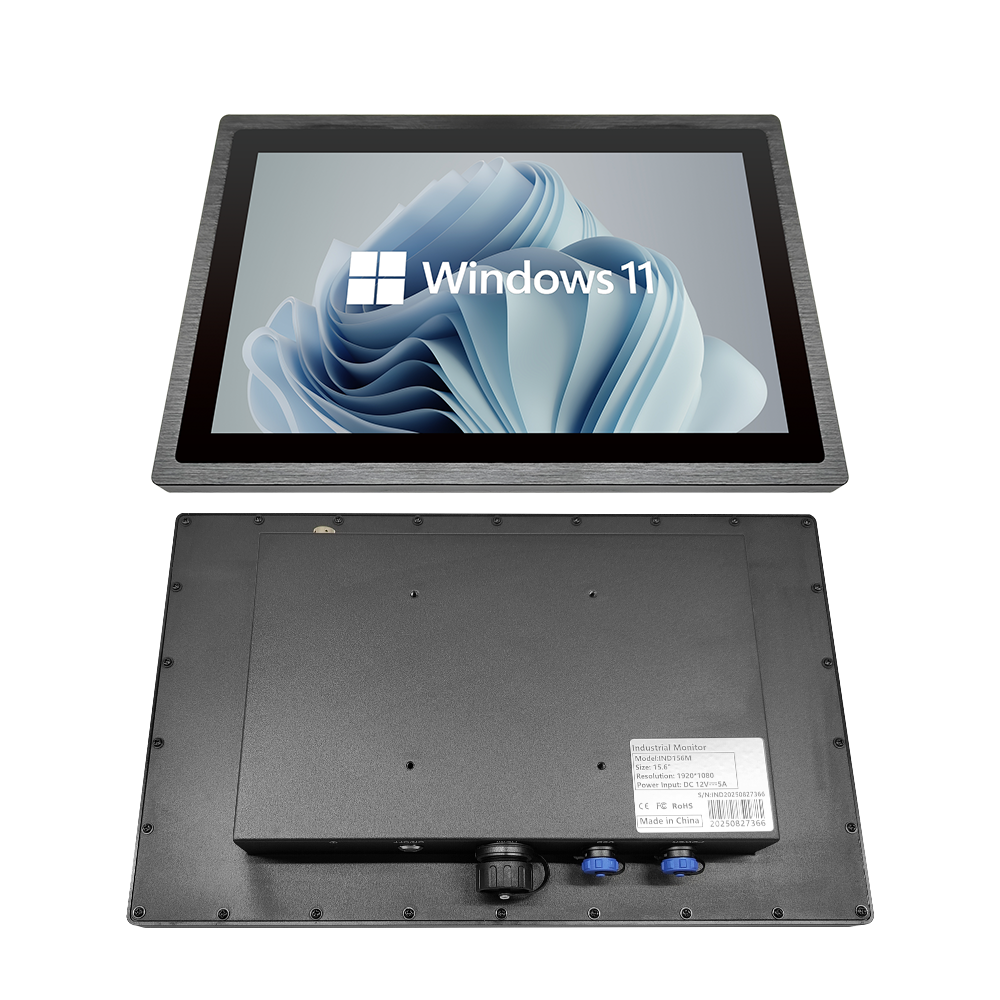
15.6″ Full IP65 CNC Waterproof Touch Monitor
Designed for CNC machine tool consoles, robotic welding cells, and industrial washdown stations. Features a monolithic 6061-T6 CNC aluminum chassis, full IP65 all-round sealing, differential PCAP touch with VFD inverter noise immunity, and screw-locking video inputs.
2. Monolithic CNC 6061-T6 Construction & Washdown Fluid Ingress Defenses
Surviving heavy industrial environments requires comprehensive mechanical and chemical protection:
- Monolithic 6061-T6 CNC Billet Machining: Precision-milled from solid aluminum billet, the housing eliminates stamped sheet-metal seams that bow under vibration, ensuring continuous 1.0 MPa gasket sealing stress across all six faces.
- Full IP65 All-Round Ingress Sealing: Both front face and rear enclosure housing are fully sealed against cutting fluid sprays, lubricating oil mists, and low-pressure water washdowns.
- Chemically Toughened 7H Front Glass: Surface hardness resists micro-scratching from sharp metal swarf, abrasive cutting dust, and aggressive solvent cleaning wipes.
Commercial Touch Monitor vs. Engineered 15.6″ CNC Waterproof Monitor
| Diagnostic Checkpoint | Standard Commercial Monitor | INNODA 15.6″ CNC Waterproof Monitor |
|---|---|---|
| VFD Inverter Noise Immunity | Ghost touches and cursor lockups near drives | Differential PCAP DSP (CMRR ≥ 64 dB noise immunity) |
| Chassis Manufacturing | Folded sheet metal with plastic bezels | Monolithic billet CNC-machined 6061-T6 aluminum |
| Ingress Protection Rating | IP50 / IP54 front only (Rear ports open) | Full IP65 all-round sealed (Front and rear chassis) |
| Surface Glass Hardness | 3H PET film (Scratched by metal chips) | 7H chemically strengthened aluminosilicate glass |
| Video Connector Retention | Unsecured consumer friction-fit HDMI port | Screw-locking industrial HDMI, DVI, and VGA ports |
3. Commissioning Guidelines for Machine Tool Consoles
- Chassis Star Grounding: Connect the dedicated grounding stud on the monitor chassis to the electrical cabinet ground bus using a heavy braided copper strap (≥ 4 mm²) to drain high-frequency electrical transients.
- Video Cable Shielding: Utilize double-shielded industrial HDMI/DVI cables with braided foil shielding, hand-tightening thumbscrews to 0.4 Nm to maintain continuous 360-degree shield engagement.
- Wet Glove Touch Verification: Verify that the touch controller firmware is set to “water-rejection mode,” confirming responsive touch tracking when operators interact using wet nitrile or latex work gloves.
Standardizing automated machine consoles on 15.6-inch full IP65 CNC waterproof touch monitors guarantees clear 1080p widescreen visualization while eliminating VFD electrical noise downtime. Contact INNODA’s industrial display application team to request 3D STEP packaging files, EMI test reports, and custom mounting hardware.