
Modern high-speed logistics parcel sorting hubs, automated automated guided vehicle (AGV) dispatch centers, and heavy industrial machinery cabs require large-format visual operator interfaces. A 17.3-inch widescreen display (16:9 Full HD 1920×1080 resolution) provides the ideal visual canvas, allowing warehouse supervisors to monitor automated barcode scanning tunnels, conveyor belt jam sensors, and live security camera feeds side-by-side. Operating an Android computing platform on a large 17.3-inch display delivers smartphone-like multi-touch fluency combined with industrial-grade 24/7 reliability.
However, deploying large-format touch terminals on heavy machinery presents severe mechanical and processing challenges. Across a wide 420 mm display span, standard stamped sheet-metal bezels flex and bow when operators press virtual buttons, breaking perimeter dust seals. Simultaneously, decoding multiple 1080p RTSP camera streams in software overloads standard ARM CPUs, causing frame drops and touch latency. Designing a dependable terminal for modern touch panel pc networks requires analyzing billet 6061-T6 aluminum flexural stiffness, dedicated Video Processing Unit (VPU) hardware decoding, and IP65 dust-tight front protection.
1. Billet 6061-T6 Flexural Rigidity vs. Stamped Sheet Metal Across 420 mm Spans
When an operator applies heavy touch force (up to 30 N during rapid emergency inputs), the horizontal front bezel resists mechanical bending deflection. Comparing the flexural stiffness (E × I) of a 6.0 mm CNC-machined 6061-T6 aluminum bezel against a standard 1.2 mm stamped sheet steel housing illustrates the mechanical advantage:
Beam Flexural Stiffness & Deflection Resistance Equation: Flexural Rigidity: S = E × I_area Where Area Moment of Inertia for Rectangular Cross-Section (Width b): I_area = (b × t^3) / 12 – Stamped Commercial Sheet Steel: Modulus E_steel ≈ 205 GPa, Thickness t_steel = 1.2 mm = 0.0012 m. – Monolithic CNC 6061-T6 Aluminum: Modulus E_al ≈ 68.9 GPa, Thickness t_al = 6.0 mm = 0.0060 m. Stiffness Ratio Calculation: S_al / S_steel = [ E_al × (t_al)^3 ] / [ E_steel × (t_steel)^3 ] S_al / S_steel = [ 68.9 × (6.0)^3 ] / [ 205 × (1.2)^3 ] = [ 68.9 × 216.0 ] / [ 205 × 1.728 ] S_al / S_steel = 14,882.4 / 354.24 ≈ 42.01. Mechanical Result: The 6.0 mm solid CNC aluminum front bezel delivers 42.0 times higher flexural stiffness than standard 1.2 mm stamped sheet steel, completely preventing bezel deflection across wide 420 mm spans and preserving gasket compression under heavy operator touch force.
Because the CNC aluminum bezel is 42 times stiffer than stamped steel, operator touch forces transfer into the rigid enclosure frame rather than flexing the underlying LCD glass, eliminating premature glass micro-fractures and preventing perimeter seal unseating.
To eliminate enclosure flexing and provide fluid widescreen operator interaction, automation engineers specify the 17.3″ CNC Android Industrial Touch Panel PC, which combines a solid billet 6061-T6 aluminum front frame with an industrial high-performance ARM computing engine.
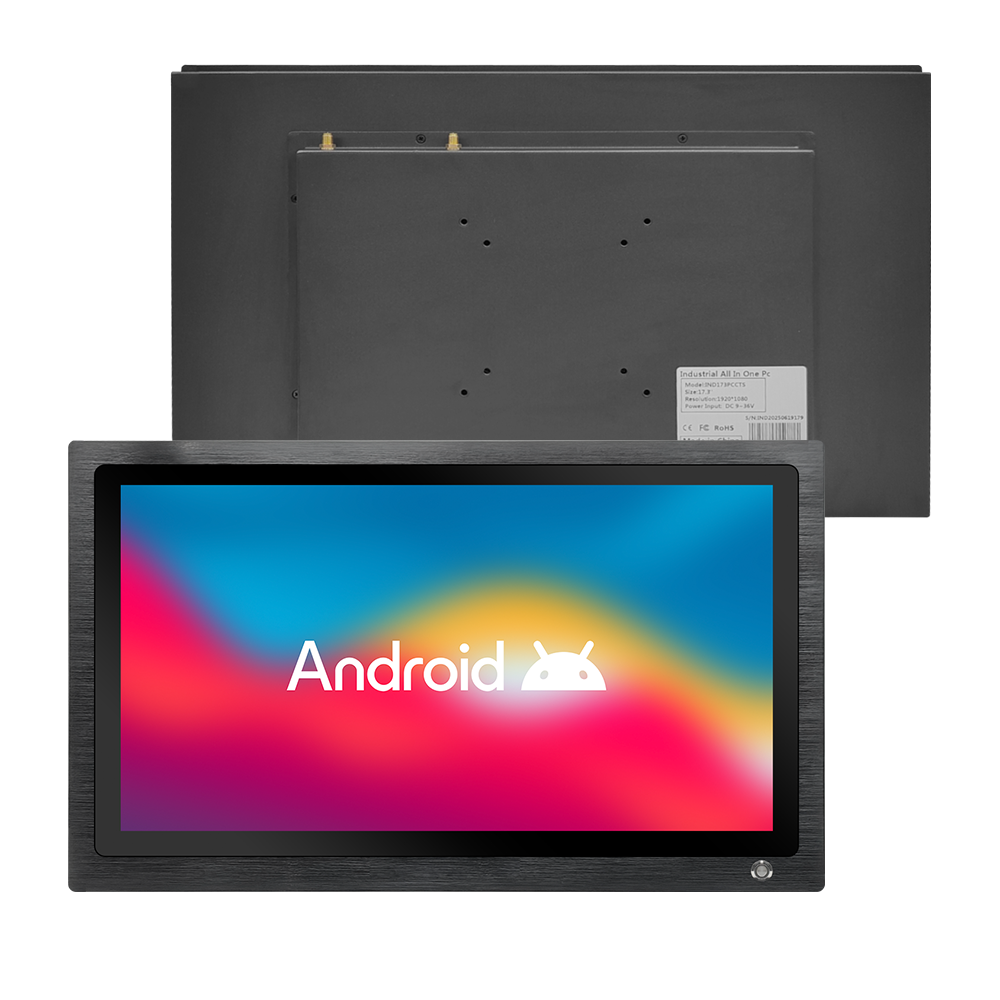
17.3″ CNC Android Industrial Panel PC
Designed for logistics sorting hubs, heavy machinery cabs, and automated SCADA consoles. Features an expansive 17.3″ Full HD widescreen display, solid 6061-T6 CNC aluminum chassis (42x higher stiffness), hardware VPU 1080p video decoding, IP65 front protection, and fanless architecture.
2. Hardware VPU Multi-Channel Video Decoding & 1080p Telemetry
Modern logistics and machine automation require deterministic video and touch execution:
- Dedicated Hardware Video Processing Unit (VPU): Decodes H.264/H.265 1080p video streams in hardware with decode latency under 12 ms, allowing simultaneous display of live conveyor inspection cameras while keeping CPU load below 18%.
- 10-Point Capacitive Multi-Touch with 7H Tempered Glass: Surface hardness resists severe scratching from keys, barcode scanner tips, and shop tools, maintaining high optical clarity across millions of touch actuations.
- Pure Fanless Passive Conduction (-20°C to +70°C): The monolithic aluminum chassis dissipates heat passively without moving parts, preventing airborne cardboard dust and lint from being sucked into the internal electronics chamber.
Commercial Tablet PC vs. Engineered 17.3″ CNC Android Panel PC Comparison
| Engineering Parameter | Commercial Stamped Steel PC | INNODA 17.3″ CNC Android PC |
|---|---|---|
| Front Bezel Construction | 1.2 mm stamped steel (Bows under 30 N touch) | Solid 6.0 mm CNC-machined 6061-T6 aluminum |
| Bending Stiffness Ratio | Baseline flex (Deflects across 420 mm span) | 42.0x Higher bending stiffness (Zero deflection) |
| Video Decode Latency | Software decode (>80 ms lag, drops frames) | Hardware VPU decode (≤ 12 ms low-latency video) |
| Front Ingress Protection | IP50 (Cardboard dust penetrates bezel) | Certified IP65 dust-tight and splash-proof front |
| DC Input Conditioning | Fixed 12V DC ±5% (Vulnerable to brownouts) | Wide DC 9V to 36V with surge suppression |
3. Commissioning Guidelines for Logistics & Machine Consoles
- Console Aperture Verification: Verify the console panel-mount cutout dimensions match the engineering drawing within ±0.5 mm to ensure uniform 30% compression of the perimeter neoprene gasket.
- Panel Clamp Sequence: Tighten the rear panel-mount retention clamps in an alternating diagonal pattern to a uniform torque of 1.0 Nm, ensuring even gasket compression across all four sides.
- Network Stream Optimization: Configure RTSP video streaming buffer sizes to 100 ms within the Android HMI software, enabling real-time conveyor monitoring without network buffer overruns.
Upgrading parcel sorting hubs and machinery consoles with 17.3-inch CNC aluminum Android industrial touch panel PCs ensures structural rigidity and eliminates video decoding lag. Contact INNODA’s logistics automation engineering team to request 3D STEP packaging files, Android BSP documentation, and custom panel cutout drawings.