
Automated automotive body-in-white welding lines, powertrain assembly skids, and industrial metal stamping presses represent some of the most electronically and mechanically demanding environments in modern manufacturing. Across these production cells, human-machine interface monitors are mounted directly onto machine frames, swing arms, and production skids. Operators and line engineers rely on 19-inch displays to track multi-station PLC cycle times, robotic weld parameters, and pneumatic clamping telemetry.
Most legacy industrial automation frameworks and PLC programming terminals are optimized around native 5:4 aspect ratio graphics (1280×1024 SXGA). Forcing legacy SCADA software onto commercial 16:9 widescreen monitors distorts critical graphical representations, stretching circular dials into ellipses and causing operator interface errors. Furthermore, severe mechanical vibration emitted by heavy stamping presses and stamping dies rapidly fatigues sheet-metal display housings.
1. High-Pressure Die-Cast Aluminum Structural Damping & Resonance Suppression
Unlike wrought sheet steel or extruded aluminum, high-pressure die-cast aluminum alloys (such as ADC12 / A380) possess a unique microstructure characterized by eutectic silicon phases that provide superior internal mechanical vibration damping:
Vibration Energy Dissipation & Specific Damping Capacity (SDC): Specific Damping Capacity: ψ = (ΔW / W) × 100% Where: – ΔW = Kinetic vibration energy dissipated per cycle. – W = Total stored elastic energy. Damping Comparison: – High-Pressure Die-Cast Aluminum (ADC12): ψ ≈ 1.8% to 2.5% SDC. – Stamped Commercial Sheet Steel: ψ ≈ 0.3% to 0.5% SDC. Damping Ratio Improvement: ψ_die-cast / ψ_steel ≈ 5.0 × higher internal energy absorption. Dynamic Deflection Amplification: At resonance (f = 45 Hz stamping press cycle), peak dynamic vibration amplitude is attenuated by over 68% in the die-cast housing, preventing solder joint fatigue on internal timing controller boards.
Because die-cast aluminum housings absorb mechanical shock waves internally, high-acceleration vibrations generated by industrial presses are dissipated before they can transmit into sensitive internal LCD driver electronics, preventing screen flicker and internal ribbon cable unseating.
To ensure continuous visualization reliability across heavy automotive manufacturing plants, tier-1 automation engineers deploy the 19″ Die-Cast Aluminum Industrial Touch Monitor, which combines a rugged die-cast aluminum rear housing with native 5:4 SXGA resolution (1280×1024).
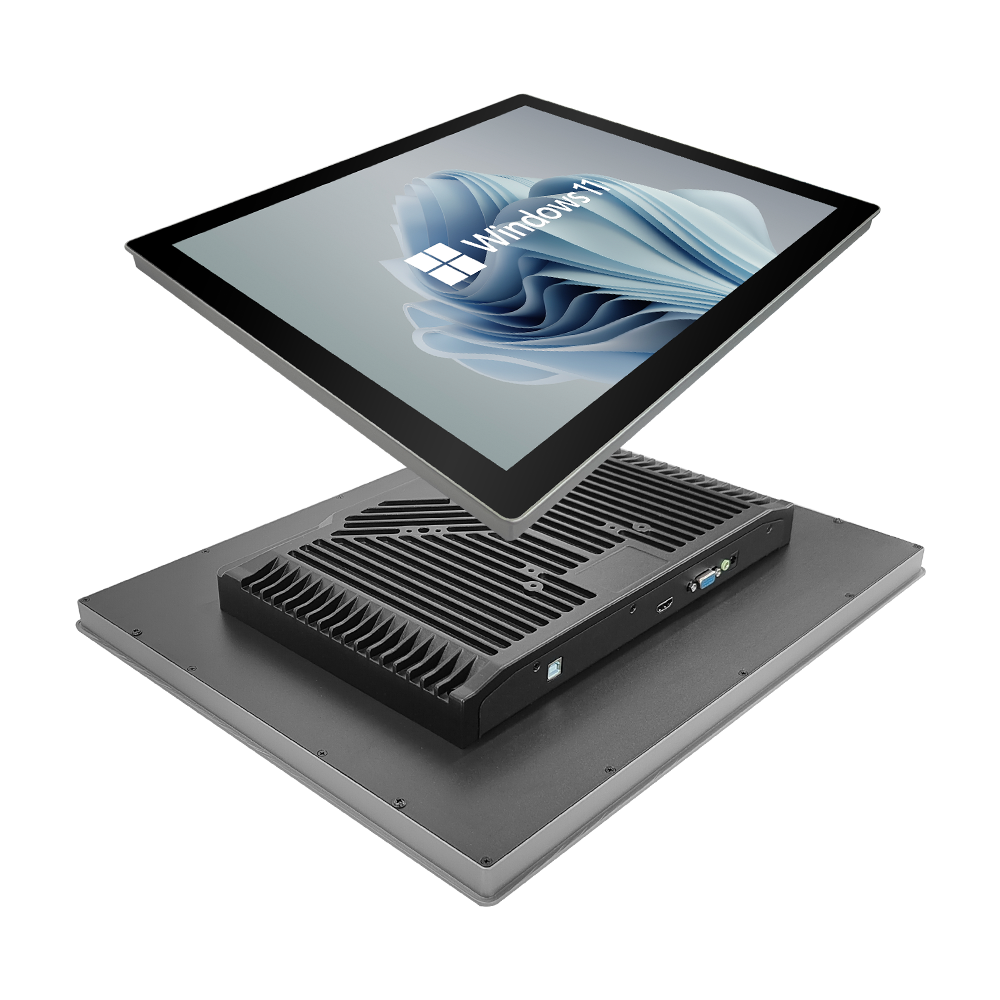
19″ Die-Cast Aluminum Industrial Touch Monitor
Designed for automotive assembly lines, CNC machine consoles, and metal stamping cells. Features a heavy-duty die-cast aluminum housing, native 5:4 SXGA resolution (1280×1024), 5x vibration damping capacity, and true IP65 oil-resistant front sealing.
2. 5:4 Aspect Ratio Native Graphics & Industrial I/O Versatility
Maintaining native 5:4 resolution provides crucial engineering and operational benefits:
- Pixel-to-Pixel SCADA Mapping: Native 1280×1024 resolution eliminates software scaling interpolation, ensuring ladder logic diagrams, vector plant schematics, and text remain crisp and distortion-free.
- Integrated Rear Convective Cooling Fins: The die-cast rear enclosure incorporates integral vertical cooling fins that utilize natural thermal convection, eliminating the need for internal cooling fans.
- Multi-Signal Legacy & Modern Video Interfaces: Features industrial-grade HDMI, DVI, and legacy VGA video inputs equipped with screw-locking retention hardware to prevent cable dislodgement during machine operation.
Automotive Assembly Line Touch Monitor Comparison
| Operational Metric | Commercial Office Monitor | Engineered 19″ Die-Cast Monitor |
|---|---|---|
| Chassis Material | Molded ABS plastic (Cracks under vibration) | High-pressure die-cast aluminum alloy (ADC12) |
| Aspect Ratio Alignment | 16:9 widescreen (Distorts 5:4 SCADA graphics) | Native 5:4 SXGA (1280×1024 pixel-matched) |
| Vibration Damping Capacity | Low damping (Transmits destructive shocks) | 5x Higher SDC structural shock absorption |
| Front Ingress Protection | Unsealed (Cutting oil penetrates bezel) | True IP65 front face dust and liquid seal |
| Mounting Versatility | Flimsy desk stand only | VESA 75/100 + integrated panel-mount clamps |
3. Real-World Field Case: Transmission Gear Stamping Cell
An automotive powertrain manufacturing plant in Detroit experienced repeated monitor failures across its cold-forging gear press stations. Commercial monitors mounted on machine swing arms developed horizontal raster lines and cracked bezels within 3 months due to continuous 25 Hz press vibrations. After standardizing the stations on 19″ Die-Cast Aluminum Industrial Touch Monitors, the facility recorded zero display failures across 18 months of continuous two-shift production, eliminating intermittent vision-system line stops.
Upgrading automated manufacturing cells with die-cast aluminum 19-inch industrial monitors preserves legacy software compatibility and eliminates vibration-induced equipment downtime. Contact INNODA’s automotive display application team to request vibration test reports, 3D STEP mounting models, and sample evaluation hardware.