
Industrial machinery builders, retrofitting specialists, and automated tooling integrators frequently encounter supply chain bottlenecks when sourcing replacement 10.1-inch operator terminals for operational production lines. Thousands of CNC milling skids, robotic packaging cells, and semiconductor test benches continue running legacy panel PCs from major automation brands (such as Advantech, Siemens, and B&R). However, procuring direct replacements from legacy OEMs often involves 16 to 26 weeks of backorder delays and inflated hardware prices. Upgrading to an open-architecture 10.1-inch fanless industrial panel PC provides an immediate drop-in replacement that fits existing cabinet cutouts without metal re-machining.
Executing a successful drop-in replacement requires evaluating structural bezel stiffness and thermal conduction pathways. Many legacy units utilize thin stamped sheet-metal front frames (1.2 mm thickness) that flex when operators press virtual pushbuttons, loosening perimeter seals and allowing cutting fluid mist to bypass enclosure gaskets. Upgrading to a solid CNC-machined 6061-T6 aluminum front bezel increases structural rigidity significantly, but requires verifying panel cutout tolerances, clamping torque limits, and fanless heat spreading.
1. Structural Flexural Rigidity: Solid CNC Aluminum vs. Stamped Sheet Metal
When an operator presses a touchscreen with high force (up to 25 N during rapid machine setting inputs), the front bezel resists mechanical bending deflection. Comparing the flexural stiffness (E × I) of a 5.0 mm CNC-machined 6061-T6 aluminum bezel against a standard 1.2 mm stamped sheet steel housing illustrates the mechanical advantage:
Beam Flexural Stiffness & Deflection Resistance Equation: Flexural Rigidity: S = E × I_area Where Area Moment of Inertia for Rectangular Cross-Section (Width b): I_area = (b × t^3) / 12 – Stamped Commercial Sheet Steel: Modulus E_steel ≈ 205 GPa, Thickness t_steel = 1.2 mm = 0.0012 m. – Monolithic CNC 6061-T6 Aluminum: Modulus E_al ≈ 68.9 GPa, Thickness t_al = 5.0 mm = 0.0050 m. Stiffness Ratio Calculation: S_al / S_steel = [ E_al × (t_al)^3 ] / [ E_steel × (t_steel)^3 ] S_al / S_steel = [ 68.9 × (5.0)^3 ] / [ 205 × (1.2)^3 ] = [ 68.9 × 125.0 ] / [ 205 × 1.728 ] S_al / S_steel = 8,612.5 / 354.24 ≈ 24.31. Mechanical Conclusion: The 5.0 mm solid CNC aluminum front bezel delivers 24.3 times higher flexural stiffness than standard 1.2 mm stamped sheet steel, completely preventing bezel deflection and preserving gasket compression under heavy operator touch force.
Because the CNC aluminum bezel is over 24 times stiffer than stamped steel, operator touch forces transfer into the rigid enclosure frame rather than flexing the underlying LCD glass, eliminating premature glass micro-fractures and preventing perimeter seal unseating.
To execute rapid machine retrofits with high structural durability, automation builders deploy the 10.1″ CNC Aluminum Embedded Panel PC, which combines a solid 6061-T6 aluminum front frame with an energy-efficient fanless architecture designed for standard cabinet apertures.
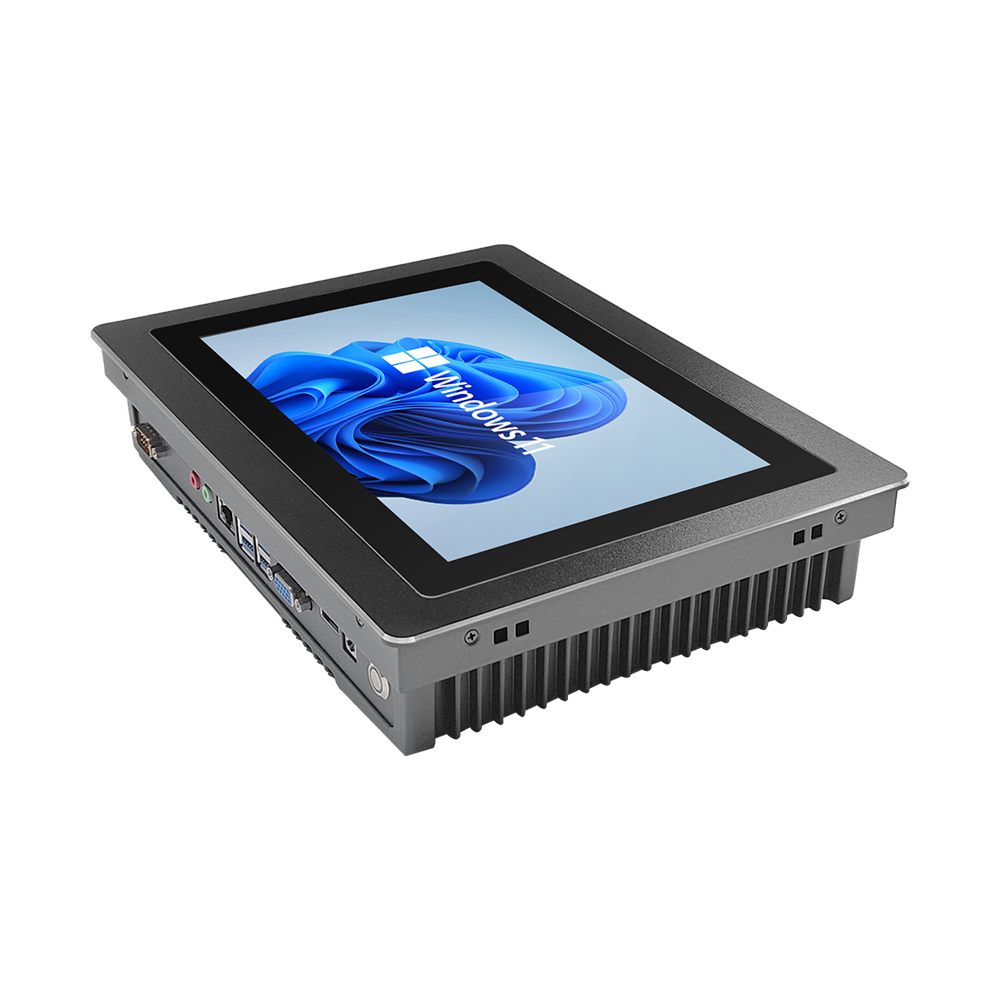
10.1″ CNC Aluminum Embedded Panel PC
Designed as a modern drop-in replacement for aging CNC machine tool consoles and automated test skids. Features a solid 6061-T6 CNC aluminum front bezel (24x higher stiffness), 100% fanless passive cooling, dual Gigabit LAN, and IP65 front washdown sealing.
2. Drop-in Mechanical Cutout & Electrical Interfacing Compatibility
Executing a drop-in replacement on an operational factory line requires streamlined integration:
- Standard Panel-Mount Cutout Compatibility: The outer flange dimensions and cutout profile match standard 10.1-inch industrial formats (266 mm x 180 mm cutout ± 1.0 mm), allowing the unit to slip directly into existing cabinet openings without sheet-metal cutting.
- 100% Fanless Solid Conduction Cooling: Internal processor heat is conducted directly into the monolithic CNC aluminum housing via copper heat pipes (k > 10,000 W/(m·K)), eliminating fans that suck in airborne cutting oils and metallic shavings.
- Multi-Serial & Dual Gigabit Ethernet: Integrates dual hardware-isolated Intel Gigabit LAN controllers alongside software-configurable RS232/RS485 serial ports, supporting seamless communication with legacy machine PLCs (including Siemens S7, Modbus TCP, and Allen-Bradley).
Legacy OEM vs. INNODA 10.1″ CNC Panel PC Comparison
| Engineering Parameter | Legacy Brand 10.1″ Panel PC | INNODA 10.1″ CNC Aluminum PC |
|---|---|---|
| Front Bezel Construction | 1.2 mm stamped sheet steel or plastic trim | Solid 5.0 mm CNC-machined 6061-T6 aluminum |
| Bending Stiffness Ratio | Baseline flex (Deflects under 25 N touch) | 24.3x Higher bending stiffness (Zero deflection) |
| Thermal Dissipation Type | Internal ventilation fan (Draws oily dust) | 100% Fanless solid aluminum passive conduction |
| Front Ingress Protection | IP54 / IP65 with adhesive foam tape | True IP65 dust-tight and oil-mist sealed |
| Replacement Lead Time | 16 to 26 weeks backorder | Standard factory stock (Dispatched in days) |
3. Retrofitting & Commissioning Best Practices
- Cutout Edge Deburring: Ensure the existing machine enclosure cutout opening is fully deburred and degreased to allow the closed-cell neoprene perimeter gasket to seat evenly.
- Diagonal Clamp Torquing: Tighten the rear panel-mount retention clamps in a cross-diagonal sequence to 1.0 Nm of torque using a calibrated screwdriver to avoid localized frame stresses.
- BIOS Watchdog Timer Activation: Enable the hardware watchdog timer in the BIOS menu to ensure automatic system recovery within 60 seconds in the event of an unhandled software lockup on the production line.
Upgrading legacy machine tool consoles with 10.1-inch CNC aluminum embedded panel PCs slashes procurement backorders and provides lasting mechanical durability. Contact INNODA’s machine automation engineering team to request 3D STEP replacement templates, PLC communication pinouts, and custom branding bezels.