
Modern smart manufacturing facilities, automated warehousing distribution hubs, and pharmaceutical MES workstations require high-performance edge computing combined with seamless operator identity authentication. Across these digital production cells, operators interact with 15.0-inch 4:3 displays (1024×768 XGA resolution) to verify work orders, log tool checkouts, and execute automated visual quality inspections. Integrating the flagship Rockchip RK3588 octa-core processor (4x Cortex-A76 + 4x Cortex-A55) alongside an integrated 6 TOPS Neural Processing Unit (NPU) transforms the operator panel into an intelligent edge-AI node.
However, deploying high-throughput edge-AI terminals on the factory floor presents complex electromagnetic and thermal design trade-offs. Running real-time computer vision models generates localized thermal flux, while embedding 13.56 MHz RFID/NFC card readers directly inside CNC aluminum bezels creates severe eddy current losses that degrade card-swiping read distances. Specifying a dependable 15-inch Android AI terminal requires analyzing NPU inference pipeline latency, ferrite magnetic decoupling shielding, and recessed mechanical interface protection.
1. 6 TOPS NPU Edge Inference Latency & Video Pipeline Architecture
Processing local facial recognition, operator PPE compliance checking, and defect classification directly on the terminal eliminates cloud network bandwidth bottlenecks. The RK3588 tri-core NPU executes quantized INT8 neural networks with deterministic latency:
Edge-AI Vision Inference Pipeline & NPU Compute Latency: Target Neural Network: YOLOv8s Quantized INT8 Object Detection Model. Model Computational Complexity: C_model ≈ 28.5 GFLOPs (MACs ≈ 14.25 GMACs). Dedicated NPU Theoretical Peak Compute: P_npu = 6.0 TOPS = 6,000 GOP/s (at INT8). Ideal Compute Execution Time: t_npu = (C_model / P_npu) × 1000 = (28.5 / 6,000) × 1000 ≈ 4.75 ms. Memory Bandwidth Latency (1080p Frame Transfer via LPDDR4x at 34 GB/s): t_dma ≈ (1920 × 1080 × 3 bytes) / (34 × 10^9 bytes/s) ≈ 6.22 MB / 34,000 MB/s ≈ 0.18 ms. Total Edge Pipeline Latency: T_total = t_npu + t_dma ≈ 4.75 + 0.18 ≈ 4.93 ms (~5.0 ms total frame inference). Throughput Advantage: Real-time inference executes at over 120 FPS locally, allowing simultaneous dual-camera processing while keeping CPU load below 20%.
Because the dedicated NPU processes vision inference in under 5 milliseconds, the terminal executes concurrent facial verification and barcode decoding instantaneously without dropping camera preview frames or lagging the primary Android supervisory HMI.
To deliver rapid edge-AI analytics and operator access control on automated lines, system builders deploy the 15″ RK3588 Android Industrial Panel PC with RFID, which couples the RK3588 processor with an integrated 13.56 MHz/125 kHz badge reader and top-mounted industrial camera.
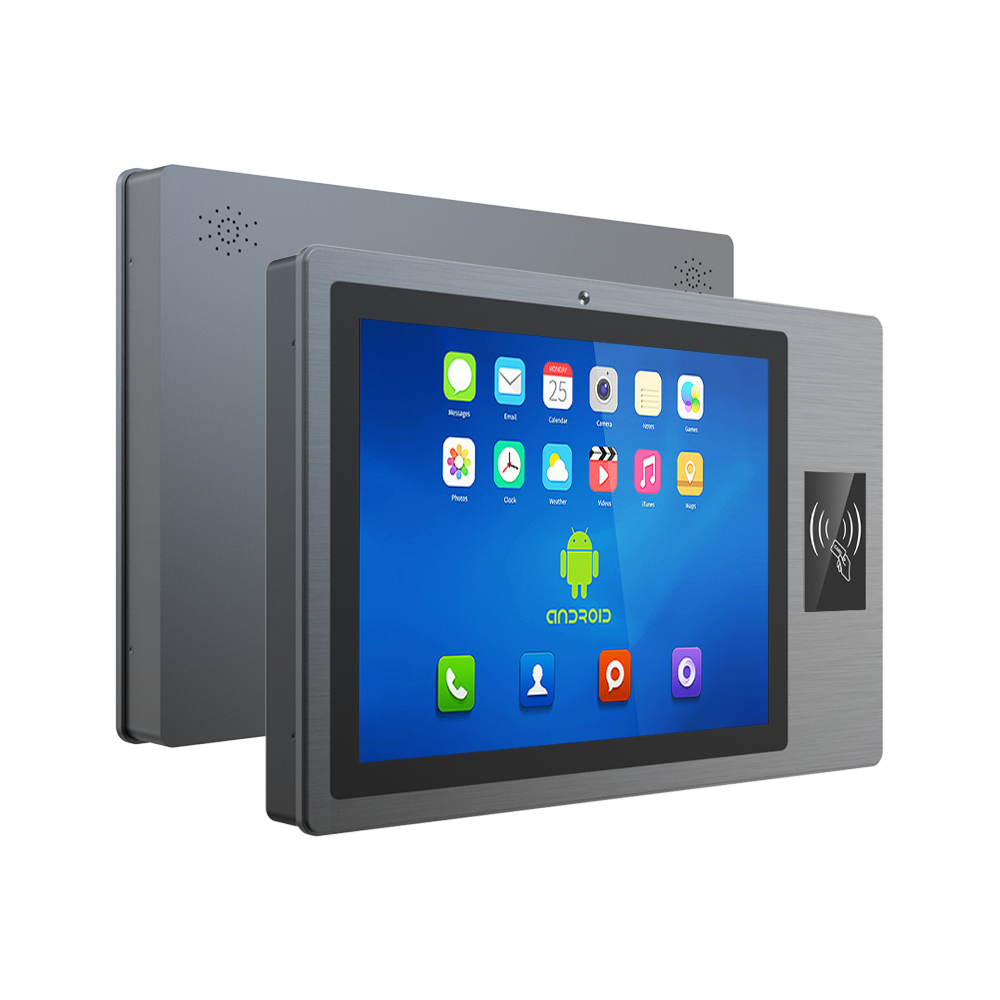
15″ RK3588 Android Industrial Panel PC (RFID)
Designed for smart factory MES terminals, operator access portals, and AI visual inspection stations. Powered by the Rockchip RK3588 octa-core SoC with 6 TOPS NPU, integrated 13.56 MHz RFID/NFC reader, top-mounted industrial camera, IP65 front sealing, and recessed I/O.
2. 13.56 MHz Eddy Current Suppression & Recessed Cabling Cavity
Integrating radio-frequency identification into metal housings requires advanced electromagnetic barrier engineering:
- High-Permeability Sintered Ferrite Shielding: Monolithic aluminum bezels induce counter-electromotive eddy currents at 13.56 MHz that cancel reader magnetic fields. Placing a multi-layer ferrite polymer sheet (μ’ > 120, μ” < 5) behind the antenna isolates the coil from the metal frame, preserving a reliable 30 mm to 50 mm card read range.
- Recessed Collision-Proof I/O Bay: External power, HDMI, dual USB, Gigabit Ethernet, and SIM/TF slots are housed in an undercut bottom-entry cavity, shielding connectors from accidental mechanical impacts by forklift pallets or operator carts.
- Fanless Monolithic Thermal Architecture: Pure passive conduction across the rear aluminum heatsink disperses processor heat across -20°C to +70°C operating ambients without noisy, dust-clogging cooling fans.
Industrial Edge AI Panel PC Comparison Matrix
| Engineering Parameter | Commercial Consumer Tablet | Engineered 15″ RK3588 Panel PC |
|---|---|---|
| AI Acceleration Core | None (CPU software emulation, severe lag) | Hardware 6 TOPS NPU (<5 ms YOLOv8 inference) |
| RFID Integration Quality | External USB dongle (Loose trailing cord) | Integrated bezel RFID/NFC with ferrite shielding |
| I/O Physical Protection | Exposed side ports (Vulnerable to shear) | Recessed undercut bottom-entry collision cavity |
| Front Ingress Protection | IP52 / Unsealed (Dust enters speaker holes) | True IP65 dust-tight and liquid-splash resistant |
| Power Sourcing Architecture | 5V USB battery-backed (Thermal swell risk) | Thread-locking DC 12V / 9V-36V battery-free power |
3. Commissioning Guidelines for MES Workstations
- RFID Reader Field Calibration: Verify that the integrated RFID module reads employee NFC credentials within a calibrated 35 mm distance across 10 consecutive test taps, confirming absence of metal eddy-current degradation.
- Panel-Mount Clamp Sequence: Tighten the rear panel-mount retaining clamps in a cross-diagonal sequence to 1.0 Nm of torque, ensuring uniform compression of the closed-cell perimeter gasket against the enclosure door.
- NPU Driver Verification: Confirm that the Rockchip RKNN runtime daemon (librknnrt.so) is initialized in the Android system image, verifying that camera frames are routed directly to the NPU without CPU memory copying.
Standardizing factory workstations and automated parcel lockers on RK3588-powered Android industrial panel PCs provides powerful edge-AI processing and seamless badge access control. Contact INNODA’s embedded AI engineering team to request RKNN model conversion guides, 3D CAD cutout models, and custom peripheral integration options.