
Modern machine-level automation, automated guided vehicles (AGVs), and compact CNC control stations require space-saving embedded computing hardware. A 10.1-inch widescreen human-machine interface delivers responsive SCADA visualization and real-time fieldbus management within narrow electrical control cabinet footprints. Utilizing Intel’s 10nm Elkhart Lake Celeron J6412 processor (quad-core, up to 2.60 GHz), these embedded touch panel pcs deliver exceptional computing throughput while operating with a modest 10W Thermal Design Power (TDP).
However, operating fanless computing hardware inside unventilated, high-density NEMA 4/12 electrical enclosures presents thermal challenges. In manufacturing facilities without climate control, internal cabinet temperatures routinely reach 55°C to 65°C. Without proper mechanical thermal paths and chassis grounding, processors enter thermal throttling, causing missed motion pulses and production delays.
1. Die-Cast vs. CNC Chassis Thermal Conduction Dynamics
In fanless industrial panel PCs, the structural metal chassis functions as the primary heat sink. Selecting between die-cast aluminum alloys and CNC-machined 6061-T6 aluminum directly affects heat transfer efficiency:
Fourier Conduction Law & Thermal Resistance: R_th = L / (k × A) Thermal Properties Comparison: – High-Pressure Die-Cast Aluminum (A380/ADC12): k ≈ 96 W/(m·K). High silicon content causes acoustic phonon scattering. – CNC Extruded Aluminum (6061-T6): k ≈ 167 W/(m·K). Pure crystalline wrought matrix. Thermal Conduction Advantage: k_6061 / k_A380 = 167 / 96 ≈ 1.74 × (74% faster thermal transfer away from CPU core).
High-pressure die-cast chassis can exhibit localized gas porosity voids (typically 1.5% to 3.0% volume fraction) if injection parameters are not tightly controlled. These micro-voids act as thermal insulating barriers. For high-density computing loads, combining a CNC-machined front bezel with an optimized rear finned heatsink ensures continuous thermal dissipation without hot-spot accumulation.
To deliver continuous performance under severe ambient thermal loading, automation builders deploy the 10.1″ J6412 CNC Aluminum Industrial Panel PC, which incorporates an aluminum conduction block bonded directly to the processor die using high-conductivity phase-change thermal interface material (TIM).
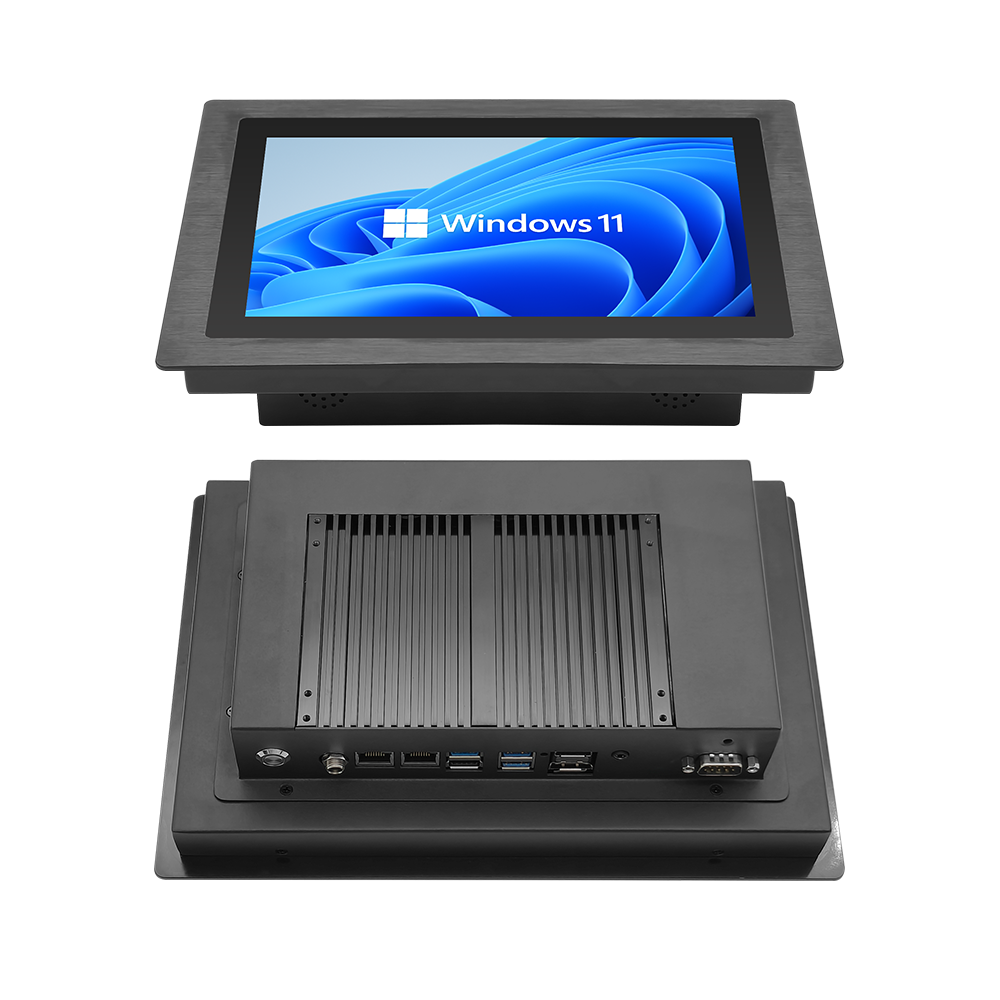
10.1″ J6412 CNC Aluminum Fanless Panel PC
Designed for high-density machine control cabinets, AGVs, and CNC human-machine interfaces. Powered by an Intel Celeron J6412 quad-core processor, solid 6061-T6 aluminum passive conduction chassis, native RS232/RS485 ports, and wide 9V-36V DC input.
2. Preventing Windows/Linux PROCHOT Thermal Clock Throttling
Intel Elkhart Lake processors integrate internal thermal monitoring diodes. When junction temperatures (T_j) reach the factory-set threshold (typically 100°C to 105°C), the bidirectional Processor Hot (PROCHOT) signal engages:
- Performance Throttling Penalty: The processor dynamically scales down core operating clock speeds from 2.60 GHz down to 800 MHz while skipping execution cycles. In machine vision and CNC motion tasks, this clock reduction causes cycle lag, packet drops, and PLC communication watchdogs to trip.
- Thermal Margin Target: Maintaining reliable 24/7 deterministic automation requires engineering the system so that core junction temperatures remain below 80°C when ambient cabinet air sits at 50°C, preserving a ≥ 25°C safety thermal headroom.
- Proper Thermal Pad Preload: Ensuring consistent contact pressure across the internal thermal interface pad is critical. Thermal pads require a calibrated 25% to 30% mechanical compression to eliminate microscopic air gaps without fracturing the semiconductor silicon die.
Compact Embedded Panel PC Engineering Comparison
| Diagnostic Checkpoint | Consumer-Grade Panel Mount Screen | Engineered 10.1″ J6412 Industrial PC |
|---|---|---|
| Processor Thermal Dissipation | Tiny internal fan (Fails from dust in 12 mos) | 100% Fanless solid aluminum passive conduction |
| Cabinet Temperature Ceiling | Throttles above 40°C ambient air | Operates deterministically up to 60°C cabinet air |
| Power Input Protection | Narrow 12V DC ±5% (Vulnerable to brownouts) | Wide DC 9V – 36V with transient surge suppressor |
| Serial Fieldbus I/O | Virtual USB-to-UART (Random COM numbering) | Native Super I/O hardware RS232/RS485 ports |
| Chassis Material Quality | Thin stamped steel with plastic bezel frame | Solid CNC aircraft-grade 6061-T6 aluminum bezel |
3. Electrical Cabinet Enclosure Sizing & Maintenance Routine
- Cabinet Surface Area Heat Sizing: Verify that your sealed electrical control cabinet provides adequate surface area for convective heat dissipation to the outside room air: Required Area: A_cabinet = P_total / (k_cabinet × ΔT) Where k_cabinet ≈ 5.5 W/(m²·°C) for painted steel enclosures, ensuring internal cabinet air does not exceed 55°C.
- Equipotential Earth Grounding: Connect the dedicated chassis grounding screw of the panel PC to the main enclosure earth busbar using a 12 AWG tinned copper bonding strap to eliminate electrical noise induced by adjacent variable frequency drives (VFDs).
- Quarterly Dust Clearance: Use dry, filtered compressed air (< 2 bar) to blow away accumulated airborne dust and lint from the rear aluminum cooling fins every 3 months.
Deploying engineered 10.1-inch fanless J6412 panel PCs ensures deterministic real-time processing and eliminates thermal maintenance downtime in compact control cabinets. Contact INNODA’s embedded application team to request thermal dissipation simulation profiles, 3D STEP packaging models, and OEM customization options.