
In modern industrial manufacturing plants, automated assembly lines, and CNC machining cells, operators rely on secondary touch display stations distributed across machine frames. An embedded industrial monitor installed on a swing arm or electrical enclosure door frequently interfaces with an industrial computing unit located up to 10 to 15 meters away inside a main control cabinet. Connecting high-speed digital video streams (HDMI, DVI, DisplayPort) alongside USB touchscreen data lines over these distances exposes systems to harsh electromagnetic interference.
Factory environments are dense with high-power variable frequency drives (VFDs), large servo motors, and inductive contactors. When display ground lines bridge separate sub-panels with differing electrical potentials, circulating ground currents induce common-mode noise, leading to dropped video frames, horizontal raster tearing, and phantom touchscreen touches.
1. Ground Differential Potentials and Signal Shield Current Conduction
When an industrial monitor is powered from a local machine-frame 24V supply while receiving video from an IPC grounded at a distant main electrical busbar, a non-zero ground potential difference (ΔV_gnd) forms across the cable shield:
Circulating Shield Current & Induced Noise Voltage: I_shield = ΔV_gnd / R_shield_loop For an induced ΔV_gnd = 4.5V AC (generated by adjacent 15 kW spindle motor switching transients) and cable shield resistance R_shield = 0.8 Ω: I_shield = 4.5 / 0.8 ≈ 5.625 A circulating ground current. Induced Differential Mode Error: V_error = M_mutual × (dI_shield / dt) → Peak transient V_error > 380 mV across HDMI TMDS clock lines.
Because Transition-Minimized Differential Signaling (TMDS) in HDMI relies on differential voltage thresholds of ±150 mV to ±200 mV, an induced 380 mV common-mode spike collapses the receiver eye diagram. The display controller loses clock synchronization, causing the monitor to flash black momentarily (“signal drop out”) whenever heavy machinery cycles on.
To preserve signal integrity under factory ground fluctuations, automation engineers deploy the 15.6″ Flat Touch Industrial Monitor, which integrates dedicated galvanic ground decoupling capacitors and high-attenuation common-mode chokes across all video receiver stages.
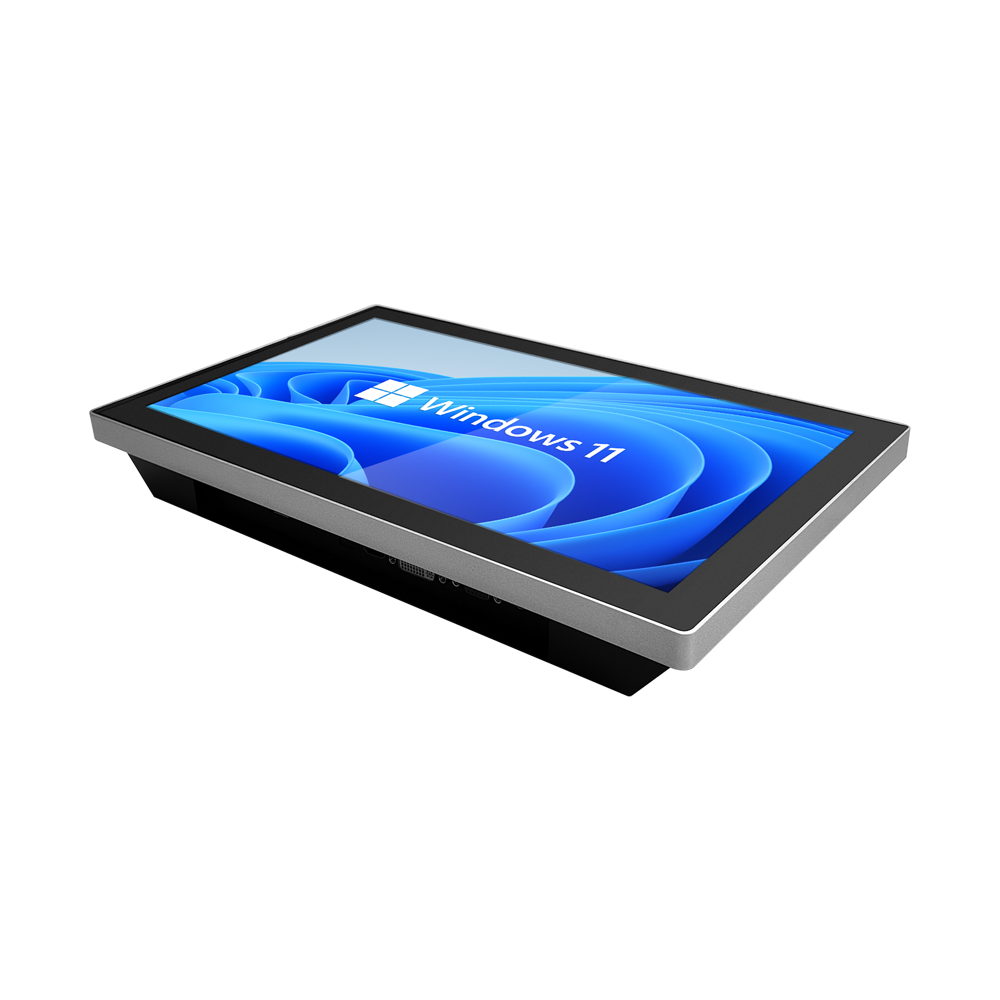
15.6″ Flat Touch Industrial Monitor (Full HD PCAP)
Designed for industrial automation cells, CNC control arms, and SCADA monitoring. Features a true-flat IP65 front glass bezel, 10-point projected capacitive touch, high noise rejection against VFD motors, and industrial HDMI/VGA/DVI inputs.
2. Projected Capacitive (PCAP) Signal-to-Noise Ratio (SNR) Architecture
A true seamless 15.6-inch flat glass front fascia provides exceptional IP65 fluid resistance, but the large glass surface area acts as an antenna for ambient electromagnetic noise:
- Differential Capacitive Scanning: Instead of measuring single-ended capacitance against system ground, advanced touch controllers drive orthogonal TX/RX matrices using differential bipolar pulses. Any radiated noise induced equally across adjacent electrode tracks cancels out at the receiver differential stage.
- Adaptive Frequency Hopping: The internal touch DSP monitors baseline noise across a 50 kHz to 400 kHz spectrum. When high-frequency inverter noise peaks at 150 kHz, the controller shifts its drive frequency to 260 kHz within 2 frame refresh periods (≤ 16 ms).
- Conductive ITO Shield Layer: A dedicated, grounded Indium Tin Oxide (ITO) rear shield layer situated between the LCD backlight and the touch sensor intercepts parasitic capacitive coupling from internal LED driver circuits.
Industrial Touch Monitor Signal & Optical Comparison
| Engineering Parameter | Standard Commercial Monitor | Engineered 15.6″ Flat Industrial Monitor |
|---|---|---|
| Common-Mode Rejection (CMRR) | < 20 dB (Vulnerable to VFD motor hash) | > 45 dB with active common-mode line chokes |
| Touch Controller SNR | Single-ended scan (SNR ≈ 12:1, false touches) | Differential PCAP DSP (SNR > 35:1 with noise hopping) |
| Front Surface Geometry | Raised plastic bezel with dust crevices | Edge-to-edge true flat tempered glass (IP65 front) |
| Video Inputs | HDMI only (Consumer unshielded port) | Industrial HDMI, VGA, DVI with screw-locking posts |
| Power Stage Isolation | Non-isolated external plastic brick | Wide DC 12V-36V input with 1.5 kV surge isolation |
3. Commissioning Guidelines for Long Cable Runs
- Equipotential Bonding: Install a heavy 6 mm² green/yellow bonding strap connecting the monitor chassis earth stud directly to the machine swing-arm structural ground to eliminate static potential float.
- Cable Run Separation: Route video and USB touch communication cables through separate metallic conduit or wireways located at least 200 mm away from 3-phase AC spindle motor cables.
- Locking Hardware Engagement: Tighten DVI and VGA thumbscrews to 0.4 Nm, and utilize screw-locking HDMI cables to ensure outer shield continuity remains intact under machine vibration.
Integrating hardened flat-touch industrial monitors prevents intermittent display blackouts and ensures crisp HMI visualization on noisy factory floors. Contact INNODA’s display interface engineering team for signal eye-diagram test data, custom touch firmware profiles, and mounting bracket specifications.