
Pharmaceutical compounding suites, semiconductor wafer fabs, and sterile biotechnology suites operating under ISO 14644-1 cleanroom classifications enforce stringent contamination protocols. Airborne particulate counts are strictly regulated, and wall interfaces undergo continuous chemical wipe-downs using aggressive sterilizing agents such as vaporized hydrogen peroxide (VHP), 70% isopropyl alcohol (IPA), and sporicidal hypochlorite solutions.
When engineering human-machine interfaces (HMIs) integrated directly into cleanroom sandwich wall panels or stainless steel machine consoles, conventional raised-bezel industrial monitors introduce severe contamination risks: perimeter dirt traps, bacterial harbor seams, and laminar airflow turbulence.
1. Hygienic Design Physics: DIN EN 1672-2 Compliance & Dead-Zone Elimination
Traditional panel-mount hardware utilizes stepped front bezels extending 5mm to 10mm from the mounting surface. In cleanroom environments, this raised profile disrupts vertical laminar airflow, creating microscopic eddy currents where airborne aerosols deposit. Furthermore, manual sanitization sponges cannot penetrate 90-degree step corners, leaving chemical residues and bio-burden behind.
Under international sanitary machinery standards (DIN EN 1672-2 and EHEDG guidelines), all food and pharmaceutical contact interfaces must eliminate acute internal angles, mandating continuous curvature radii:
Minimum Corner Radius: R ≥ 3.0 mm (Zero Crevice Geometry)
Deploying purpose-built hygienic hardware such as the 15″ Flush Panel Mount Stainless Steel Industrial PC solves this architectural challenge. The outer SUS304 front bezel is precision-machined with tapered transitions, sitting flush against the cutout boundary. Paired with a continuous true-flat projected capacitive (PCAP) glass faceplate, it presents an uninterrupted plane that allows sanitizing wipes to glide across without snagging or leaving unsterilized dead zones.
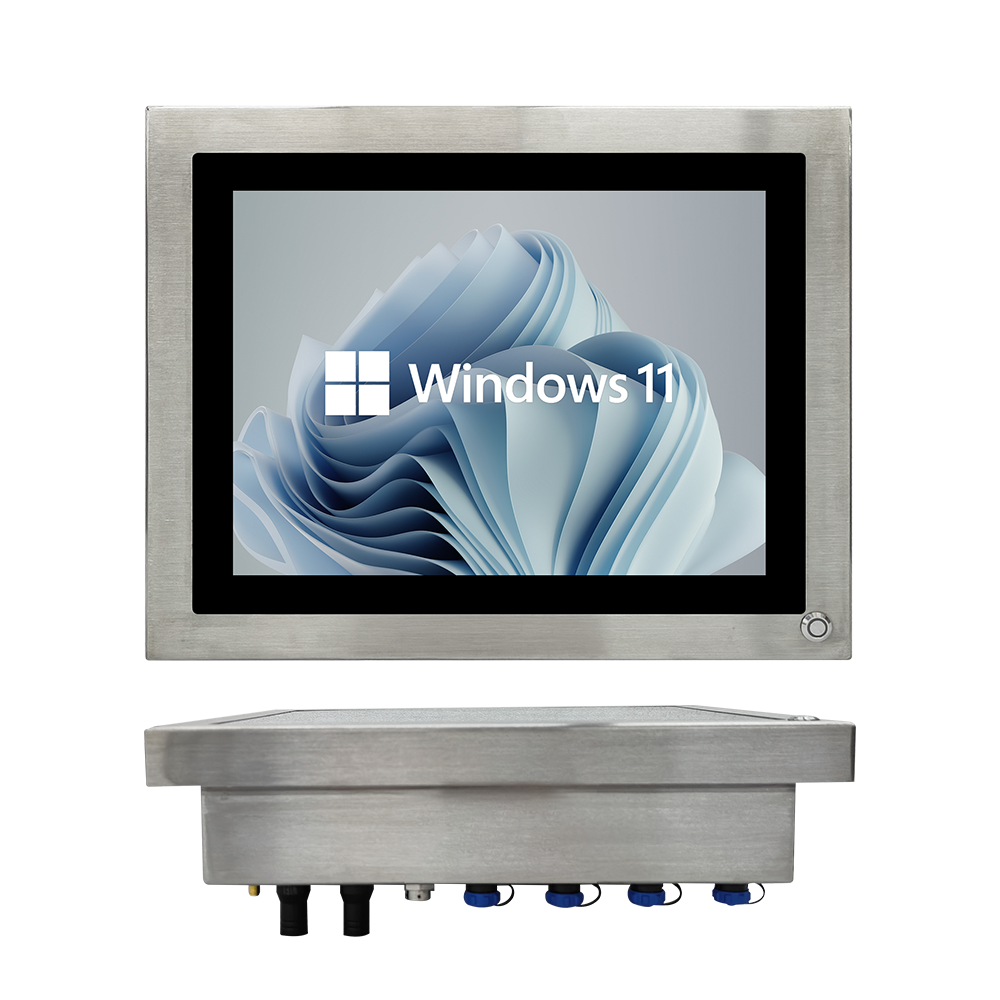
15″ Flush Panel Mount Stainless Steel Industrial Panel PC
Engineered for ISO-classified pharmaceutical cleanrooms and sterile food packaging suites. Features a seamless flush-mount SUS304 stainless steel front bezel, electropolished Ra ≤ 0.4 μm finish, IP65 true-flat PCAP multi-touch, and fanless passive thermal conduction.
2. Material Passivation & Surface Metrology: Electropolished SUS304
Cleanroom-grade stainless steel performance is dictated by micro-roughness metrology. Standard brushed sheet metal features longitudinal microscopic valleys where microbes anchor. Industrial cleanroom panel PCs utilize electropolished austenitic AISI 304 stainless steel:
- Surface Micro-Roughness: The chemical electropolishing process removes microscopic peaks, achieving an average surface roughness of Ra ≤ 0.4 μm. This ultra-smooth barrier reduces bacterial adhesion by over 99.8% compared to standard mill-finish steel.
- Passive Chromium Oxide Barrier: Electropolishing enriches the surface chromium-to-iron ratio (Cr/Fe ≥ 1.5), producing a dense 2–3 nm chromium oxide (Cr2O3) passive film that prevents pitting degradation during repeated VHP sterilization cycles.
Cleanroom Panel Mount Engineering Matrix
| Engineering Parameter | Standard Industrial PC | Flush-Mount Cleanroom Panel PC |
|---|---|---|
| Front Bezel Profile | Raised 6–10mm lip (Airflow turbulence trap) | Seamless true-flat flush mount (Zero trap) |
| Surface Roughness (Ra) | Ra > 1.2 μm (Porous to bacterial spores) | Ra ≤ 0.4 μm (Electropolished hygienic finish) |
| Sterilization Resistance | Chassis paint bubbles under IPA/VHP | Impervious to IPA, VHP, and sporicides |
| Touch Sensor Interface | Standard resistive or grooved PCAP | 7H chemically strengthened edge-to-edge PCAP |
Are you engineering an ISO-classified cleanroom console, pharmaceutical batching terminal, or sterile filling station? Contact INNODA’s hygienic engineering specialists for flush cutout engineering DXF files, surface roughness profilometer certifications, and chemical compatibility documentation.