
Offshore sportfishing captains, commercial trawler operators, and yacht refit integrators frequently confront a costly architectural limitation when upgrading bridge electronics: legacy marine Multi-Function Displays (MFDs) lock users into closed, proprietary operating systems. Replacing an aging helm screen often requires discarding functional sonar transducers or paying steep OEM licensing fees for restricted chart formats. Transitioning to an open-architecture marine chartplotter panel PC—available across 12.1-inch, 15.6-inch, 18.5-inch, and 21.5-inch widescreen formats—eliminates external black-box processors by integrating Rockchip RK3576 (Android 14) or Intel N100 (Windows 11 / Linux) computing directly inside a full IP67 waterproof marine enclosure.
However, deploying a standalone marine computing terminal on an open flybridge or center-console helm introduces severe electrical and optical challenges. High-horsepower diesel engines and outboard starters cause severe battery bus voltage sags during ignition, while tropical sunlight and polarized fishing sunglasses render standard LCDs completely black. Selecting a reliable terminal within modern rugged marine display architectures requires analyzing wide-range buck-boost power regulation, native NMEA 2000/0183 bus isolation, and quarter-wave plate (QWP) polarized optics.
1. Marine Engine Cranking Voltage Sag & Wide DC 9V-36V Buck-Boost Regulation
When a captain cranks high-compression marine diesel engines or twin offshore outboards, heavy starter motor inrush current drags a nominal 12V lead-acid or LiFePO4 house battery bus down to 9.2V DC. Standard 12V marine displays reboot mid-crank, losing active GPS tracks and sonar bottom locks. A wide-range synchronous buck-boost power stage maintains continuous system stability:
Marine Starter Cranking Voltage Sag & Buck-Boost Current Equation: Full-Load Terminal Power Draw (1500 Nits Backlight + CPU + NMEA 2000): P_load = 32.0 Watts. Buck-Boost Converter Conversion Efficiency: η_conv = 92.0% (0.92). Worst-Case Engine Cranking Bus Voltage: V_crank = 9.20 Volts DC. Peak Input Current Draw during Cranking: I_input = P_load / (V_crank × η_conv) = 32.0 / (9.20 × 0.92) = 32.0 / 8.464 ≈ 3.78 Amperes. Electrical Protection Margin: The thread-locking circular power port and internal power stage are rated for 8.0 A continuous current across DC 9V to 36V, integrating ISO 7637-2 transient voltage suppressors (TVS) that clamp inductive alternator load-dump spikes without rebooting the chartplotter OS.
Because the internal synchronous buck-boost regulator sustains clean logic power down to 9.0V DC, captains can restart engines offshore without losing critical waypoint routes, AIS targets, or active sonar sweeps.
To consolidate chartplotting, fishfinding, and vessel telemetry onto a single standalone bridge terminal, marine integrators deploy the 12.1″ to 21.5″ Marine Chartplotter Panel PC (NMEA 2000, IP67), which integrates native NMEA 2000/0183 ports, internal GPS with an external SMA antenna jack, and 1500-nit polarized-sunglasses-readable optics.
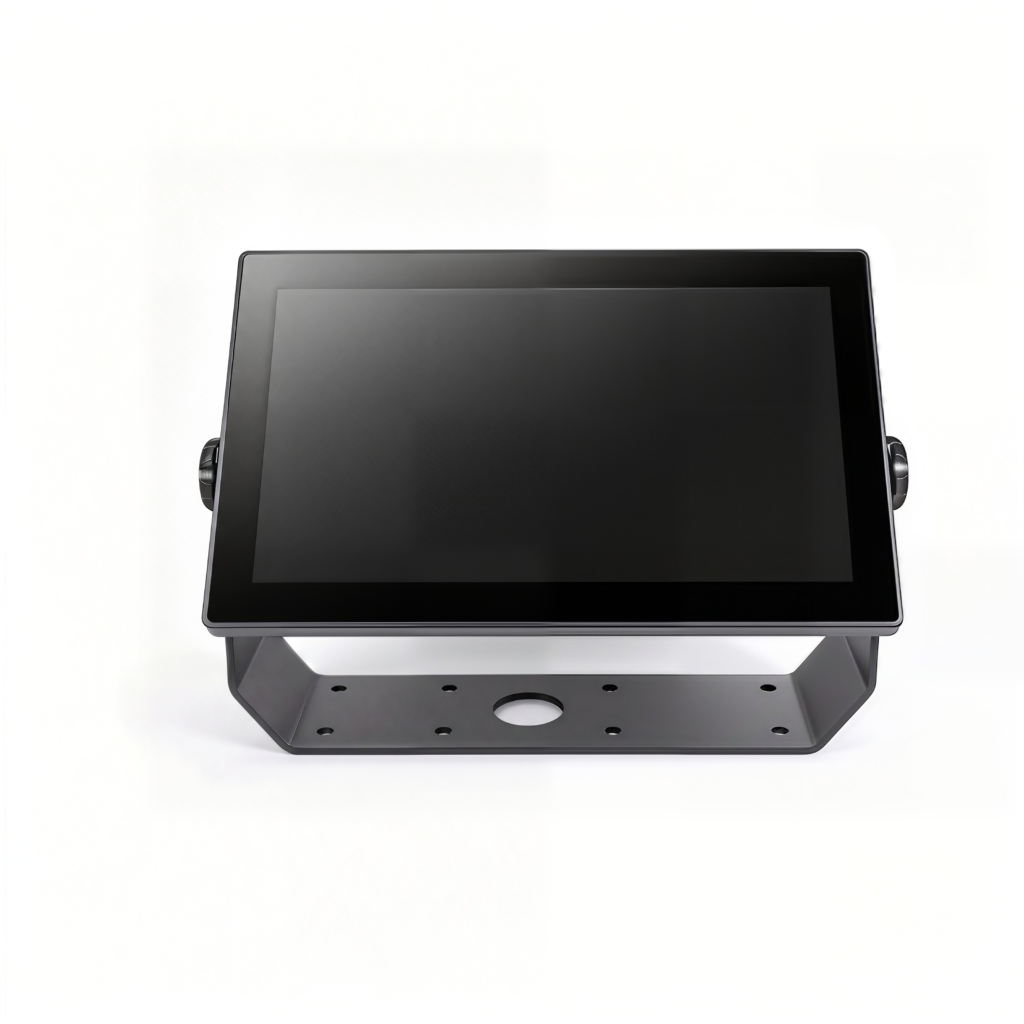
12.1″-21.5″ Marine Chartplotter Panel PC (NMEA 2000)
All-in-one standalone marine MFD powered by Rockchip RK3576 (Android 14) or Intel N100 (Windows 11/Linux). Features 1500 nits sunlight & polarized sunglasses readability, optical bonding, native waterproof NMEA 2000/0183 ports, internal GPS with external SMA antenna, full IP67 sealing, and DC 9V-36V input.
2. Native NMEA 2000 / NMEA 0183 Protocols & Polarized Sunglasses Readability
Replacing proprietary marine chartplotters requires comprehensive marine protocol and optical engineering:
- Native Waterproof NMEA 2000 & NMEA 0183 Interfaces: Connects directly to vessel CAN-bus backbones to ingest real-time engine RPM, fuel flow, autopilot heading, depth sounder, and AIS transponder data without external USB-to-NMEA gateway dongles.
- 1500 Nits + Quarter-Wave Plate (QWP) Polarized Optics: Linearly polarized LCD light turns completely black when viewed through polarized fishing sunglasses at certain head angles. Bonding a QWP optical retarder transforms linear light into circularly polarized light, maintaining 100% visibility across all 360-degree viewing angles under 100,000-lux sun.
- Full IP67 Immersion Sealing & Front Touch-Lock Key: Features a CNC-machined anti-corrosion aluminum housing with a hydrophobic pressure breather valve, waterproof RJ45/USB/HDMI aviation connectors, and a physical front touch-lock button to prevent accidental screen taps during heavy offshore swells.
Proprietary Marine Brand MFD vs. INNODA All-in-One Chartplotter PC
| Marine Engineering Factor | Closed Proprietary Marine MFD | INNODA 12.1″-21.5″ Marine Panel PC |
|---|---|---|
| Computing & Chart OS | Locked vendor OS (Expensive proprietary charts) | Open RK3576 (Android 14) or Intel N100 (Win11/Linux) |
| Marine Vessel Bus | Requires brand-specific adapter cables | Native waterproof NMEA 2000 + NMEA 0183 ports |
| Polarized Glasses View | Dims or blacks out at 45°-90° head tilt | 1500 Nits + QWP circular polarization + Optical Bonding |
| GPS Reception in Cabin | Internal patch blocked by metal/hardtop roofs | Built-in GPS + external waterproof SMA antenna port |
| Mounting Flexibility | Flush dash mount only (Bracket sold extra) | Includes heavy side gimbal bracket + VESA + flush mount |
3. Helm Installation & Commissioning Guidelines
- NMEA 2000 Backbone Termination: Connect the waterproof NMEA 2000 drop cable to a T-connector on the vessel’s powered backbone, confirming both ends of the main trunk are terminated with 120-Ω resistors.
- External SMA GPS Antenna Routing: When mounting inside an enclosed pilothouse or beneath a fiberglass hardtop, connect an external marine-grade SMA GPS antenna with a clear sky view to guarantee sub-2-meter WAAS/SBAS positioning accuracy.
- Side Gimbal Bracket & Ground Bonding: Tighten the dual side gimbal knobs firmly against rubber friction washers to resist wave slamming, and bond the rear chassis ground lug to the vessel’s DC negative bus.
Upgrading offshore sportfishing boats and commercial workboats with open-architecture 12.1-inch to 21.5-inch marine chartplotter panel PCs eliminates proprietary vendor lock-in and delivers superior daylight readability. Contact INNODA’s marine electronics engineering team to request NMEA 2000 PGN compatibility lists, CAD mounting templates, and custom dual-screen helm packages.