
Compact Computer Numerical Control (CNC) machinery, automated dispensing stations, and chemical batch skids rely on 12.1-inch human-machine interfaces to deliver localized machine control. A 12.1-inch 4:3 format (1024×768 XGA resolution) provides an ideal physical footprint for integration directly onto machine frames and compact electrical enclosures. Operating fanless computing hardware in these high-vibration, coolant-splashed environments demands strict adherence to preventative maintenance protocols.
Over extended operating periods, industrial computing hardware faces two primary field failure mechanisms: elastomeric gasket compression set that permits cutting fluid ingress, and high-frequency ground noise emitted by adjacent Variable Frequency Drives (VFDs) that corrupts touch tracking and serial communication lines.
1. Elastomeric O-Ring Compression Set & Seal Elasticity Loss
Full IP65 waterproof sealing in CNC panel PCs relies on an elastomeric O-ring compressed between precision-machined aluminum housing halves. Under continuous mechanical clamping combined with thermal cycling (fluctuating between 20°C ambient and 55°C operating temperature), elastomers lose their elastic recovery stress:
Elastomeric Compression Set Equation (ASTM D395 Method B): C_s = [ (h_0 – h_1) / (h_0 – h_s) ] × 100% Where: – h_0 = Original uncompressed O-ring cross-section diameter (3.00 mm). – h_s = Groove depth / compressed height limit (2.10 mm → 30% nominal compression). – h_1 = Final recovered height measured after 2,000 hours of continuous service. Failure Threshold: If standard commercial nitrile (NBR) is exposed to synthetic machining coolants: C_s exceeds 45% (Recovered height h_1 drops below 2.50 mm). Result: Sealing contact pressure drops below the critical 0.65 MPa threshold, allowing low-surface-tension cutting emulsions to seep into the internal motherboard chamber.
To eliminate seal relaxation failures, precision-machined terminals utilize closed-cell fluorosilicone or premium Viton elastomers that maintain compression set below 18%, preserving continuous elastic sealing contact force across years of coolant exposure.
To guarantee lasting ingress protection under abrasive machine shop conditions, automation engineers standardize on the 12.1″ Full IP65 CNC Waterproof Industrial Panel PC, which combines a monolithic CNC-machined 6061 aluminum enclosure with precision-retained fluorosilicone perimeter O-rings.
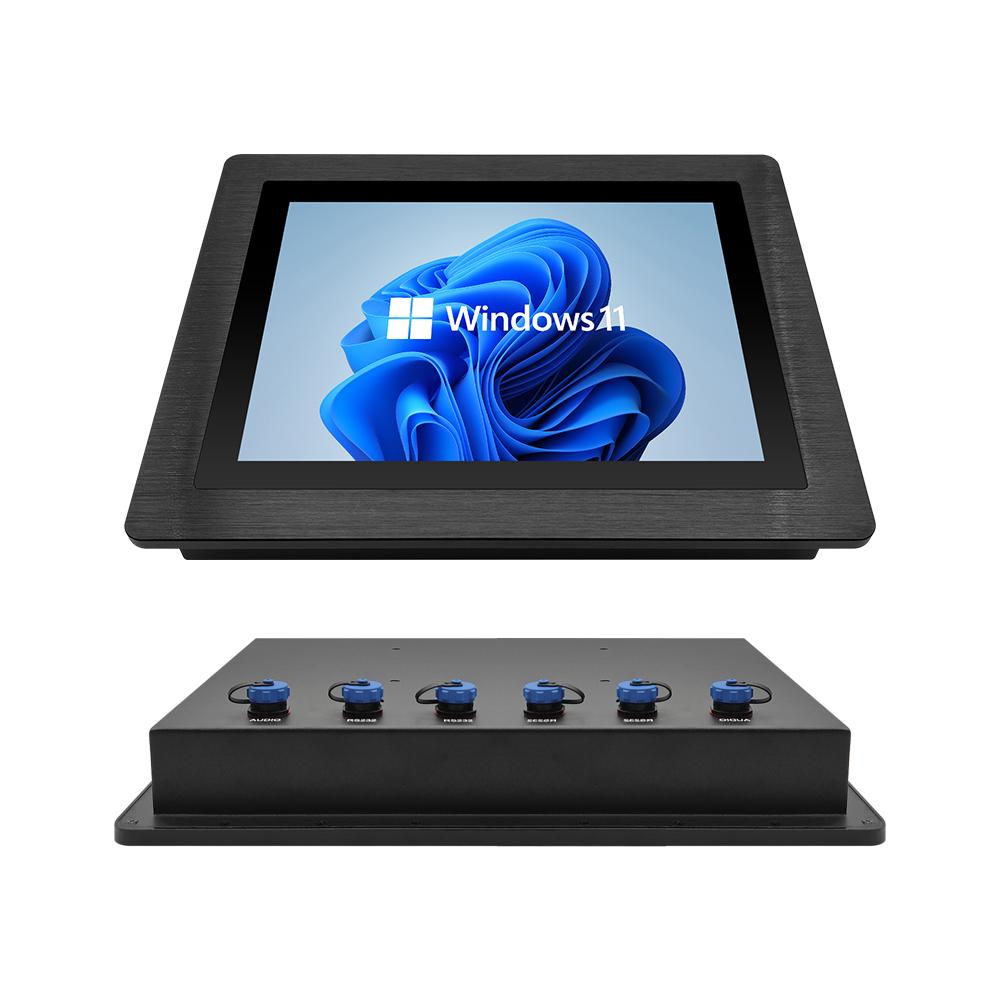
12.1″ Full IP65 CNC Waterproof Industrial Panel PC
Built for harsh CNC machine tools, automated skids, and coolant-spray environments. Features a monolithic 6061-T6 CNC aluminum chassis, full IP65 waterproof sealing, oil-resistant fluorosilicone O-rings, and advanced PCAP noise immunity against high-power spindle motors.
2. Mitigating High-Frequency VFD Common-Mode Ground Noise
Modern CNC machine tools utilize pulse-width modulated (PWM) AC servo drives and spindle inverters. High switching speeds (dV/dt > 5 kV/μs) create capacitive leakage currents through motor bearings and cables directly into the machine frame:
- Touchscreen Jitter & False Actuations: When the panel PC chassis is connected to a noisy machine ground, common-mode ground noise couples into the projected capacitive (PCAP) sensing electrodes, causing erratic cursor jumping and unregistered operator clicks.
- Single-Point Star Grounding: Connect the panel PC dedicated grounding lug directly to the central electrical panel star ground bus using a low-inductance braided copper ground strap (≥ 6 mm²), rather than chaining ground through adjacent motor mount brackets.
- Galvanic Serial & Ethernet Isolation: Ensure all RS485 and LAN communication lines connecting to external PLCs incorporate 1.5 kV to 2.5 kV galvanic isolation barriers to prevent circulating ground currents from burning out PHY communication transceivers.
Compact CNC Industrial PC Diagnostic Matrix
| Diagnostic Checkpoint | Standard Commercial Panel PC | Engineered 12.1″ CNC Waterproof PC |
|---|---|---|
| Chassis Construction | Stamped sheet metal with plastic snap-tabs | Solid billet CNC-machined 6061-T6 aluminum |
| Coolant Chemical Durability | Gasket softens and swells in cutting oil | High-grade fluorosilicone (Resists synthetic oils) |
| VFD EMI Immunity | Erratic touch behavior near 10 kW spindle motors | Differential PCAP filtering with auto-frequency hopping |
| Thermal Dissipation Method | Internal fan (Clogs with oil mist within months) | 100% Fanless solid aluminum passive heatsink |
| Ingress Protection Rating | IP54 / IP65 front face only | Full IP65 (Front, rear housing, and all I/O ports) |
3. Semi-Annual Preventative Maintenance Checklist
- O-Ring Inspection & Cleaning: Every 6 months, clean accumulated cutting oil sludge from around the outer chassis seams using pure isopropyl alcohol. Inspect perimeter fluorosilicone seals for hardening or chemical degradation.
- Thermal Conduction Path Clearance: Use low-pressure dry compressed air (< 2 bar) to clear airborne chips and dust from the rear aluminum cooling fins, preserving thermal dissipation efficiency.
- Fastener Torque Verification: Check all rear chassis and mounting clamp bolts using a calibrated torque wrench, verifying fasteners maintain 1.0 Nm to 1.2 Nm torque to prevent machine vibration from loosening seal preloads.
Standardizing CNC machining cells and automated skids on full IP65 CNC aluminum panel PCs prevents coolant contamination and guarantees continuous manufacturing uptime. Contact INNODA’s field maintenance engineering team to request replacement O-ring maintenance kits, wiring schematics, and custom CNC mounting bracket options.