
Modern commercial fleet dispatching, precision agriculture harvesters, open-pit mining haul trucks, and port terminal container tractors rely on rugged in-cab computing terminals. In these mobile operational environments, operators require large-format visual displays to oversee real-time satellite navigation tracks, dispatch orders, obstacle avoidance video streams, and engine telemetry data simultaneously. A 15.6-inch widescreen (16:9 Full HD 1920×1080) Android terminal provides the optimal spatial real estate for split-screen navigation and telemetry monitoring.
However, deploying consumer-grade tablets or low-tier automotive screens in mobile industrial machinery leads to frequent field failures. Unconditioned vehicle electrical systems deliver dirty DC voltage spikes, vehicle engine vibrations loosen internal antenna connectors, and weak satellite positioning hardware loses carrier lock under urban canyons or dense tree canopies. Selecting an engineered 15.6-inch Android vehicle terminal requires analyzing multi-constellation GNSS dilution of precision, edge NPU compute efficiency, and wide-voltage vehicle power stages.
1. Multi-Constellation GNSS Kinematics & Dilution of Precision (DOP)
Accurate vehicle navigation and autonomous implement tracking in agricultural and mining applications depend on receiving signals from multiple satellite constellations (GPS, GLONASS, BeiDou, and Galileo). Positioning accuracy is fundamentally governed by user equivalent range errors (UERE) multiplied by geometric satellite geometry:
Position Dilution of Precision (PDOP) & 3D Error Mechanics: σ_pos = PDOP × σ_UERE Where: – User Equivalent Range Error: σ_UERE ≈ 2.4 meters (ionospheric, tropospheric, and clock bias). – PDOP Matrix Trace: PDOP = ( σ_x^2 + σ_y^2 + σ_z^2 )^0.5 / σ_UERE. Constellation Geometry Comparison: – Single-Band Legacy GPS (4 to 6 visible satellites): PDOP ≈ 3.8 to 5.2. σ_pos = 4.5 × 2.4 ≈ 10.8 meters (Unacceptable for row-crop guidance or autonomous mining). – Multi-Constellation Quad-GNSS (GPS+BeiDou+GLONASS+Galileo, ≥ 24 visible satellites): PDOP ≈ 1.4 to 1.8. σ_pos = 1.6 × 2.4 ≈ 3.84 meters (Raw); reduced to < 0.05 meters when augmented with RTK corrections.
Consumer tablets using single-band GPS antennas suffer severe positioning drift when machines pass near high-wall quarry faces or metallic shipping container stacks. Deploying dedicated active multi-band GNSS receivers with integrated low-noise amplifiers (LNA) guarantees rapid cold-start fixes (< 35 seconds) and continuous sub-meter lane accuracy.
To deliver deterministic vehicle navigation and edge fleet analytics, equipment integrators deploy the 15.6″ RK3576 Android Industrial Panel PC with GPS, which combines an energy-efficient Rockchip RK3576 SoC with high-sensitivity multi-satellite GNSS positioning modules.
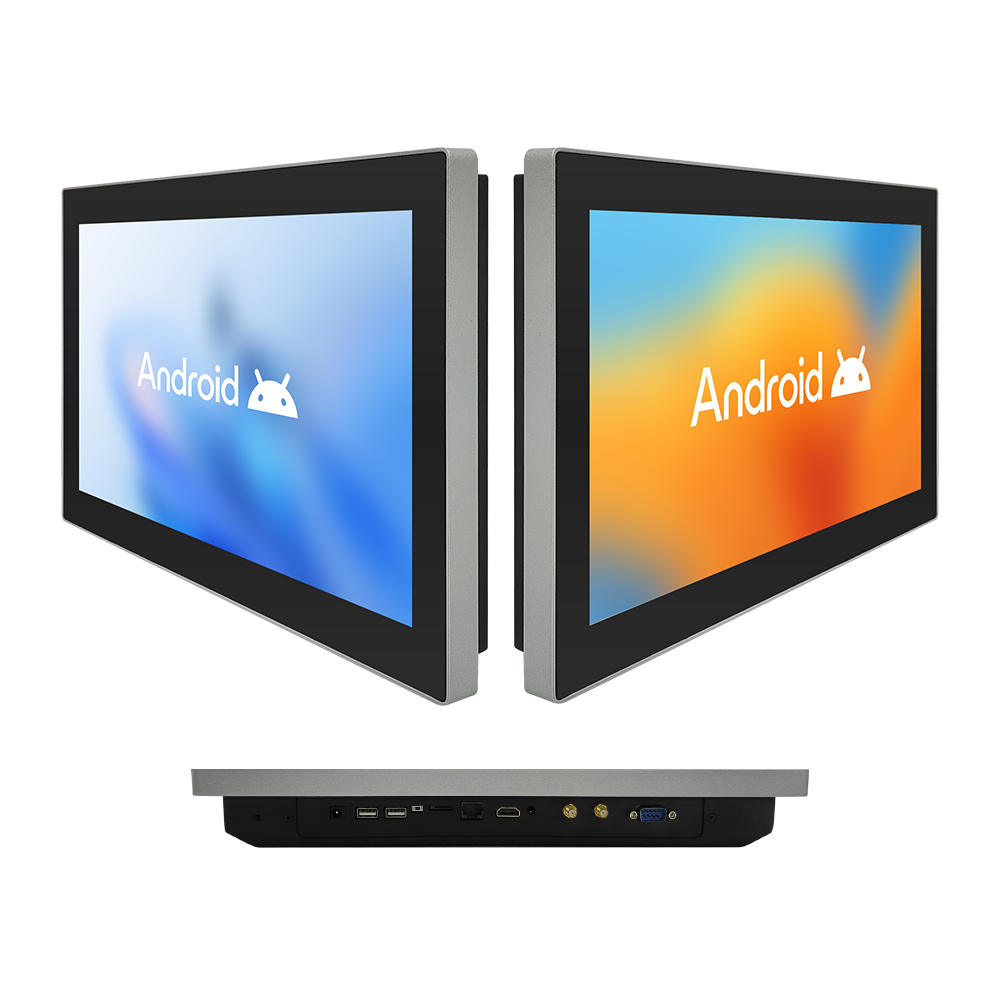
15.6″ RK3576 Android Industrial Panel PC with GPS
Engineered for commercial vehicle fleets, precision agriculture, and mining machinery. Powered by the Rockchip RK3576 SoC with 6 TOPS NPU, multi-constellation GNSS positioning, wide 9V-36V DC vehicle power input, and full 1080p widescreen capacitive multi-touch.
2. Edge AI Acceleration via RK3576 NPU & Vehicle Electrical Hardening
Modern intelligent in-cab terminals must process local AI vision workloads alongside standard navigation telemetry:
- Dedicated Neural Processing Unit (NPU): The RK3576 processor integrates a high-efficiency NPU capable of up to 6 TOPS INT8 machine-learning inference. This allows local execution of Driver Monitoring Systems (DMS for fatigue and distraction detection) and real-time obstacle segmentation without loading cloud networks.
- ISO 7637-2 Automotive Transient Clamping: Heavy machinery starter motors induce massive load dump surges (up to 87V transients). The terminal’s wide DC 9V to 36V power input integrates high-energy TVS diodes and multi-stage inductors that absorb electrical spikes without rebooting.
- Vibration-Proof SMA Antenna Ports: Ruggedized gold-plated SMA brass threaded connectors lock external GNSS, 4G/5G, and dual-band Wi-Fi antenna leads securely against chassis shock up to 30G (MIL-STD-810H).
Vehicle Telematics Terminal Engineering Comparison
| Engineering Parameter | Commercial Consumer Tablet | Engineered 15.6″ RK3576 Vehicle PC |
|---|---|---|
| Satellite Receiver | Consumer GPS (Single constellation, high drift) | Quad-GNSS (GPS, BeiDou, GLONASS, Galileo) + RTK option |
| AI Inference Engine | None (CPU software emulation, high heat) | Integrated 6 TOPS hardware NPU (Local DMS & Vision) |
| Power Input Stage | 5V USB-C (Unprotected, resets on crank) | Wide DC 9V-36V with ISO 7637-2 load-dump protection |
| Thermal Dissipation | Plastic casing (Throttles in summer cabs) | 100% Fanless solid aluminum passive conduction (-20°C to +70°C) |
| Chassis & Mount Rigidity | Flimsy plastic cradle (Cracks under shock) | Heavy metal chassis with reinforced VESA 75/100 mounts |
3. Commissioning Guidelines for Fleet Cab Installations
- External Antenna Skyward Alignment: Mount the external active GNSS antenna on the highest horizontal surface of the vehicle cab roof, ensuring an unobstructed 360-degree view of the horizon away from high-power radio communication whips.
- Direct Battery Bus Wiring: Wire the terminal’s DC power harness directly to the auxiliary vehicle battery distribution block using 16 AWG twisted-pair conductors with an in-line 5A fast-acting automotive fuse.
- Ignition Sense Delay Calibration: Configure the Android power-management daemon to utilize the vehicle ignition signal (ACC) to initiate automated shutdown delays (typically 10 to 15 minutes) to maintain communication during brief operator engine shutoffs.
Equipping agricultural and industrial logistics fleets with RK3576-powered Android terminals ensures reliable vehicle navigation and high-throughput edge machine learning. Contact INNODA’s vehicle telematics engineering team to request BSP source code, GNSS test performance logs, and custom vehicle mounting bracket options.