
Engineering managers and plant procurement teams specifying washdown operator terminals across food processing, dairy bottling, and sterile pharmaceutical manufacturing must make two foundational specification decisions: selecting between SUS304 and SUS316L austenitic stainless steel alloys, and matching IP66 versus ISO 20653 IP69K ingress protection to actual sanitation pressures. Combining proper metallurgical selection with disciplined preventative maintenance ensures multi-year sanitary compliance across both standard operator terminals and advanced multifunction systems such as a 21.5-inch IP69K stainless steel panel PC with integrated HD camera, waterproof speakers, and waterproof HDMI output.
⚡ Commercial & Maintenance Executive Summary (Master Guide Takeaways):
- PREN Corrosion Threshold (25.56 vs. 19.30): Molybdenum-alloyed SUS316L resists chloride pitting in salt-brine, seafood, and chlorinated/VHP cleanrooms where standard SUS304 develops rust tea-staining.
- IP66 Hose vs. IP69K 80°C Steam Defense: Specify IP66 for low-pressure deck hoses and wipe-downs; mandate full IP69K whenever sanitation crews deploy 80°C, 100-bar pressurized steam wands.
- Semi-Annual Passivation & Breather Care: Performing 10% citric acid passivation wipes, 0.6 Nm M12 connector torque checks, and deionized rinsing of the ePTFE breather valve prevents vacuum moisture ingress.
When standardizing hygienic computing hardware across modern stainless steel hmi suites, pairing electropolished Ra ≤ 0.4 μm surfaces with flush perimeter mounting prevents bacterial biofilm harborages. For additional engineering insights on flush sanitary bezel geometry, review our guide on EHEDG flush coplanar design and capillary prevention in stainless panel PCs.
1. Metallurgical PREN Comparison & CIP Thermal Vacuum Maintenance Physics
Evaluating the Pitting Resistance Equivalent Number (PREN) alongside post-washdown thermal vacuum mechanics provides an objective engineering framework for both procurement and maintenance teams:
Stainless Alloy PREN & Post-Sanitation Thermal Vacuum Equation: 1. Pitting Resistance Equivalent Number (PREN = %Cr + 3.3 × %Mo + 16 × %N): – SUS304 Austenitic Stainless (18.5% Cr, 0% Mo, 0.05% N): PREN_304 = 18.5 + 0 + 0.80 = 19.30. – SUS316L Marine/Pharma Stainless (17.5% Cr, 2.2% Mo, 0.05% N): PREN_316L = 17.5 + 7.26 + 0.80 = 25.56 (+32.4% higher chloride pitting resistance). 2. Post-Washdown Cooling Vacuum Differential (80°C Steam → 15°C Chilled Room): ΔP_vacuum = 101.325 kPa × [ 1 – (288.15 K / 353.15 K) ] ≈ 18.65 kPa inward suction. Maintenance Action: Keeping the top/rear 0.2 μm hydrophobic ePTFE breather valve free of dried salt or chemical crusts ensures instantaneous pressure equalization without sucking sanitizer past perimeter gaskets.
For sterile cleanroom isolators and high-care processing corridors that require remote video supervision, audible voice alarms, and overhead scoreboard mirroring without leaving containment zones, plant engineers deploy the 21.5″ Full IP66/IP69K Stainless Steel Panel PC (Camera, Speakers & Waterproof HDMI), which integrates all multimedia and I/O ports into an electropolished SUS304/316L housing.
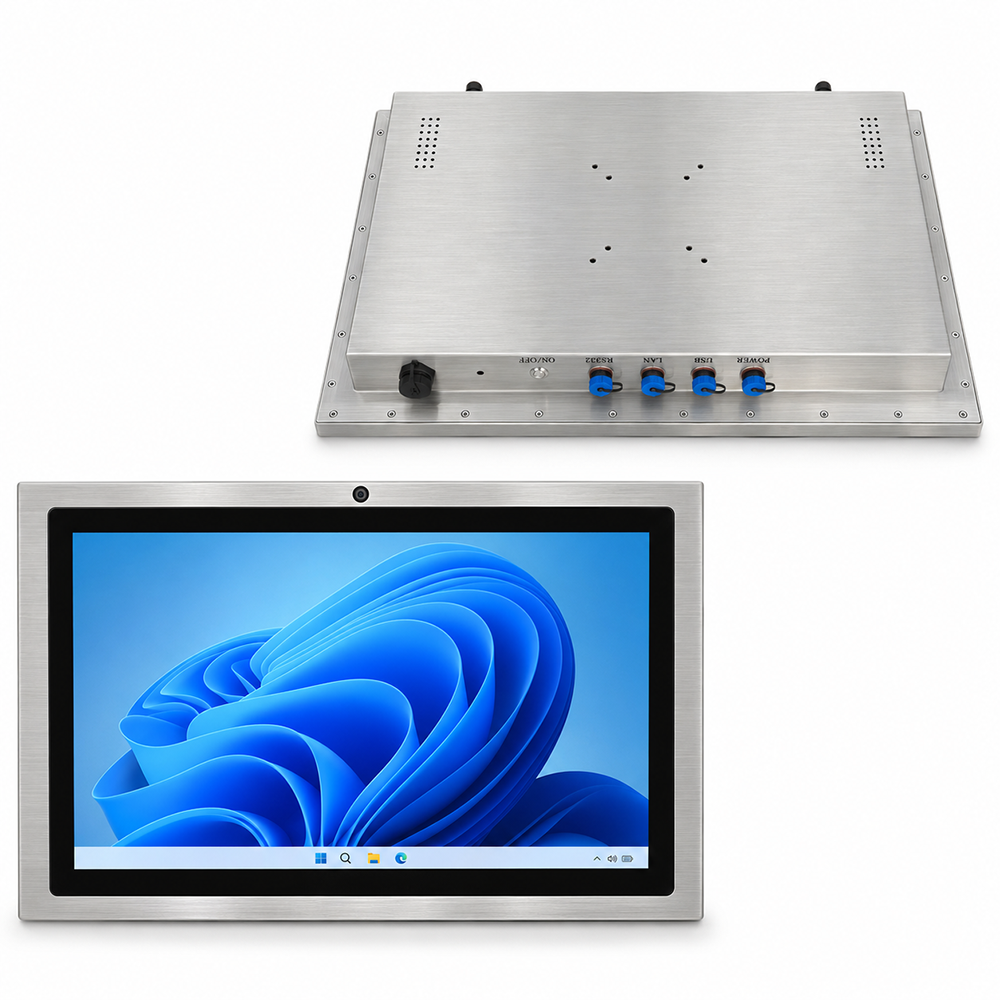
21.5″ IP69K Stainless Panel PC (Camera, Speakers & HDMI)
INNODA’s flagship sanitary communication and visualization terminal. Features a 21.5″ Full HD display, electropolished SUS304/316L IP66/IP69K housing, top-mounted sealed HD camera, dual waterproof speakers, waterproof HDMI output, and flush flange mounting.
Master Selection & Preventative Maintenance Decision Matrix
| Plant Environment & Task | Recommended Hardware Spec | Mandatory Maintenance Protocol |
|---|---|---|
| Brine, Seafood & VHP Rooms | SUS316L (PREN 25.6) + Full IP69K | Semi-annual 10% citric acid passivation wipe |
| 80°C Steam Lance Washdown | ISO 20653 IP69K + M12 & ePTFE breather | Quarterly 0.6 Nm M12 torque & vent rinse |
| Standard Bottling & Bakery | SUS304 (PREN 19.3) + Full IP66 | Daily warm rinse + 70% IPA glass wipe-down |
| Cleanroom Isolator Comms | 21.5″ IP69K with Camera, Speakers & HDMI | Inspect flush wall gasket & ePTFE audio mesh |
| Foam-Heavy Chemical Skids | True-flat 5-wire resistive or foam-DSP PCAP | Use soft microfiber cloths; avoid metal scrapers |
2. Frequently Asked Questions (Engineering & Procurement FAQ)
Q1: How can maintenance technicians remove superficial rust “tea-staining” on stainless steel panel PCs?
Superficial tea-staining occurs when free iron particles or high-chloride sanitizers settle on the surface. Clean the enclosure with a non-abrasive nylon pad and neutral detergent, apply a 10% food-grade citric acid solution for 20 minutes to restore the passive chromium oxide film, and rinse thoroughly with deionized water.
Q2: Can we mix IP66 and IP69K stainless steel panel PCs within the same facility to optimize capital budget?
Yes. Many food and beverage plants deploy IP69K SUS316L terminals directly in raw-ingredient, slaughter, and CIP steam washdown zones while standardizing downstream dry-packaging and palletizing corridors on cost-effective IP66 SUS304 units.
Q3: Does INNODA supply spare Viton O-ring kits, ePTFE breather valves, and replacement M12 cables for long-term plant spares?
Yes. Complete preventative maintenance spare-parts kits—including replacement Viton M12 O-rings, perimeter silicone gaskets, breather valves, and custom-length M12 harnesses—are stocked for immediate global dispatch.
Pairing the right stainless steel grade (SUS304 vs. SUS316L) and ingress rating (IP66 vs. IP69K) with a structured preventative maintenance schedule maximizes uptime and hygiene compliance across your entire facility. Contact INNODA’s sanitary computing engineering team to request material certifications, 3D CAD drawings, and custom OEM configurations.