
Deploying industrial computing terminals in coastal container terminals, offshore oil platforms, and outdoor chemical storage tank yards demands hardware that withstands harsh environmental conditions. Terminals must endure continuous solar irradiation exceeding 1000 W/m², driving rain, and airborne chloride aerosols. Selecting pc enclosure material composition for such environments requires analyzing structural corrosion dynamics alongside internal thermal conduction paths.
When an industrial computing system incorporates a 1000-nit high-brightness display inside a completely sealed full IP67 enclosure, standard sheet-metal enclosures fail rapidly. Either chloride ions initiate microscopic pitting through low-alloy stainless grades, or internal LED backlight heat accumulates, driving processor junction temperatures into thermal throttling.
1. Pitting Resistance Equivalent Number (PREN) and Passive Chromium Oxide Kinetics
Austenitic stainless steels rely on a self-healing chromium oxide (Cr2O3) passive layer to resist corrosive attack. In marine atmospheric environments, airborne sodium chloride particles deposit onto metal surfaces. Under solar evaporation, localized chloride concentrations spike, penetrating micro-flaws in the passive film and triggering autocatalytic pitting corrosion:
Pitting Resistance Equivalent Number (PREN) Formula: PREN = %Cr + (3.3 × %Mo) + (16 × %N) Comparative Metallurgy: – SUS304 Alloy: 18.2% Cr, 0.05% Mo, 0.04% N → PREN ≈ 18.2 + 0.165 + 0.64 = 19.0 – SUS316L Alloy: 17.5% Cr, 2.25% Mo, 0.06% N → PREN ≈ 17.5 + (3.3 × 2.25) + (16 × 0.06) ≈ 25.9 Conclusion: Molybdenum addition in SUS316L increases localized pitting corrosion resistance by >36%, preventing pitting penetration in marine chloride zones.
Where standard SUS304 alloys develop brown rust stains (tea-staining) and microscopic pinholes within 6 to 12 months of coastal exposure, passivated SUS316L maintains an unbroken passive barrier across decades of marine salt-fog exposure.
To ensure long-term survivability in high-salinity outdoor installations, systems like the 1000 Nits Full IP67 Outdoor Stainless Steel Panel PC are built with heavy-gauge SUS316L enclosures passivated via chemical electropolishing (Ra ≤ 0.4 μm).
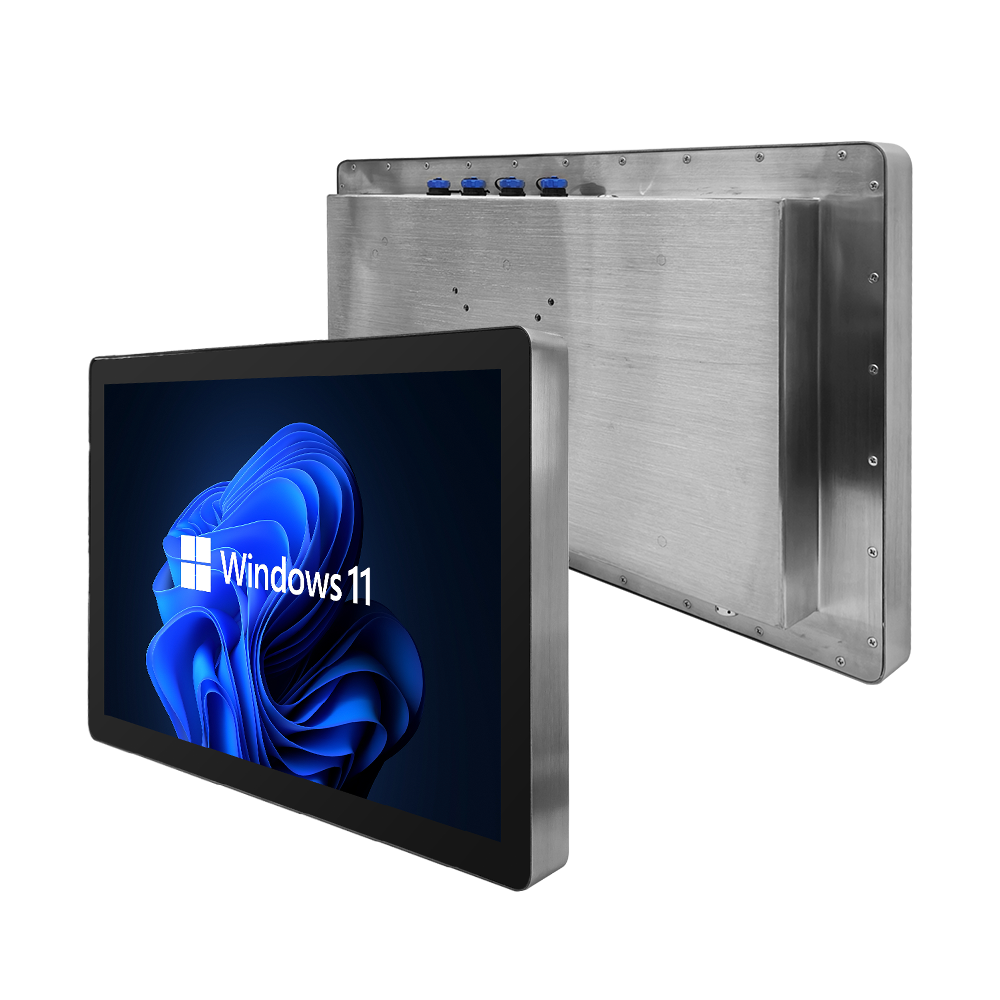
1000 Nits Full IP67 Outdoor Stainless Steel Panel PC
Designed for marine shipping terminals, oil refineries, and outdoor automation cells. Features heavy SUS316L stainless steel construction, 1000 nits daylight readability, internal copper thermal dissipation, and certified full IP67 ingress protection.
2. Thermal Resistance Network in a Sealed Stainless Conduction Enclosure
While stainless steel provides exceptional chemical resilience, its thermal conductivity (k ≈ 16.2 W/(m·K)) is less than one-tenth that of aluminum (k ≈ 167 W/(m·K)). In a 1000-nit outdoor panel PC, the combined thermal dissipation of the high-power LED backlight array (22W) and the system processing core (15W) totals over 37W inside a sealed housing.
Total System Thermal Resistance Network: Θ_total = Θ_jc + Θ_tim + Θ_spreader + Θ_enclosure-conduction + Θ_convection-radiation To prevent CPU junction temperatures (T_j) from exceeding 85°C at 50°C ambient: Max Allowable Θ_total = (T_j_max – T_ambient) / P_dissipated = (85 – 50) / 37 ≈ 0.946 °C/W.
- Internal Copper Heat Spreader Plane: Because a raw stainless steel backplate cannot conduct heat quickly enough across its planar dimensions, high-conductivity pure copper heat pipes (k ≈ 390 W/(m·K)) are bonded to the LED edge and CPU cold plate to spread thermal flux evenly over the entire rear surface.
- Radiative Black Electroless Plating: Enhancing the emissivity (ε) of internal heat sinks from 0.05 (bare polished metal) to 0.85 accelerates radiative heat transfer to the internal casing walls.
- External Hydrophobic Breather Vent: An ePTFE membrane vent equalizes internal pressure shifts caused by 40°C temperature swings, preventing internal vacuum forces from sucking moisture through perimeter gaskets.
Outdoor Enclosure Material & Thermal Engineering Matrix
| Engineering Parameter | Commercial Coated Sheet Steel | Engineered SUS316L Stainless IP67 |
|---|---|---|
| Pitting Resistance (PREN) | < 12.0 (Rapid blistering under coastal fog) | ≥ 25.0 (Resists marine chloride atmospheres) |
| Thermal Spreading Method | None (Localized hot spots behind CPU & LED) | Embedded copper vapor chambers / heat pipes |
| Ingress Protection Rating | IP54 / IP65 front face only | Full IP67 (Front, rear housing, and I/O glands) |
| Solar Radiation Resistance | Paint powder coat chalks and fades under UV | Inorganic electropolished stainless finish |
| Liquid Crystal High-Temp Limit | T_ni ≈ 75°C (Solar blackening under sunlight) | T_ni > 105°C (High-clearing point fluid matrix) |
3. Preventive Field Maintenance in Marine Environments
- Chloride Salt Wash: Periodically rinse outer stainless surfaces with clean fresh water every 3 months to prevent salt crusting from concentrating chloride levels beyond 1,000 ppm.
- Passivation Integrity Check: Inspect weld seams for discoloration using a ferroxyl test solution to confirm the absence of free iron contamination from installation tooling.
- M12 Metal Cap Sealing: Ensure all unused industrial M12 aviation ports are sealed using knurled stainless steel caps fitted with Viton O-rings torqued to 0.6 Nm.
Specifying SUS316L stainless hardware with integrated thermal spreading ensures long-term operational reliability in corrosive coastal environments. Contact INNODA’s metallurgical engineering team to request PREN test certificates, salt spray chamber reports, and custom marine mounting options.