
Modern Computer Numerical Control (CNC) machining centers, automated laser-welding work cells, and automated pharmaceutical packaging skids require high-performance computing platforms integrated directly into machine operator consoles. Equipment builders are transitioning rapidly from legacy square displays to 15.6-inch widescreen formats (16:9 Full HD 1920×1080 resolution). The expansive 1080p visual canvas allows operators to supervise multi-axis G-code toolpaths, live high-speed spindle telemetry, and interactive web-based SCADA dashboards side-by-side without horizontal scrolling.
However, running high-throughput computing hardware inside an unventilated, sealed machine console creates severe thermal challenges. Ambient temperatures inside crowded electrical enclosures frequently reach 45°C to 50°C. Concurrently, cutting fluid aerosols and conductive metallic dust quickly destroy computers with active cooling fans. Sizing a dependable terminal for modern embedded panel pc skids requires analyzing internal thermal interface material (TIM) conduction networks, monolithic CNC chassis dissipation, and wide DC voltage power conditioning.
1. Junction-to-Chassis Thermal Resistance Network Modeling
In a true fanless computing terminal, processor heat must flow through a multi-stage mechanical conduction path to reach the outer convective cooling fins of the 6061-T6 aluminum chassis:
Conduction Thermal Resistance Network & Temperature Rise Equation: Total Thermal Resistance: R_th_total = R_tim + R_chassis + R_convection Where: – Processor Thermal Design Power: P_tdp = 15.0 Watts. – Phase-Change TIM Layer: Thickness t_tim = 0.15 mm, Conductivity k_tim = 4.0 W/(m·K), Area A_c = 0.008 m². R_tim = t_tim / (k_tim × A_c) = (1.5 × 10^-4) / (4.0 × 0.008) ≈ 0.0047 K/W. – CNC 6061-T6 Aluminum Chassis Conduction: Conduction Length L = 15 mm, k_al = 167 W/(m·K), Area A = 0.04 m². R_chassis = L / (k_al × A) = 0.015 / (167 × 0.04) ≈ 0.0023 K/W. – Exterior Natural Convective Fins: Convective Coefficient h = 9.5 W/(m²·K), Total Area A_surf = 0.28 m². R_convection = 1 / (h × A_surf) = 1 / (9.5 × 0.28) ≈ 0.3759 K/W. Total Thermal Resistance: R_th_total = 0.0047 + 0.0023 + 0.3759 ≈ 0.3829 K/W. Chassis Steady-State Temperature Rise above Cabinet Ambient: ΔT = P_tdp × R_th_total = 15.0 × 0.3829 ≈ 5.74 °C. Operating Result: At 50°C cabinet internal ambient, outer chassis temperature stabilizes at ~55.7°C, keeping internal processor silicon well below 75°C without active fans.
Because the total thermal resistance from die to ambient air remains under 0.39 K/W, internal processor silicon operates comfortably within its safe operating envelope, completely preventing CPU thermal throttling during continuous full-load production runs.
To eliminate fan breakdown downtime on high-precision machining skids, automation builders deploy the 15.6″ CNC Fanless Industrial Touch Panel PC, which combines a solid 6061-T6 CNC aluminum chassis with internal sintered copper heat spreading blocks.
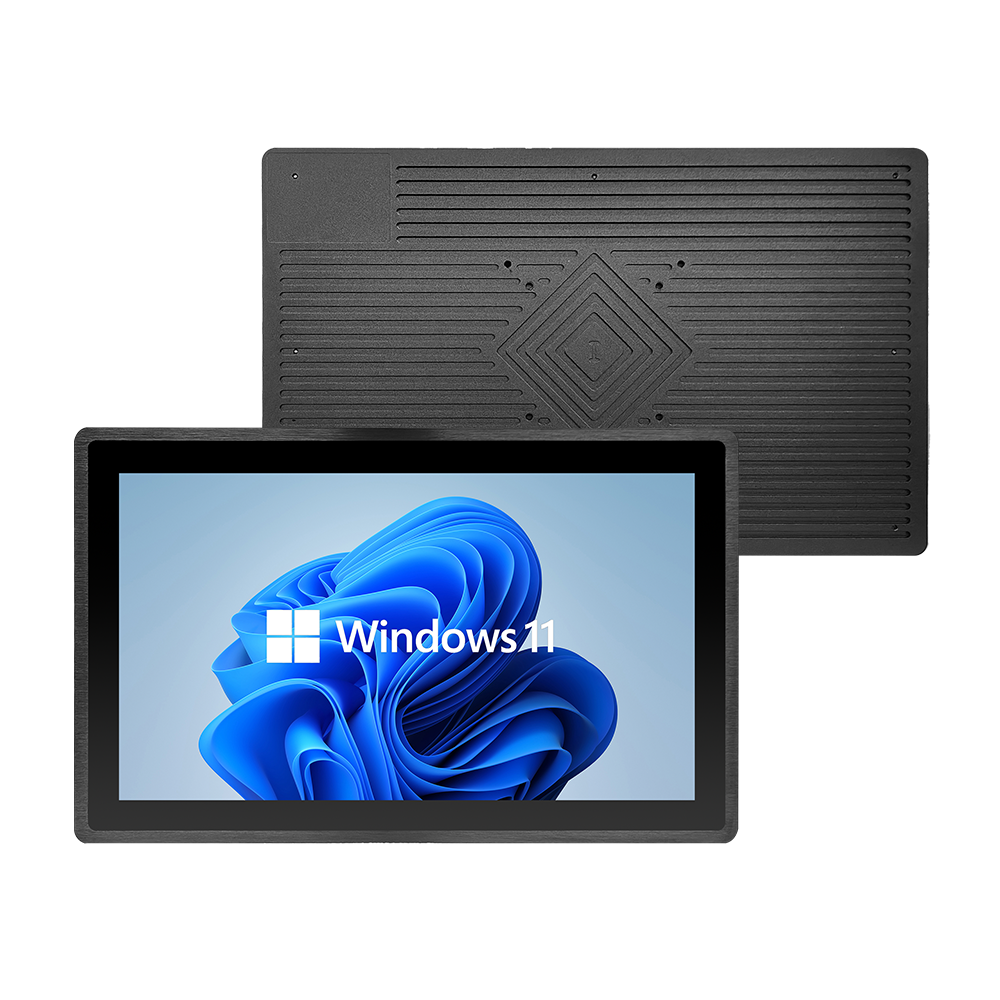
15.6″ CNC Fanless Industrial Touch Panel PC
Designed for CNC machine consoles, automated assembly skids, and industrial SCADA terminals. Features a solid 6061-T6 CNC aluminum chassis, 100% fanless passive cooling with copper heat spreader blocks, IP65 front washdown protection, and wide 9V-36V DC input.
2. Monolithic CNC Bezel Rigidity & Industrial Cutting Fluid Sealing
Surviving harsh metalworking factory environments requires strict structural and electrical defenses:
- Monolithic CNC 6061-T6 Front Bezel: Machined from solid aerospace-grade aluminum billet, the front bezel provides superior flexural rigidity, resisting torsional twisting under heavy corner touches and maintaining uniform perimeter gasket compression.
- Closed-Cell Neoprene IP65 Gasket: Provides continuous compressive contact stress (≥ 0.85 MPa) along the enclosure cutout boundary, preventing water-soluble cutting coolants and lubricating oils from penetrating the electrical cabinet.
- Wide-Voltage Industrial DC Power (9V-36V): Integrates multi-stage LC filters and Transient Voltage Suppressors (TVS) that clamp heavy inductive voltage spikes generated when high-power spindle motors cycle on and off.
Commercial Sheet-Metal PC vs. Engineered 15.6″ CNC Panel PC Comparison
| Engineering Parameter | Standard Stamped Sheet-Metal PC | INNODA 15.6″ CNC Fanless Panel PC |
|---|---|---|
| Chassis Manufacturing | Folded sheet steel with riveted joints | Solid billet CNC-machined 6061-T6 aluminum |
| Thermal Dissipation Type | Internal ventilation fan (Draws oily dust) | 100% Fanless solid aluminum passive conduction |
| Front Ingress Protection | IP50 / IP54 (Coolant leaks past seam) | Certified IP65 dust-tight and cutting-oil sealed |
| Display Aspect Ratio | Legacy 4:3 format (Restricts web SCADA) | 16:9 Full HD 1080p widescreen resolution |
| DC Input Range | Fixed 12V DC ±5% (Vulnerable to sags) | Wide DC 9V to 36V with reverse polarity protection |
3. Panel-Mount Installation & Commissioning Guidelines
- Cabinet Aperture Tolerance Check: Ensure the machine cabinet door cutout matches the engineering drawing within ±0.5 mm to guarantee uniform 30% compression of the closed-cell perimeter gasket.
- Criss-Cross Clamp Torquing: Tighten the rear panel-mount retention clamps in a cross-diagonal sequence to 1.0 Nm of torque using a calibrated screwdriver to avoid localized frame stresses.
- Chassis Star Grounding: Connect the dedicated grounding stud on the rear chassis to the machine’s primary ground bus using a heavy braided copper lead (≥ 4 mm²) to shunt high-frequency electrical noise.
Standardizing automated machine tool consoles on 15.6-inch CNC aluminum fanless touch panel PCs ensures crisp widescreen SCADA visualization and eliminates thermal throttling downtime. Contact INNODA’s industrial automation engineering team to request 3D STEP packaging models, panel cutout templates, and custom I/O bracket options.