
Commercial bakery dough mixers, chemical dosing skids, industrial electroplating lines, and caustic Clean-in-Place (CIP) washdown stations present an extreme challenge for operator touchscreens: thick conductive alkaline foams, viscous sugar batters, and high-pressure water sprays frequently trigger false phantom clicks on standard capacitive displays. Deploying a compact 12.1-inch 4:3 stainless steel waterproof Android panel PC (1024×768 XGA resolution) equipped with a true-flat 5-wire analog resistive touchscreen and full IP66/IP69K SUS304/316L sealing ensures deterministic, zero-false-trigger control in the wettest processing zones.
⚡ Commercial & Engineering Executive Summary (Application Highlights):
- 100% Conductive Foam & Batter Immunity: 5-wire resistive sensing requires ≥ 0.85 N mechanical contact force to close the 15 μm spacer gap—completely ignoring 2-bar foam sprays (0.20 N) and viscous conductive fluids.
- True-Flat Sanitary Bezel + IP66/IP69K Sealing: Eliminates recessed step edges that trap dough or bacteria while surviving 80°C high-pressure steam washdowns across electropolished SUS304/316L surfaces.
- 35-Million-Touch Single-Point Lifespan: Ratiometric 5-wire architecture places all active electrodes on the rear glass substrate, preventing calibration drift across decades of repetitive button presses.
When specifying compact washdown terminals across modern stainless steel hmi deployments, matching touch sensing physics to process media prevents erratic machine stops. For related hygienic flush-bezel engineering principles, review our guide on EHEDG flush coplanar design and capillary prevention in stainless panel PCs.
1. 5-Wire Resistive Mechanical Threshold vs. Conductive CIP Foam
Unlike capacitive sensors that measure electric field changes (and can be triggered by thick salt brines or foaming detergents), a 5-wire resistive touchscreen requires physical mechanical deflection of the top membrane across an insulating spacer dot matrix:
5-Wire Resistive Actuation Threshold vs. Washdown Spray Pressure: Micro-Spacer Dot Gap Height: h_gap = 15.0 μm = 1.5 × 10^-5 m. Required Mechanical Finger / Glove / Stylus Actuation Force: F_actuation ≥ 0.85 N (~85 grams-force localized tip pressure). Hydrodynamic Force of Flowing CIP Foam / 2-Bar Spray over 1 mm² Area: P_spray = 2.0 bar = 0.20 MPa (0.20 N/mm²) → F_spray = 0.20 N < 0.85 N threshold (Zero phantom clicks!). 5-Wire Ratiometric Coordinate Stability: All four corner drive electrodes (UL, UR, LL, LR) reside on the rigid rear glass, while the flexible top polyester hard-coat layer acts purely as a passive voltage probe (V_sense = V_cc × X / L), maintaining < 1.5% linearity error across 35 million actuations.
All-metal M12 circular aviation connectors and a rear hydrophobic ePTFE breather valve protect the compact 12.1-inch stainless housing against 80°C thermal shock vacuums.
To eliminate phantom touches on mixing lines, chemical dosing skids, and washdown corridors, plant engineers deploy the 12.1″ Stainless Steel Waterproof Resistive Android Panel PC, which combines a true-flat resistive bezel with fanless Android edge computing.
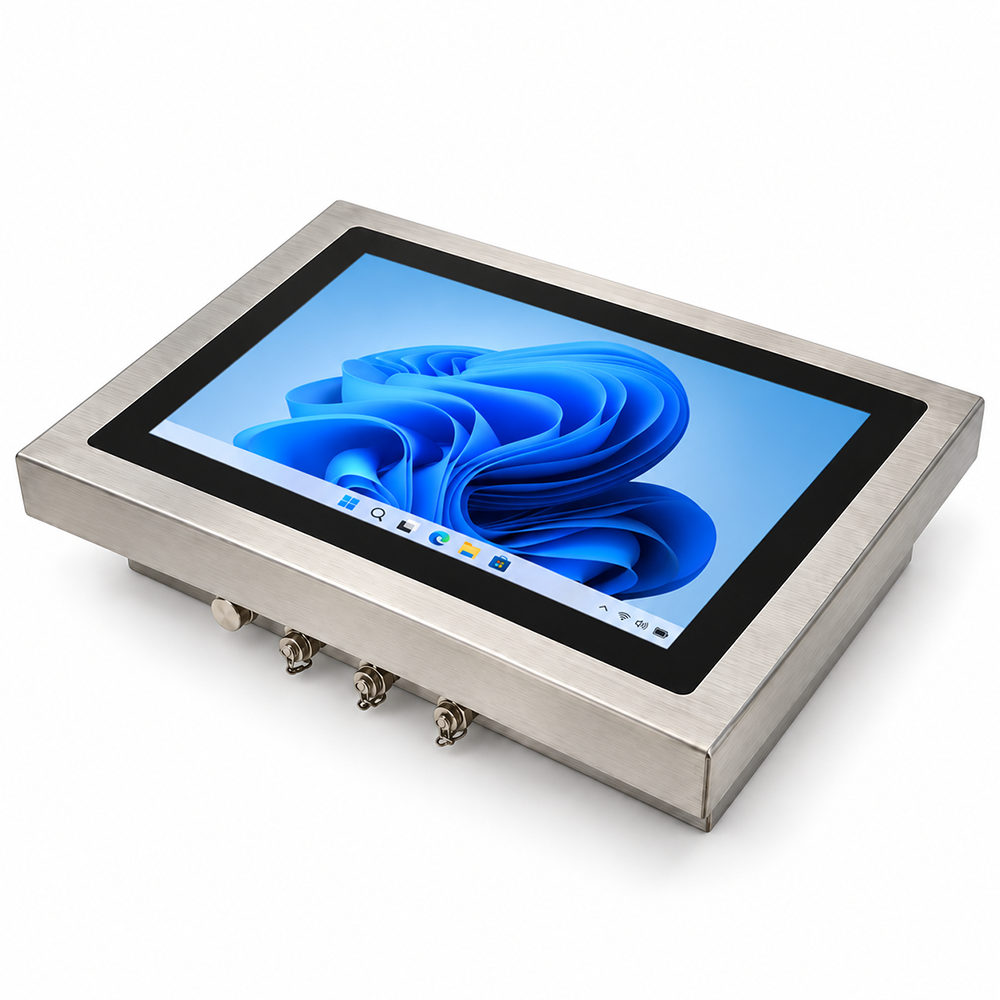
12.1″ Stainless Steel Waterproof Resistive Android PC
Engineered for chemical dosing skids, commercial bakeries, and foam-heavy CIP washdown zones. Features a 12.1″ true-flat 5-wire resistive touchscreen immune to conductive foam, electropolished SUS304/316L IP66/IP69K housing, ePTFE breather valve, and M12 aviation I/O.
Standard Capacitive Tablet vs. INNODA 12.1″ Stainless Resistive Android PC
| Harsh Process Factor | Standard Capacitive Panel PC | INNODA 12.1″ Stainless Resistive PC |
|---|---|---|
| Thick Foam & Batter | Triggers false touches from conductive foam | 100% Immune (Requires ≥ 0.85 N mechanical press) |
| Heavy Insulated Gloves | Fails through thick rubber/neoprene gloves | Works with any glove, knuckle, or blunt stylus |
| Bezel Hygiene Profile | Traditional resistive screens have stepped edges | True-flat flush resistive bezel (No dirt traps) |
| Washdown Ingress Rating | IP65 front only (Rear ports pool water) | Certified Full IP66 / IP69K with M12 aviation I/O |
| Chassis Metallurgy | Painted steel or aluminum pits in chemicals | Electropolished SUS304 / SUS316L (Ra ≤ 0.4 μm) |
2. Frequently Asked Questions (Engineering & Procurement FAQ)
Q1: Why choose a 5-wire resistive touchscreen instead of capacitive touch for chemical or bakery lines?
While capacitive touch is ideal for multi-touch gestures, 5-wire resistive touch relies purely on physical pressure, making it completely immune to thick conductive chemical foams, flour/dough buildup, electromagnetic interference from nearby VFDs, and heavy insulated chemical gloves.
Q2: Does this true-flat resistive bezel still trap food particles around the edges?
No. Unlike legacy recessed resistive panels with deep plastic bezel steps, INNODA’s true-flat resistive design bonds the outer hard-coated membrane flush with the stainless frame, eliminating bacterial crevices.
Q3: Can we run custom Modbus TCP/RTU Android HMI apps on this 12.1″ terminal?
Yes. The onboard ARM processor runs Android 11–14 or Linux with native RS-232/485 serial ports, Gigabit Ethernet, and kiosk auto-boot lockdown for seamless PLC communication.
Standardizing chemical dosing skids, commercial bakeries, and CIP washdown zones on 12.1-inch stainless steel waterproof resistive Android panel PCs eliminates false touch triggers and maximizes multi-year uptime. Contact INNODA’s washdown HMI engineering team to request 3D CAD drawings, SUS316L material certifications, and custom M12 cable assemblies.