On modern industrial shop floors, machine operators interact with touch displays using metal styluses, abrasive work gloves, and hands coated in metal shavings, cutting oils, and ceramic dust. When specifying a human-machine interface (HMI) or panel PC, automation engineers frequently see the specification: 7H Surface Hardness.
However, confusion often arises regarding what “7H” actually measures. Treating surface hardness as a secondary cosmetic metric frequently results in premature field replacements: soft plastic or untreated soda-lime glass scratches easily, cutting delicate internal indium tin oxide (ITO) touch traces and causing dead zones. Understanding chemical ion-exchange tempering and surface hardness standards ensures your touch terminal survives relentless shop-floor abrasion.
Touchscreen Cover Lens Material Comparison
| Cover Lens Material | Hardness Rating (Mohs / Pencil) | Abrasion Resistance against Silica | Impact Absorption (IK Rating) | Primary Industrial Vulnerability |
| Standard Polyester (PET) Film | 2H to 3H Pencil Hardness | Extremely Poor (Scratched by fingernails & grit) | IK03 / IK04 (Easily punctured) | Resistive film stretches; localized dead zones |
| Untreated Annealed Soda-Lime Glass | 5H Pencil Hardness (Mohs ~5.5) | Moderate; scratches from abrasive tools | IK05 (Shatters into dangerous sharp shards) | Brittle fracture under mechanical point impacts |
| Chemically Strengthened Glass (7H) | ≥ 7H Pencil Hardness (Mohs ~6.5 to 7.0) | Exceptional (Resists airborne silica dust) | IK08 / IK09 Compliant | None; high-yield surface compressive stress |
| Thermally Tempered Glass (>4 mm) | 8H to 9H Pencil Hardness | Very High | IK10 (Heavy architectural impact) | High optical thickness; increases touch parallax |
The Chemistry of 7H Strengthening: Potassium-Sodium Ion Exchange
Achieving a true 7H surface hardness involves advanced chemical bath processing:
- Chemical Immersion: Float glass panels are submerged in a molten potassium nitrate ($KNO_3$) salt bath heated to approximately 400°C.
- Ion-Exchange Dynamics: Smaller sodium ions ($Na^+$) near the glass surface migrate outward into the molten salt, replaced by larger potassium ions ($K^+$) from the bath.
- Compressive Stress Layer (DOL): Because the potassium ions occupy significantly greater volume, their wedging effect creates a continuous compressive stress layer (Depth of Layer, typically 15 to 40 microns) on the surface, raising surface resistance to Mohs 6.5 to 7.0.
Why 7H Hardness is Mandatory Against Industrial Silica
Common workshop dust contains fine particles of crystalline silica ($SiO_2$), which has a Mohs hardness of 7:
- When a line operator wipes away oil mist using a dry cloth contaminated with silica particles, standard glass or plastic films are gouged with microscopic grooves.
- These scratches refract display backlight, causing annoying optical glare, and can propagate downward into the micro-etched capacitive sensor grid.
- Deploying platforms engineered with 7H chemically strengthened glass—such as the 13.3″ Aluminum Bezel Industrial Panel PC —ensures the front touch surface remains pristine even when subjected to continuous factory wipe-downs.
- In extreme washdown zones where caustic fluids accompany abrasive grit, hardware like the 15″ Full IP67 Waterproof CNC Aluminum Industrial Panel PC pairs 7H front glass with airtight metal enclosures and twist-lock aviation connectors.
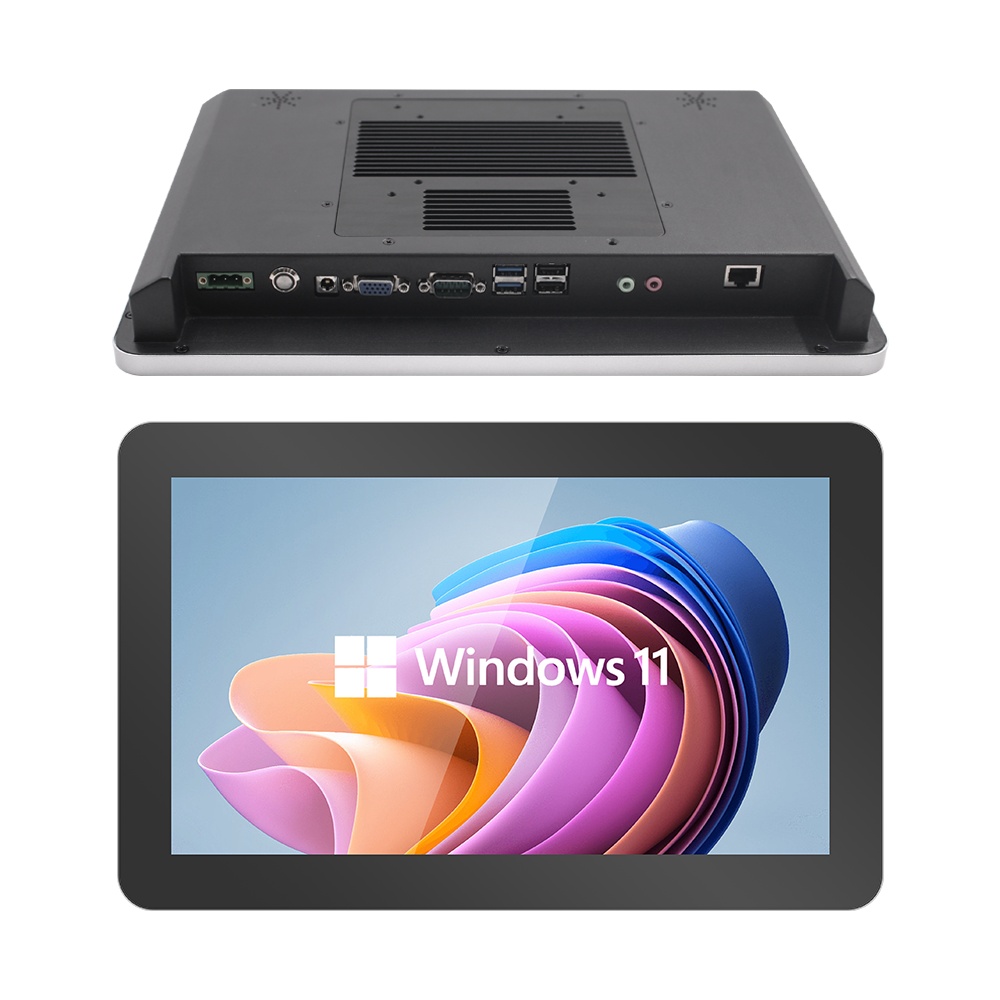
13.3″ Aluminum Bezel Industrial Panel PC
7H chemically strengthened PCAP touch surface, extruded aluminum front bezel, heavy steel chassis, recessed downward I/O bay, and dual 9V–36V DC wide voltage.
Procurement Guidelines for Engineering Specifiers
- Demand Pencil Hardness Test ASTM D3363 Certification verifying resistance to a calibrated 7H graphite lead pressed at 45 degrees under a 1 kg load.
- Verify that the glass thickness is matched to your chassis: 2 mm to 3 mm chemically strengthened glass delivers optimum IK08 kinetic impact protection without degrading capacitive touch responsiveness.
Need certified optical transmission curves, ball-drop IK test reports, or custom anti-glare (AG) glass coatings? Contact INNODA’s display engineering team for technical specifications and evaluation samples.