
Industrial panel computers deployed across coastal desalination stations, offshore oil platforms, pharmaceutical compounding cleanrooms, and meat-curing plants operate in chemically hostile atmospheres. Air saturated with airborne sodium chloride (halide ions) or high-concentration sodium hypochlorite wash solutions attacks metallic enclosure surfaces relentlessly.
When engineering human-machine interfaces (HMIs) for these sectors, mechanical specifiers must understand the electrochemistry of Pitting Resistance Equivalent Number (PREN), passive film breakdown, and why selecting between AISI 304 and molybdenum-alloyed AISI 316L stainless steel dictates the multi-year lifecycle of the installation.
1. Electrochemistry of Halide Pitting: PREN Calculation
Stainless steel achieves corrosion resistance through a self-healing chromium oxide ($Cr_2O_3$) passive layer roughly 1 to 3 nanometers thick. In environments containing high halide concentrations ($Cl^-$), chloride ions penetrate micro-defects in this film, initiating localized anodic dissolution that forms microscopic pitting cavities.
The resistance of an austenitic alloy against pitting corrosion is calculated using the empirical PREN formula:
PREN = %Cr + 3.3(%Mo) + 16(%N)
- Grade 304 Stainless Steel (18% Cr, 8% Ni): Yields a $PREN \approx 18–20$. It provides superior resistance against cleanroom wipe-downs, alcohol solvents, and neutral food substances. For clean-floor manufacturing, systems such as the 19″ Full IP67 Stainless Steel Panel PC provide an impervious 304 enclosure capable of withstanding daily sanitization routines.
- Grade 316L Stainless Steel (16% Cr, 10% Ni, 2–3% Mo): Incorporating 2% to 3% molybdenum boosts the score to $PREN \approx 23–25$. Molybdenum acts as a passive film stabilizer by forming insoluble molybdates at initial pit sites, choking off localized electrochemical attack. In high-salinity or acidic food environments, 316L is mandatory.
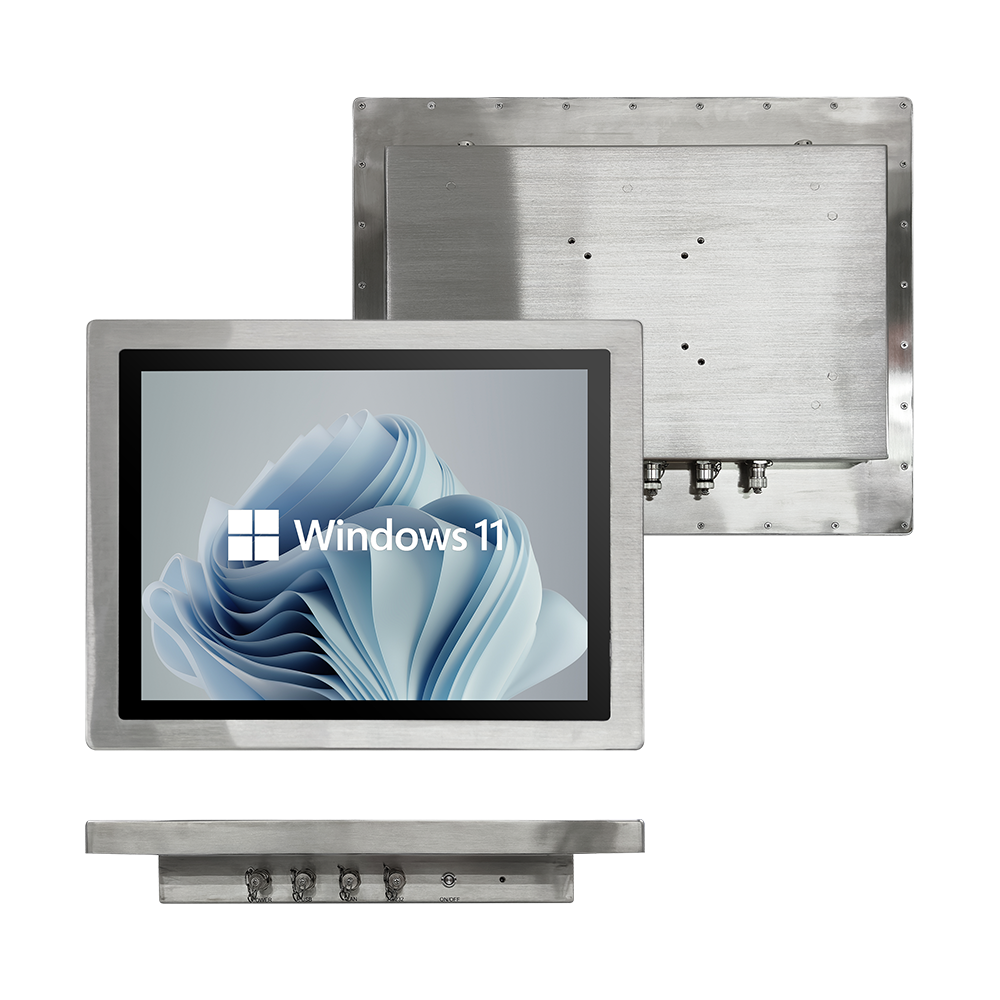
19″ Full IP67 Stainless Steel Industrial Panel PC
Built with 304/316L food-grade stainless steel to resist caustic chemical wipe-downs, chloride pitting, and high-pressure steam washdown. Features full IP67 hermetic sealing, fanless conduction cooling, and sealed aviation I/O.
2. Mechanical Mounting Form Factors in Corrosive Facilities
Corrosion failure does not occur solely on open front bezels. Fluid stagnation behind bracket joints and mounting hardware represents a primary site for crevice corrosion. If washdown water pools in stagnant seams, oxygen depletion accelerates pitting attack.
High-reliability systems like the 21.5″ Full IP67 Stainless Steel Panel PC with Bracket feature electropolished finishes ($Ra \le 0.4\,\mu\text{m}$) and radiused corner brackets that allow high-pressure fluids to drain completely, eliminating stagnant fluid reservoirs.
Alloy Metallurgy & Corrosion Performance Matrix
| Parameter | SUS304 Stainless Steel | SUS316L Stainless Steel |
|---|---|---|
| PREN Value | 18.0 – 20.0 | 23.0 – 25.0 (High pitting resistance) |
| Molybdenum Content | 0% (None) | 2.0% – 3.0% Mo (Blocks chloride attack) |
| ASTM B117 Salt Fog Life | 500–1000 Hours (Clean air applications) | >2000+ Hours (Marine & high-salinity zones) |
Specifying washdown hardware for aggressive chemical processing or marine environments? Contact INNODA’s metallurgical engineering specialists for material test certificates and salt spray test reports.