
Heavy mobile machinery—including open-pit mining haul trucks, harbor gantry cranes, agricultural harvesters, and terminal container tractors—operates under intense environmental illumination and severe physical shock. Drivers and tele-operators rely on in-cab human-machine interfaces (HMIs) not only for vehicle telemetry and engine diagnostics, but for real-time blind-spot safety camera surveillance.
Consumer automotive displays fail quickly under these operating conditions due to two engineering limitations: inability to overcome direct solar irradiance without washing out, and frame latency in IP camera feeds causing blind-spot safety hazards.
1. High Luminance (1500 Nits) & Thermal Dissipation on Open Cabs
Vehicle windshields and open tractor cabins transmit unfiltered solar irradiance, with ambient lux levels frequently surpassing 12,000 to 15,000 lux. To maintain legible operator warnings and hydraulic telemetry, the display backlight must output a minimum of 1000 to 1500 nits ($cd/m^2$).
High-power LED backlights generate considerable internal heat. Without engineered dissipation, the LED junctions overheat, leading to color shift and premature half-life degradation. High-brightness units such as the 15″ 1500 Nits High Brightness Touch Industrial Monitor utilize direct-edge copper core heat spreaders coupled to heavy aluminum rear housings, preventing localized thermal buildup inside vehicle dashboards.
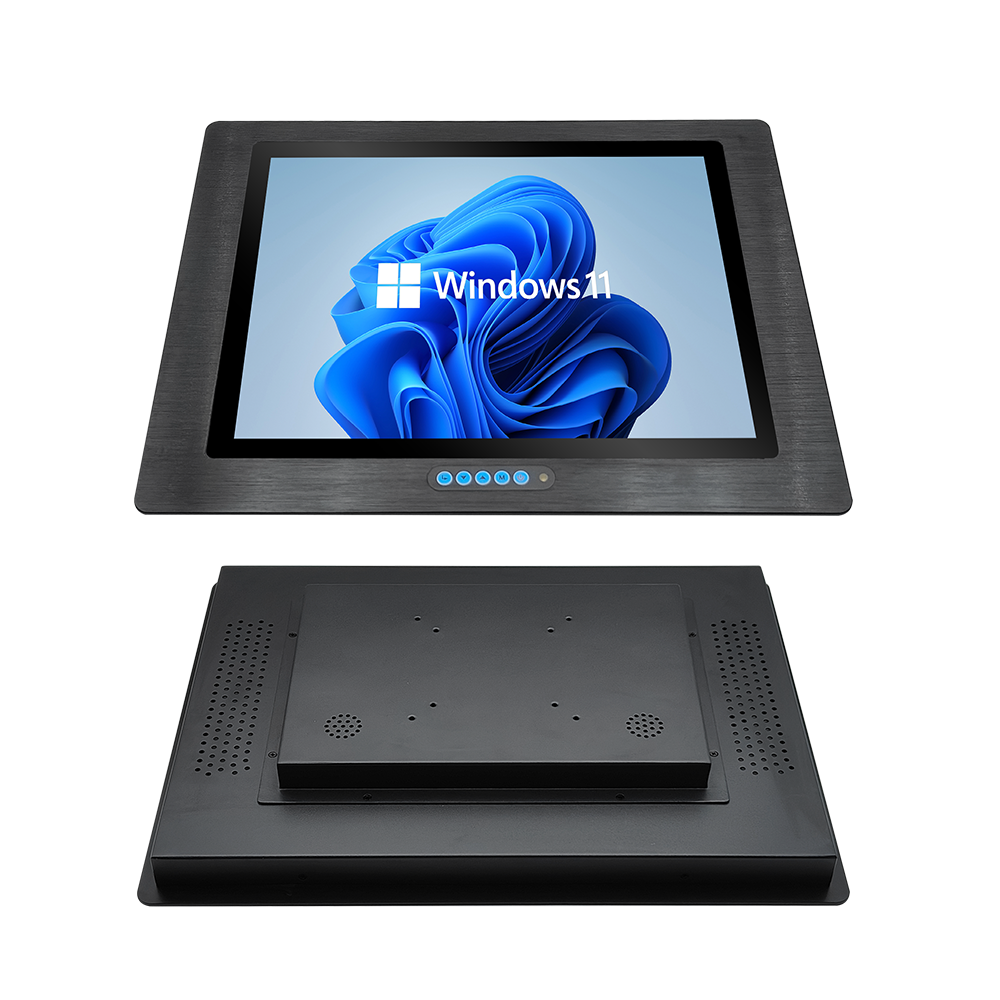
15″ 1500 Nits High Brightness Touch Industrial Monitor
Engineered for outdoor consoles and heavy mobile machinery cabs. Delivers an ultra-bright 1500-nit LED backlight, optical bonding, anti-glare tempered glass, and wide DC 9V–36V power input to guarantee crystal-clear visibility under intense solar exposure.
2. Analog High Definition (AHD) vs. IP Video: Zero-Latency Field Safety
While digital IP Ethernet cameras are standard in plant-wide surveillance, vehicle maneuvering demands zero video delay. Digital IP video streams require H.264/H.265 compression, network switch routing, and decoding buffering, introducing a latency of 150 ms to 300 ms. At a maneuvering speed of 25 km/h, a 300 ms video lag means the vehicle travels over 2 meters before the driver observes an obstacle.
Industrial vehicle consoles leverage AHD (Analog High Definition) architecture, transmitting uncompressed 1080p video over coaxial lines with sub-1ms ultra-low latency. Hardware platforms like the 18.5″ 1000 Nits Industrial AHD Monitor integrate dedicated AHD BNC inputs alongside standard HDMI/VGA channels, allowing machine operators to toggle between split-screen CCTV camera feeds and fleet management software without frame stutter.
Vehicle Display Architecture Matrix
| Parameter | Commercial In-Cab Screen | Industrial AHD Fleet Monitor |
|---|---|---|
| Luminance | 300–400 nits (Illegible in sunlight) | 1000–1500 nits (Sunlight readable) |
| Camera Latency | 150–300 ms (IP video buffer delay) | <1 ms Real-time uncompressed AHD |
| Vibration Spec | Uncertified consumer solder joints | MIL-STD-810G / IEC 60068-2-6 compliant |
Upgrading your fleet equipment, mining machinery, or gantry cranes with zero-latency AHD vision and high-nit displays? Contact INNODA’s vehicle display team for technical wiring schematics and vibration test data.