
In meat processing plants, commercial bakeries, and pharmaceutical packaging facilities, sanitizing routines subject running electrical equipment to sudden thermal shock. Computers operating at an internal temperature of 45°C to 55°C are washed down with pressurized water sprays at temperatures as low as 4°C to 10°C, followed by steam cycles exceeding 80°C.
A widespread maintenance failure in these environments is vacuum moisture siphoning: an industrial panel PC certified to IP65 or IP66 passes initial water spray testing, yet fills with internal condensation within weeks of installation. Mastering the thermodynamics of thermal shock and internal cavity pressure changes is vital to ensuring seal longevity.
1. The Thermodynamics of Negative Pressure Formation
The air volume enclosed inside a sealed computing chassis behaves according to the Ideal Gas Law ($P \cdot V = n \cdot R \cdot T$). Because the enclosure volume ($V$) is rigid and fixed, internal air pressure ($P$) is directly proportional to absolute internal temperature ($T$).
When high-pressure cold washdown water strikes a warm, operating panel PC enclosure, the internal air temperature drops rapidly (e.g., from 50°C down to 15°C within two minutes). This thermal drop causes a rapid decrease in internal air pressure, creating a strong internal vacuum ($\Delta P \approx 100–150 \text{ mbar}$).
This negative pressure turns perimeter elastomeric gaskets into suction valves. Instead of having to resist positive external water pressure, microscopic defects in the gasket are subjected to inward atmospheric suction, pulling washdown water and chemical aerosols directly through connector threads and gasket seams into internal power boards.
2. Pressure Equalization Membranes & Surface Treatment
To eliminate this vacuum siphoning effect, modern industrial washdown terminals utilize two core mechanical engineering defenses:
- Breathable Gore-Tex Pressure Equalization Vents: Hydrophobic and oleophobic ePTFE membranes allow continuous airflow while barring liquid water droplets. When thermal shock strikes, air passes freely through the membrane to equalize pressure differentials, maintaining $\Delta P \approx 0$ across perimeter seals.
- Surface Passivation & Black Oxide Coatings: In environments with severe radiant heat or optical glare, deploying platforms such as the 27″ 1500 Nits Black Stainless Steel Touch Monitor pairs treated anti-corrosion stainless steel with engineered pressure relief to prevent optical fogging behind large cover glass plates.
- Precision Machined O-Ring Grooves: For space-restricted consoles, systems like the 12.1″ Full IP65 CNC Waterproof Panel PC incorporate CNC-milled dovetail gasket retaining channels that prevent elastomeric seals from rolling or dislodging during repetitive thermal expansion cycles.
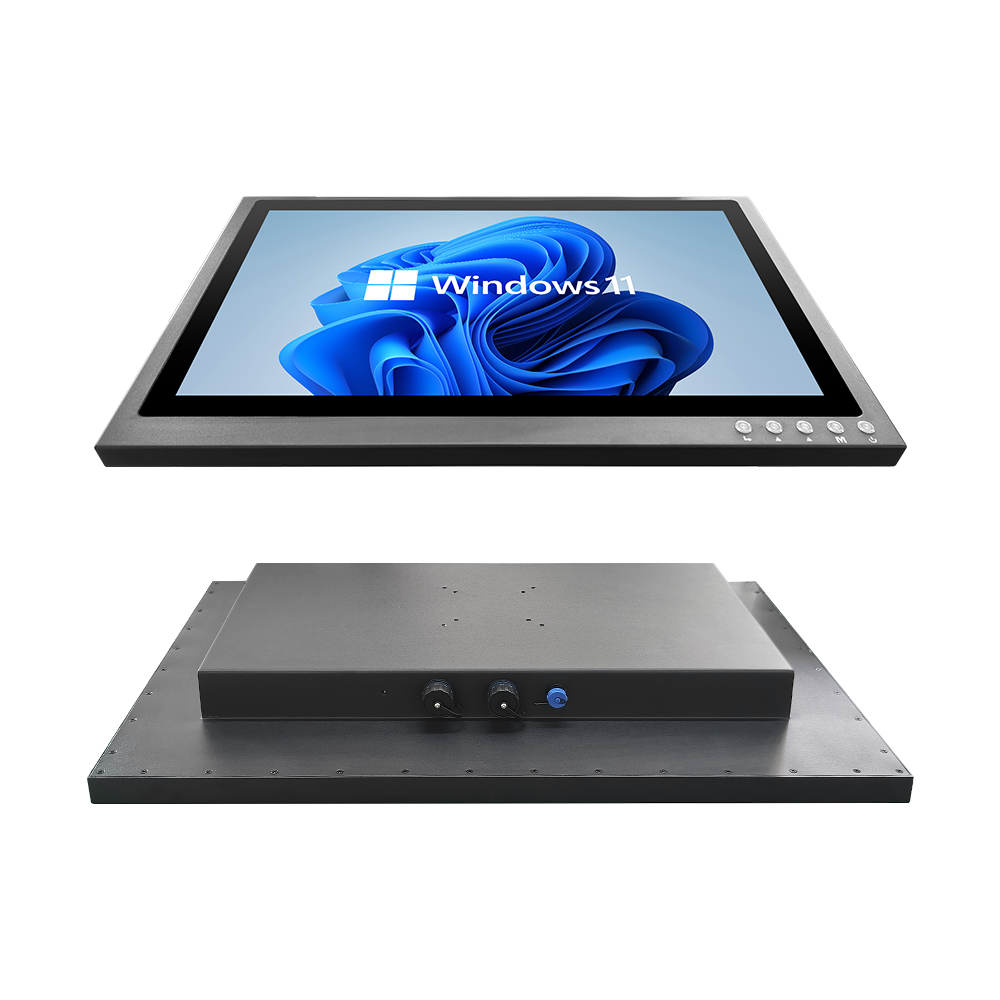
27″ 1500 Nits Black Stainless Steel Touch Monitor
Engineered for high-glare control rooms and severe industrial washdown environments. Features an ultra-bright 1500-nit panel, true-flat PCAP multi-touch, full IP65 waterproof housing, and durable black-passivated stainless steel.
Thermal Shock Maintenance Protocol
| Maintenance Parameter | Standard Sealed Enclosure | Equalized Industrial Washdown Terminal |
|---|---|---|
| Thermal Shock Response | Creates internal vacuum (>100 mbar suction) | Zero pressure delta via ePTFE membrane vent |
| Moisture Ingress Risk | High; liquid sucked past gaskets | Eliminated; seals maintain uniform compression |
| Inspection Interval | Requires monthly desiccant checks | Maintenance-free seal-for-life operation |
Encountering repetitive moisture ingress or internal fogging during washdown cleaning shifts? Contact INNODA’s environmental sealing engineers for pressure equalization vent specifications and thermal cycle test results.