
When system integrators install industrial monitors and panel PCs into control cabinet cutouts, achieving certified NEMA 4X or IP65 front ingress protection depends entirely on the mechanical interface between the display front bezel, the elastomeric gasket, and the cabinet sheet-metal faceplate.
Field warranty audits indicate that water leakage past cabinet cutouts rarely occurs through the center of the display. Instead, leakage develops along the peripheral seal. Understanding the mechanical differences between precision CNC-milled aluminum bezels with retained gasket channels versus stamped sheet-metal clamp bezels is vital for long-term ingress security.
1. Structural Rigidity & Uniform Linear Compression Force
To establish a water-impermeable barrier against airborne aerosols and pressurized spray, an elastomeric gasket (such as closed-cell EPDM) requires uniform compression along its entire perimeter:
Compression Ratio: CR = [ (H0 – Hc) / H0 ] × 100%
Where $H_0$ is the uncompressed gasket height and $H_c$ is the compressed height under mechanical clamp pressure. Optimal sealing requires a stable compression ratio between 25% and 35%.
- Stamped Sheet-Metal Flange Deflection: Thin stamped steel bezels (1.2mm to 1.5mm) lack torsional rigidity. When mounting studs are tightened, the metal bows between clamp locations (known as “scalloping”). The gasket reaches 40% compression near the clamp screws, but drops below 10% compression mid-span, creating low-pressure pathways where fluids penetrate during thermal cabinet expansion.
- Precision CNC Aluminum Milled Flanges: Solid aircraft-grade aluminum bezels (6mm to 10mm thickness) exhibit high area moments of inertia. Platforms such as the 15″ Full IP65 CNC Waterproof Touch Monitor maintain planar rigidity across the entire bezel. Clamp torque translates into uniform linear pressure, preventing localized compression gaps.
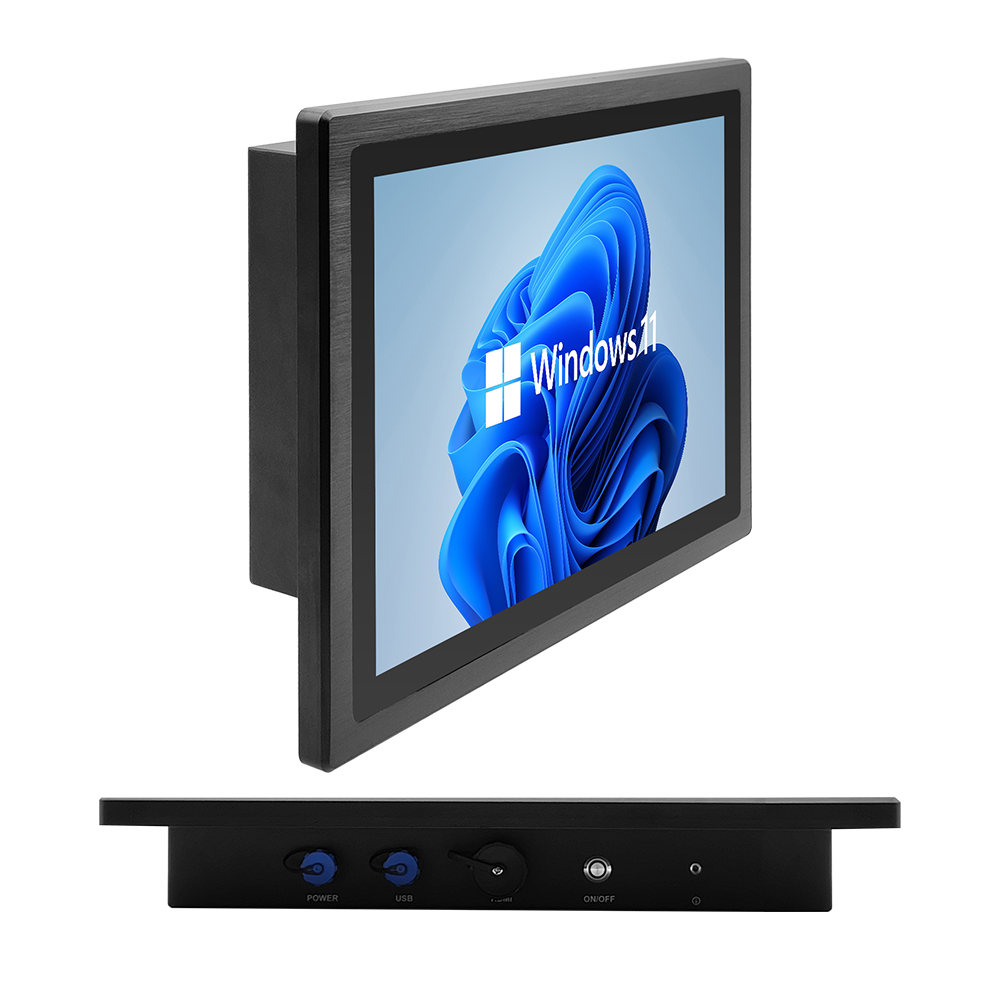
15″ Full IP65 CNC Waterproof Industrial Touch Monitor
Engineered for airtight control cabinet integration. Features a solid CNC-machined front aluminum flange, precision perimeter gasket retention, true-flat PCAP touch glass, and wide DC input for harsh factory automation consoles.
2. Dovetail Gasket Channels vs. Adhesive Surface Strips
Conventional panel-mount displays use flat sponge rubber strips with pressure-sensitive adhesive (PSA) backings. Under high-temperature cycling (50°C internal cabinet temperatures), the adhesive softens and shears under lateral gasket expansion, squeezing the gasket outward.
High-end flush-mounted terminals, including the 18.5″ Stainless Steel Panel Mount Industrial Touch Monitor, incorporate precision CNC-machined retention grooves (such as dovetail or recessed channel geometries). The elastomer is mechanically locked into place, preventing seal migration even under severe washdown pressures exceeding 50 bar.
Mechanical Bezel Architecture Benchmark
| Engineering Metric | Stamped Sheet Metal Bezel | CNC Machined Heavy Flange |
|---|---|---|
| Bending Stiffness (EI) | Low; flexes between mounting clips | High; maintains true planar flatness |
| Gasket Retention | Flat surface adhesive (Risk of seal creep) | Machined dovetail groove (Zero migration) |
| Ingress Lifespan | 12–18 Months in fluctuating ambient | 5+ Years maintenance-free seal integrity |
Designing a customized operator console or NEMA 4X cabinet cutout? Contact INNODA’s mechanical integration team for panel-mount cutout templates and torque specification guidelines.