Automated clean-in-place (CIP) and clean-out-of-place (COP) sanitation routines in dairy bottling, milk pasteurization, and chemical mixing facilities represent some of the most aggressive physical environments for industrial automation electronics. Lines undergo multi-stage washdowns involving 1.5% to 2.0% hot sodium hydroxide (caustic soda, pH ≥ 12) at 75°C, followed by intermediate nitric or phosphoric acid rinses (pH ≤ 2), and concluding with peracetic acid sanitizers.
Specifying human-machine interfaces (HMIs) for these wet processing areas requires a clear material distinction: where powder-coated die-cast aluminum displays are suitable, and where only full SUS304/SUS316L stainless steel enclosures can survive.
1. Die-Cast Aluminum in Packaging & Secondary Processing Zones
Die-cast aluminum alloy (ADC12) delivers high dimensional stability, integrated mounting brackets, and cost-effective weight profiles. In secondary packaging, palletizing, and dry processing corridors where high-pressure chemical spray is absent, systems such as the 19″ Die-Cast Aluminum Industrial Touch Monitor provide robust impact resistance and sealed front IP65 bezels.
However, when exposed directly to caustic solutions, aluminum reacts amphoterically, releasing hydrogen gas and dissolving surface coatings:
2Al + 2NaOH + 6H2O → 2Na[Al(OH)4] + 3H2 ↑
Any scratch in the protective paint allows caustic chemicals to undercut the coating, causing blister flaking that contaminates food batches.
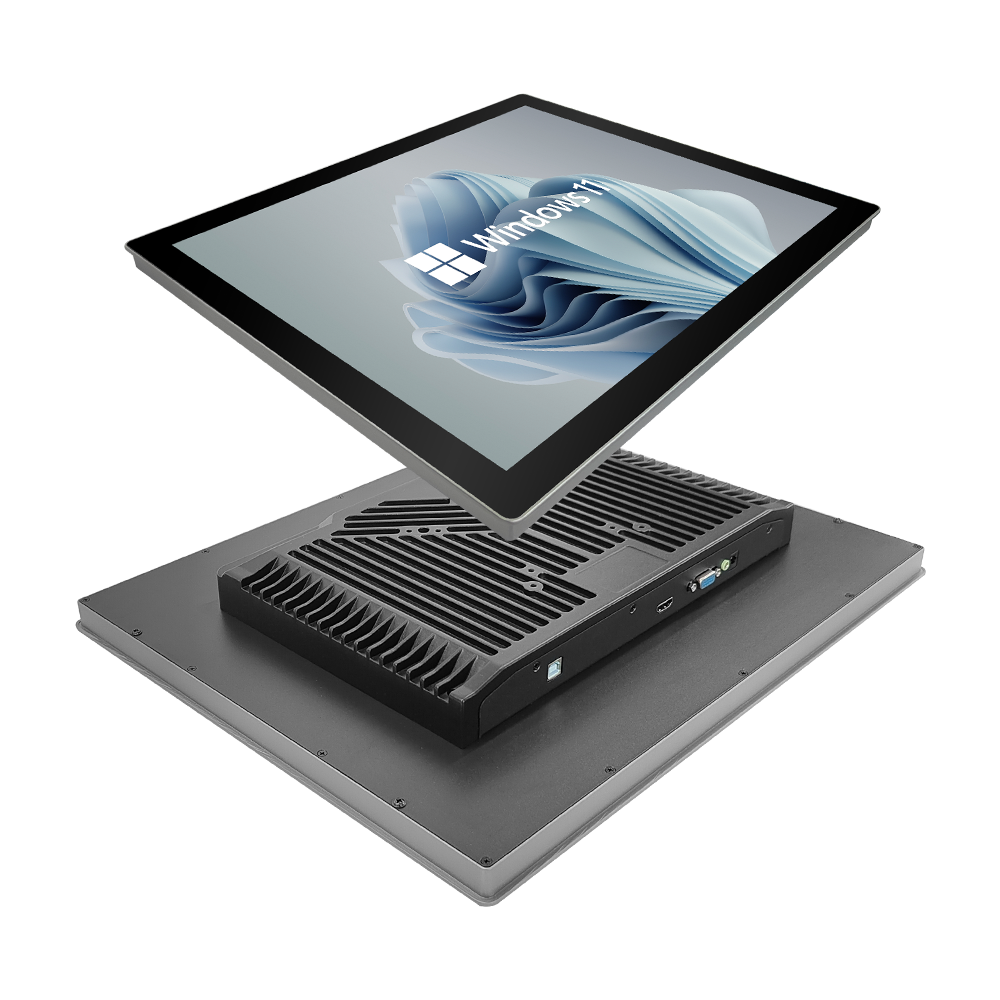
19″ Die-Cast Aluminum Industrial Touch Monitor
Engineered for automated packaging, sorting stations, and light industrial consoles. Features a rugged ADC12 die-cast aluminum frame, true-flat PCAP multi-touch screen, IP65 front protection, and versatile HDMI/DVI/VGA video connectivity.
2. Primary Processing & Continuous Washdown: The SUS304 Imperative
In wet separation, raw milk processing, and chemical reactor tanks, hardware surfaces must withstand direct high-pressure hose-downs and acidic foaming cleaners.
For these demanding zones, deploying an all-stainless system such as the 15″ Full IP67 Stainless Steel 304 Touch Monitor ensures that the passive chromium oxide film ($Cr_2O_3$) self-heals in the presence of oxygen. The electropolished surface finish ($Ra \le 0.4\,\mu\text{m}$) prevents dairy milkstones and fats from adhering to the chassis, allowing automated spray nozzles to flush away organic residues completely.
CIP Material Selection Protocol
| Dairy / Chemical Zone | Environmental Threat | Recommended Material & Ingress |
|---|---|---|
| Raw Milk Separation & Pasteurization | Hot caustic soda (75°C), peracetic acid spray | SUS304 / SUS316L, Full IP67 / IP69K Sealing |
| Secondary Bottling & Capping | Intermittent washdown, chemical wipe-downs | SUS304 Stainless Steel with True-Flat PCAP |
| End-of-Line Palletizing | Airborne dust, cardboard fibers, dry ambient | Die-Cast Aluminum ADC12, Front IP65 |
Upgrading your dairy plant or chemical batching line with hygienic, washdown-proof human-machine interfaces? Contact INNODA’s sanitary automation team for chemical compatibility test reports and sanitary mounting accessories.