Navigating open water under direct tropical sunlight universally requires polarized sunglasses to suppress blinding specular reflections from water surfaces. However, marine navigators frequently encounter a critical visibility failure: tilting the head, scanning navigation instruments, or shifting viewing postures causes the chartplotter display to darken completely into a pitch-black screen.
This optical blackout phenomenon stems directly from classical wave polarization mechanics. In fast-paced marine navigation, momentary screen extinction represents an unacceptable operational hazard that compromises collision avoidance and situational awareness.
1. Wavefront Extinction: Linear Polarizer Alignment Mechanics
Liquid Crystal Displays rely fundamentally on cross-polarization to modulate backlight transmission. White light passes through a rear linear polarizer, rotates through the liquid crystal matrix, and exits through an outer front polarizing film aligned along a specific linear axis (typically oriented at 0°, 45°, or 90°). Polarized sunglasses contain vertical poly-vinyl alcohol (PVA) iodine filters designed to block horizontally polarized reflections off the sea.
Malus’s Transmission Law: I(θ) = I_0 × cos^2(θ) Where θ is the angular deviation between the display’s outer linear transmission axis and the sunglasses’ vertical filter axis. When θ = 90° (orthogonal state): I(90°) = I_0 × (0)^2 = 0 (Total Extinction / Complete Blackout).
When the angle between the display’s linear emission axis and the sunglasses’ vertical transmission axis approaches orthogonality (θ ≈ 90°), light transmission mathematically plummets to zero. Standard consumer and industrial displays become completely unreadable unless the skipper removes their eye protection.
To overcome this optical barrier, specialized navigation hardware such as the Polarized Sunglasses Readable Marine Touch Monitor Chartplotter integrates an engineered Quarter-Wave Plate (QWP) retardation layer directly into the display glass stack.
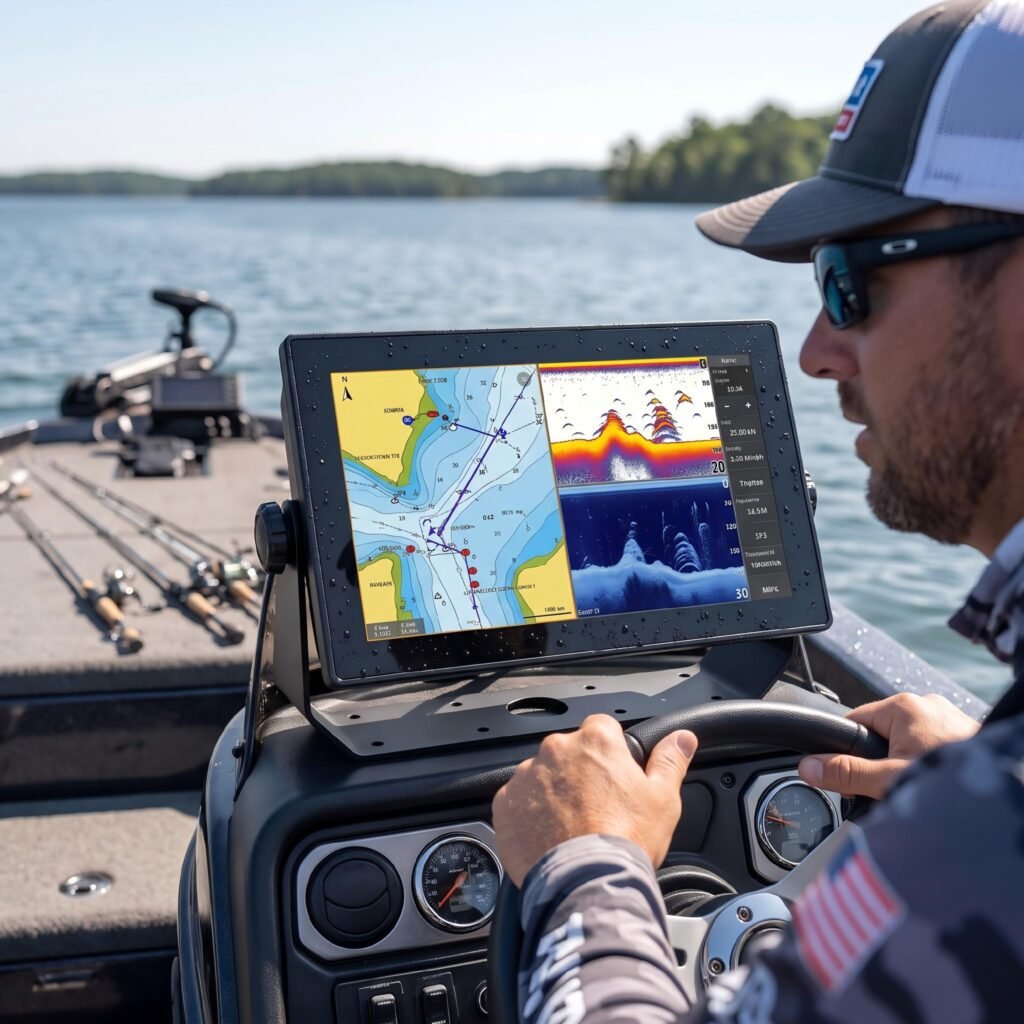
Polarized Sunglasses Readable Marine Touch Monitor
Equipped with circular polarizer (QWP) optical technology and full wet optical bonding. Delivers 1500 nits high brightness, anti-glare tempered glass, and 360-degree zero-blackout visibility for offshore skippers wearing polarized sunglasses.
2. Quarter-Wave Phase Retardation and Circular Polarization
A Quarter-Wave Plate is an anisotropic birefringent polymer film whose refractive indices along the extraordinary (slow) and ordinary (fast) optical axes are precisely calibrated to produce a 90-degree relative phase shift (λ/4 retardation).
Phase Retardation Equation: ΔΦ = (2π / λ) × d × (n_slow – n_fast) = π / 2 radians (90° phase delay) Where d is the optical film thickness (≈ 15-25 μm) and λ is the central design wavelength (550 nm green light).
- Linear to Circular Transformation: When linearly polarized light emitted by the LCD passes through the QWP oriented at 45 degrees, the orthogonal electric field vectors emerge with equal amplitude but a 90-degree phase delay, creating rotating Circularly Polarized Light.
- 360-Degree Continuous Visibility: Because circularly polarized light vectors rotate continuously along the propagation axis, polarized sunglasses pass exactly 50% of the luminous energy regardless of the operator’s head tilt or orientation, completely eliminating black-out zones.
- Index-Matched Optical Wet Bonding: Eliminates internal air boundaries (refractive index step n=1.00 to n=1.52), suppressing internal reflection losses from 4.5% to under 0.2% and preserving maximum sunlight contrast.
Marine Optical Stack Construction Comparison
| Optical Layer Parameter | Standard Marine Display | Engineered QWP Marine Monitor |
|---|---|---|
| Polarized Glass Legibility | Blackout at 45° or 90° tilt angle | Unrestricted 360° readability at all angles |
| Optical Bonding Interface | Air gap prone to internal condensation and haze | Solid refractive-matched LOCA resin layer |
| Surface Glass Hardness | 3H standard acrylic or untreated soda-lime glass | 7H chemically strengthened anti-glare glass |
| Ambient Contrast Ratio | Washed out under direct sunlight (>10,000 lux) | Maintains high readability with >1500 nits backlight |
| Specular Surface Reflection | 4.5% – 8.5% total internal/external reflection | < 0.5% with multi-layer AR coating + AG etching |
3. Temperature Stability & Solar Clearing Point
When high-brightness marine displays run in tropical waters under direct sun, solar radiation delivers up to 1100 W/m² of radiant energy onto the cover glass. If the liquid crystal fluid reaches its nematic-isotropic clearing point (T_ni), the liquid crystal molecules lose their orientation alignment, causing the display to form large, permanent black blotches (“solar isotropic blackening”).
To eliminate solar blackening, engineered marine displays implement specialized high-clearing-point liquid crystal fluids rated for T_ni > 110°C, paired with infrared-reflective (IR-cut) coatings that reflect solar thermal radiation while transmitting visible light.
Equipping offshore vessels and open bridge workstations with circular-polarization display technology guarantees continuous visual situational awareness in bright sunlight. Inquire with INNODA’s display engineers for customized optical stack configurations, cover-glass etching, and optical bonding datasheets.